
1.
At the outset, it is important to emphasize what is obvious: the current government of North Macedonia, dominated by the VMRO party, has exacerbated the political climate in this country. Interethnic tensions have not been this high for several years. Something that is not normal has become normal, namely the campaign against Albanians, especially on social networks. Calls for “killing Albanians” have become more frequent. The government is silent on this language. Other institutions are also silent. Intellectuals are silent. Macedonian civil society activists are also silent, with some exceptions.
2.
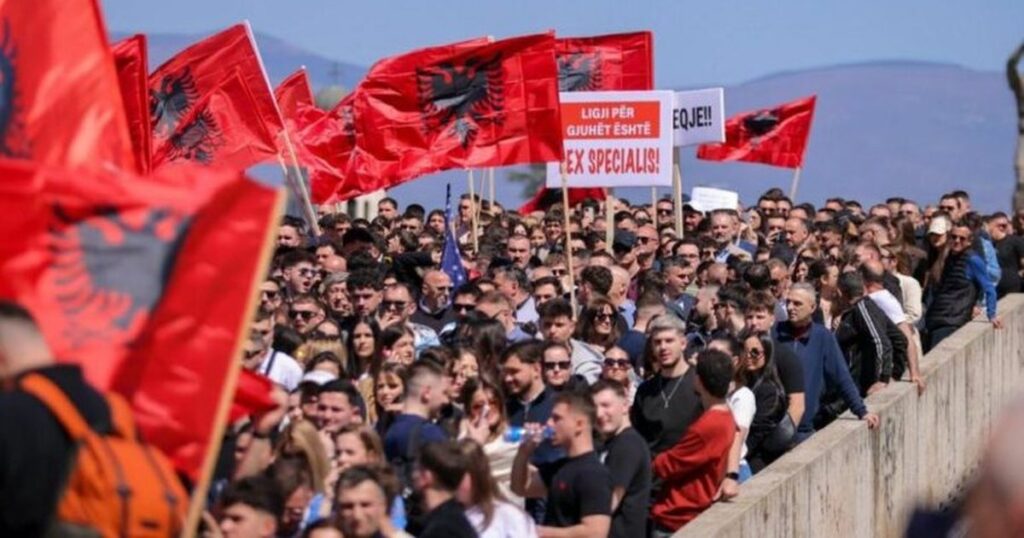
In today’s Europe, it is completely unimaginable for students to study for four years in their own language – and then, at the end, for the final (law) exam, to be told, for example by the Minister of Justice, that they must now take this exam in another language. In this case, in Macedonian.
Albanian students have been fighting against this injustice for two years, without the proper political support. The current Macedonian government is trying to devalue what has been achieved in the last quarter of a century in terms of advancing the Albanian language. After yesterday’s protest, one of the leaders of the political group VLEN, Izet Mexhiti, publicly stated that the bar exam will be given in Albanian. This is a big promise and the public should hold him accountable in the future. A politician should be measured only by the level of fulfillment of his promises. There are some contradictions in the positions of this Albanian politician. In the past, he has welcomed the law on languages ??in Macedonia. Now he says that the law has not solved the problems, but he still welcomes it. It is essential that the public soon have a clear idea: will this law improve or worsen? What is the solution that the current government in Skopje is proposing?
3.
The reality in Macedonia is also this: Albanian is being removed from national road signs. There are efforts to remove Albanian from stamps as well, although the law on languages, which came into force in 2019, has allowed the use of Albanian as an official language in parliament, government, courts, public enterprises and in all municipalities where Albanians make up over 20 percent of the population.
The formulation “20 percent” was made to avoid mentioning the Albanian language – you say that the Albanian language has fallen into disrepair and is not one of the most ancient European languages. Why does the Albanian language bother Macedonian nationalists so much? Other questions can be asked: why have Albanian politicians accepted this formulation? Why has the issue of the bar exam not been resolved so far? The current government and its Albanian partners can and should be criticized for this negligence, but, to be fair, it should be emphasized that the problem with the bar exam was not solved by the DUI either while it was in power – and not for a few months or a few years, but for over two decades.
4.
If the ultimate goal of this Macedonian government is to undermine the Ohrid Agreement, then this country could slide into deeper crises. In the coming weeks, the Constitutional Court of Macedonia is expected to rule on several parts of the language law. This government has already abolished the mechanism that provided employment quotas for Albanians in state institutions. So, the Macedonian prime minister and his VMRO party seem to be unaware of how many Albanians are the only ones who do not deny their Macedonian identity. A Bulgarian may have a problem with the Macedonian language, calling it a Bulgarian dialect. There are Serbs who see Macedonia only as an extension of Serbia, a Serbian province up to Ohrid. There is no serious Albanian politician who denies the national identity of Macedonians. (The folkloric types among Albanians, dressed in patriotic costumes, who pose like hawks in television studios, do not have a significant impact on Albanian opinion, fortunately).
5.
The bad thing about this situation in North Macedonia is that the geopolitical weather has changed and neither the European Union nor the US is very concerned. There are no protests from diplomatic circles against the actions of the Macedonian government. There are no reprimands. There are no appeals to end this campaign. There may be a Western diplomat in Skopje who privately says that “Albanian students are right”, but no one has done so publicly and loudly yet. Albanian students do well to protest, but they seem to be insufficiently organized in an area where the battle is won: in exposing the problem in the international media. Hundreds of thousands of Albanians from Macedonia living in the diaspora, despite their great economic and intellectual potential, are unorganized or have other priorities.
The government in Skopje can perhaps change its wrong course only with a unified reaction of Albanians and with the support of Pristina and Tirana. But even in Macedonia the terrain is divided: the Tirana supporters are aligned with one political group, the Pristina supporters with the other group. A unified reaction should not mean folkloric slogans. Albanians are and should behave as co-owners of the Macedonian state. They are taxpayers. Macedonia has joined NATO especially with the support of Albanians. Even these few advances it has made towards the EU are also the merit of Albanians.
6.
In all the debate, charged with emotions and sometimes even apocalyptic rhetoric, the obvious problems are being forgotten. Albanian settlements in Macedonia are emptying. The birth rate, like everywhere in the Balkans, is falling, and at the same time the countries are not attractive enough to keep young people in the country. Long-standing misgovernment, corruption and criminality are affecting societies to the core.
In an article published last year in the Balkan Studies Foundation, Merita Zulfiu Alili, a professor at the South East European University in Tetovo, wrote: “Emigration from North Macedonia is not a new phenomenon, but its scale is now alarming. Around 38 percent of the population has emigrated globally, with 18 percent heading to OECD (Organization for Economic Co-operation and Development) countries. This trend is most pronounced among the young and educated: over 55 percent of students and 38 percent of university staff express an intention to leave. A study by the Friedrich Ebert Foundation found that 42.67 percent of young people in North Macedonia want to move abroad. Since 2012, the working-age population has shrunk by 6 percent, with projections for a 15 percent decline by 2050. This ‘brain drain’ “It is particularly acute in sectors such as healthcare, information technology and education, where the loss of talent is eroding the country’s capacity for innovation and the delivery of public services.”
Regarding the causes, Professor Merita Zulfiu Alili emphasizes: “The migration of workers from North Macedonia is mainly driven by economic constraints. Research clearly shows that low wages, lack of security and poor working conditions force people to leave the country instead of entering the local labor market. As of the beginning of 2025, the average net monthly wage is 43,050 denars (approximately 700 euros), while the minimum wage was recently raised, in March 2025, to around 400 euros (24,379 denars). These figures remain significantly lower than European averages, where hourly wages in North Macedonia are approximately eight times lower than the European average.” With this trend, there is a risk that only politicians and their clientele will remain in Macedonia.
7.
The situation in Albania and Kosovo is similarly dramatic. After years of progress towards the EU, the government in Tirana has chosen to leave the railway line to Brussels and onto rusty Balkan tracks. Several seemingly spectacular court cases against corruption do not change the fact that the system has been eroded and has begun to rot from corrupt affairs. There is no proper social resistance to this deterioration, nor are there many critical voices within the ruling party.
Kosovo has been mired in political paralysis for a year and a half due to extreme polarization between political parties, unbridled ambitions for power, and pathological malice that is spreading throughout society. Without a stable government, Kosovo risks losing 800 million euros in EU aid. In this situation, waving flags and reciting patriotic poems will not solve any problems.