
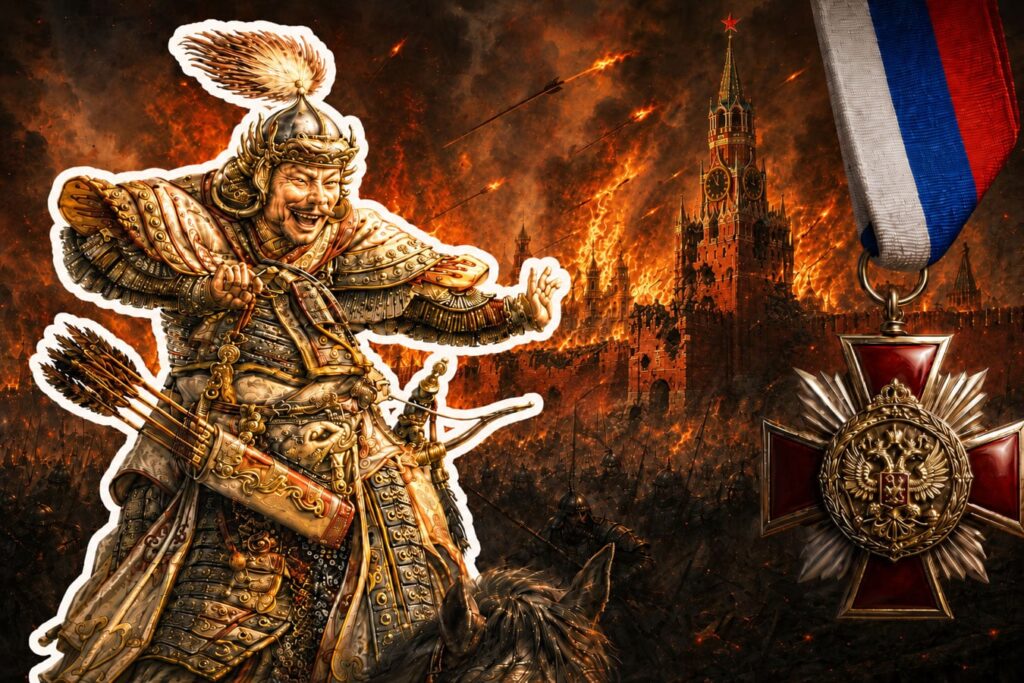
In Russia, the authorities have decided to establish an order named after Subedei — a 13th-century Mongol commander, one of the main military strategists of campaigns after which cities burned, principalities fell, and Moscow, in January 1238, was taken, looted and burned.
After the “adventures of the Pechenegs,” official thought in Russia has finally reached the Mongol-Tatar era.
In preparing this material, we used open data and materials from open sources. We do not claim to be academic researchers. But historical facts remain facts.
Russia has produced another historical absurdity — and this time it is not hidden in a propaganda speech or a school textbook. It is being turned into an actual state award.
In Tuva, one of the subjects of the Russian Federation, the authorities have decided to establish a state decoration named after Subedei — the famous Mongol commander of the 13th century, a close associate of Genghis Khan and one of the major military strategists of the Mongol Empire.
According to Russian media reports from May 19, 2026, the Order of Subedei is intended to be awarded for “exceptional merits in defending the Fatherland,” courage, bravery, protection of Russia’s territorial integrity and interests, and contribution to security. A representative of the republican authorities directly linked the creation of the award to the war against Ukraine, which Russia still calls the “special military operation.”
Yes, exactly.
A modern Russian military award for today’s war is being named after a commander associated not with the defense of Russia, but with a campaign of conquest — a campaign during which principalities on the lands of modern Russia were devastated and Moscow itself was taken, looted and burned.
Subedei, also known as Subutai-bagatur, was born, according to the common version, around 1175–1176. His origin is associated with the Mongol world, while Tuvan tradition links him to territories that today are part of Tuva.
He was not a khan and did not belong to the highest Chinggisid line. But he became one of the most successful commanders of the Mongol Empire. Under Genghis Khan, Ögedei and Batu, he took part in campaigns across enormous distances — from Central Asia and the Caucasus to Eastern Europe.
From a military point of view, Subedei was indeed a major figure. He is often described as an architect of large-scale operations: reconnaissance, multiple columns, winter campaigns, false retreats, and coordinated movement over vast territories.
But that is exactly why the new Russian symbolism looks so grotesque.
In late 1237, Batu Khan’s forces began their offensive against the northeastern principalities. First, Ryazan was devastated. Then the Mongols moved toward Kolomna.
Near Kolomna, in January 1238, a major battle took place. The forces of the Vladimir-Suzdal principality and the remaining Ryazan troops were defeated. After that, the road to Moscow was open. According to one version, survivors from Kolomna, led by Prince Vladimir Yuryevich, the son of Grand Prince Yuri Vsevolodovich, withdrew to Moscow.
The Mongols approached Moscow around mid-January 1238. Sources usually state that the siege lasted about five days, and that the city was taken on January 20, 1238.
At that time Moscow was not the center of an empire. It was not the capital. It was not yet the mythological “heart of Russia” that modern officials like to invoke. It was a relatively small city of the Vladimir-Suzdal principality. The main political center of that land was Vladimir.
The defense of Moscow is associated with Prince Vladimir Yuryevich and the voivode Filip Nyanka. In the chronicle tradition, after the city was taken, the voivode was killed, and Prince Vladimir Yuryevich was captured.
One rendering of the chronicle account says that the Tatars took Moscow, killed Filip Nyanka, captured Vladimir Yuryevich, killed many inhabitants, took others prisoner, and left with great booty.
After the assault, Moscow was looted and burned. Later retellings of the chronicles emphasize the near-total destruction of the city and the killing of its inhabitants “from the old to infants.” This is chronicle language, of course, but the meaning is clear: this was a harsh devastation.
It is important to write this accurately. There is no reliable source proving that Subedei personally commanded the storming of Moscow or physically stood at the city walls. The more precise formulation is that Moscow was taken during the western Mongol campaign under the political leadership of Batu, in which Subedei was one of the key strategists.
But that does not weaken the point. It strengthens it.
There is no need to exaggerate. The facts are already enough.
Modern Russia is creating a military award named after a commander associated with a campaign during which principalities on the lands of modern Russia were devastated and Moscow was burned.
That is the whole political joke.
They wanted a heroic symbol for war — and got a historical own goal.
They wanted to underline “military glory” — and reminded everyone that Moscow burned.
They wanted a patriotic decoration — and chose a name from the history of conquest.
This is where the story becomes larger than one regional award. It shows the way modern Russian political culture treats history. The past is no longer history. It is a warehouse of symbols.
Need “anti-fascism”? Take World War II.
Need empire? Take the tsars.
Need force? Take the Horde.
Need a medal for the current war? Take Subedei.
And if that name is connected to a campaign after which Moscow burned — apparently, no one is embarrassed.
For readers in Israel, this should sound familiar in a different way. Memory is never just decoration. Names of awards, streets, army units and state ceremonies always reveal whom a state considers worthy of honor.
When a state chooses a conqueror as a symbol for military valor, it says more about itself than it may intend.
This is why NAnews – Nikk.Agency Israel News sees this story not as a small regional curiosity, but as a political signal. Russia constantly demands that others “respect history,” but treats history itself like a box of theatrical props. Today it pulled Subedei out of that box — and decided he was a suitable name for a wartime decoration.
The irony does not end with Moscow.
In 1239, Mongol forces moved toward Kievan Rus. Chernihiv, one of the important centers of the Chernihiv principality, was taken.
In December 1240, Kyiv was taken — one of the main cities of Kievan Rus and a major symbolic center of East Slavic history.
After the fall of Kyiv, the Mongol army did not stop. It moved further west through the lands of the Galician-Volhynian principality. Cities and fortified centers on the road to Central Europe were hit, including Volodymyr-Volynskyi and Halych.
Then the Mongol forces split into several directions. One part moved toward Polish lands: Sandomierz, Kraków and other cities were attacked, and in April 1241 the Mongols defeated Polish-German forces at the Battle of Legnica.
Another main blow fell on Hungary. The Mongols crossed the Carpathians, entered the Kingdom of Hungary, and on April 11, 1241, defeated King Béla IV’s army at the Battle of Mohi. After that, large parts of Hungary were devastated.
In 1242, the Mongol forces began to withdraw. The usual explanation is the death of the Great Khan Ögedei at the end of 1241: the Mongol elite had to return for the kurultai, where the question of power was to be decided. Batu then consolidated his western domains in the steppe, where the Golden Horde later took shape.
Subedei himself, according to the common version, returned east and spent his final years as one of the oldest and most authoritative military figures of the empire. He died around 1248. His exact burial place is unknown.
And now, centuries later, Russia has found this figure and turned him into an award for the war against Ukraine.
So the question for readers is simple: if this is the logic, what should we expect next — orders named after Tokhtamysh, Stanisław Żółkiewski, Khan Devlet Giray, Hetman Petro Konashevych-Sahaidachny, Polish Prince Władysław Vasa and Napoleon Bonaparte?
If modern Russia has decided to decorate soldiers with the name of a commander associated with a campaign after which Moscow burned, then that list almost looks like the agenda for the next meeting.
Sometimes modern Russian politics writes plots so absurd that satire can only step aside.
Because this is not just a historical paradox.
It is a mirror of today’s Russia — where war, imperial mythology, the destruction of cities and the complete misunderstanding of one’s own history are once again dressed up as state virtue.