
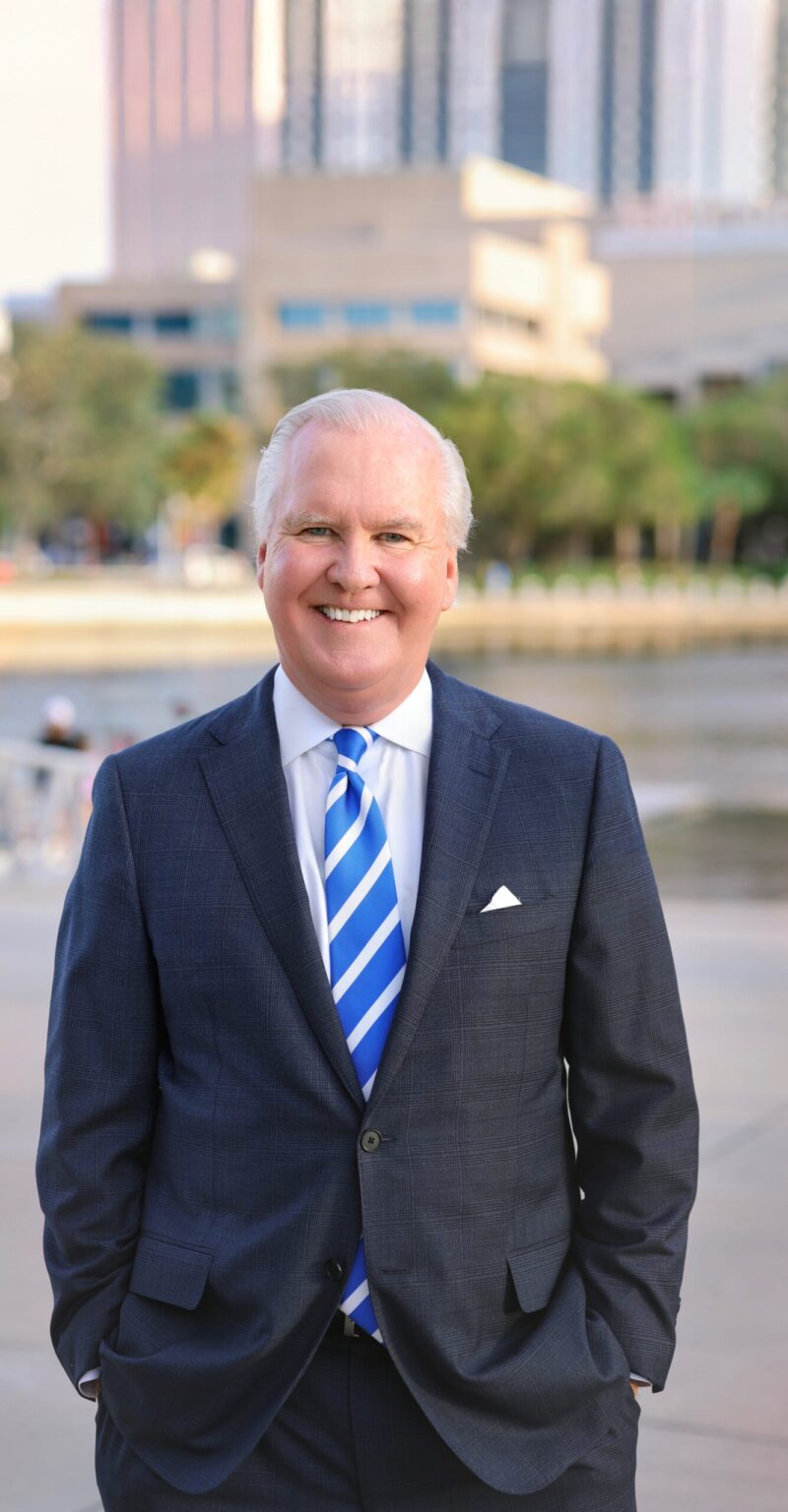
Former Tampa Mayor Bob Buckhorn has officially kicked off his bid for his old job, just over a month after he jumped into the race and several months after it became clear that he would eventually.
Already, Buckhorn’s presence in the race has stirred frustration among his detractors.
What is clear despite the reverberating noise is this: Buckhorn is the front-runner. He will be hard to beat. Very hard. Is it possible? Of course, but pretending the cards aren’t stacked in his favor is akin to pretending an impending storm isn’t going to ruin your beach day, to use a very Florida-centric analogy.
Buckhorn, much like any other establishment Democrat, has a lot of supporters, but also a contingent of very vocal critics. So far, much of the criticism against him has been related to not just the amount of cash he’s raised, but the donors who provided it.
Buckhorn has already raised $1.8 million through his political committee, Friends of Bob Buckhorn, and still has almost all of it available. That not only means an expensive campaign is ahead, it’s also a glaring piece of evidence to support naysayers who worry money could curry favor in a potential Buckhorn 3.0 administration. Creative Loafing has already lampooned the former Mayor for having more than $1.4 million in PC contributions stemming from “development and investment interests.”

The comments on a Facebook post linking to the CL story are largely critical — ranging from one person calling Buckhorn an “old white guy” to those saying he shouldn’t be allowed to seek a third term, to even some who think no one should need that much money to run for Mayor.
That last part is key.
As someone who has covered or otherwise participated in the political process in the Tampa Bay area and beyond for the better part of the past two decades, I have contacts spanning just about every political persuasion one could imagine. I have friendly relationships with people who have no problem calling themselves communists, those who openly declare themselves democratic socialists, progressives, centrists, right-of-center Reagan Republicans, MAGA warriors, “never Trumpers,” etc.
You name it, I know someone who believes it. And I either talk to these people or follow along with their commentaries on various social media sites.
What I have found is that many — certainly not all — of Buckhorn’s critics either have a limited knowledge of the political process, or they are choosing to ignore what they know because it doesn’t fit their narrative.

Buckhorn’s candidacy, outside of what’s currently going on with the Tampa Bay Rays, is one of the region’s largest political stories right now. But his race isn’t the only example of the phenomenon I’m describing. Plenty of candidates across the state and nation are facing similar critiques as Buckhorn, even at the highest echelons of power.
Buckhorn gets painted by his largely progressive detractors as a leader beholden to special interests at the detriment to his constituents. You see those conversations unfolding in federal elections all over the nation. Even in 2024, Democratic presidential nominee Kamala Harris faced similar critique from those on the far left frustrated with her establishment backing.
The common denominator
What they all have in common is a lack of recognition of various political realities.
To be clear, this is not an effort to persuade anyone to support Buckhorn. Each voter should weigh their political options carefully and select a candidate who would best fit their needs and priorities. They should do so by reviewing information from a variety of sources to ensure a whole picture.
This is not about supporting a candidate or opposing another; rather, it’s an analysis of popular political culture in the modern political climate.
That said, it is noble that many Tampa residents care less about how much a candidate raises than how they will govern for the people. They are right to question whether promises will be kept or whether donors will somehow get preferential treatment. But however noble and important those things may be, a candidate’s message is only as good as his or her ability to share it.
The Tampa Bay media market is the largest in Florida and the 11th-largest in the country. It costs more than most luxury cars to get an ad on TV, even on the stations few people watch. Digital ads can be cheaper, but they are still costly to produce. Even mailers add up quickly to five figures. Doing all of them, which is needed to ensure a campaign is reaching all targeted demographics, is a very expensive prospect.
What’s worse, none of that takes into account the campaign staff needed to determine who to message. Everything costs money, from voter lists to text messaging services. It also ignores a little thing called inflation. Think of it this way, if a pound of ground beef is twice as expensive now as it was 15 years ago (about the time Buckhorn was last seeking election as a non-incumbent) you can bet the price of running an election is, too.
Even eight years ago, when Castor was first running for Mayor, she raised $2.1 million. That’s about half of what her opponent, the late David Straz, had self-funded for his campaign. Eight years before that, in 2011, Buckhorn had raised just $567,000.
As much as Buckhorn’s critics may not want to hear it, the money does matter. And it matters a lot.
As effective as grassroots campaigning can be — it’s more direct and personal for voters — it will still never have the same impact as a big media buy. And earned media — things like positive news reports that aren’t paid for — is much harder to come by without stacks of cash.
Like it or not, poorly funded candidates don’t draw as much attention from the media, and that’s not just because reporters think they aren’t worth the press. Often, it’s because the better funded campaigns have paid staff whose sole job it is to hound reporters for coverage. Those paid staffers also work diligently to ensure bad press is kept at bay, and mitigate whatever bad press slips through the cracks.
I know this, because I’ve been on both sides of it.
Neither Buckhorn nor any of his staff or supporters would ever admit this, but the major cash advantage means all of those very vocal critics won’t matter much. Anyone who has ever worked on a campaign, or been the candidate in one, knows that you always run as if you’re behind. But in their heart of hearts, Buckhorn and his team know they have the cash to crush.
So for Buckhorn’s campaign, the fat bank account and wealthy surrogates mean he can spend ample time and resources communicating to voters that he has the experience to do the job (he already did it for eight years!) and that he knows what they need — progress for all in Tampa and a resounding answer to the affordability crisis.
As it stands right now, his opponents lack the resources to combat his positive messaging. And they have only limited resources to go on the offensive against Buckhorn to elevate the concerns his critics so loudly declare on social media.
Narrow paths
So what’s the answer for those hoping to knock Buckhorn off track as he seeks a third nonconsecutive term? “Raise more money” is too obvious an answer, and it’s oversimplified. Instead, the answer may be to consolidate support. And that can happen either now, after the Primary, or both.
In addition to Buckhorn, 10 other candidates have filed. The most recognizable names, and therefore the candidates most likely to be competitive, are Tampa City Council members Bill Carlson and Lynn Hurtak. A third candidate, Taryn Sabia, has raised a respectable sum of money so far, though her low-five-figure haul pales in comparison to Buckhorn’s seven-figure war chest.
Up until they were political foes, Hurtak and Carlson were considered largely politically aligned. Both have served as frequent checks on Castor’s current administration, and Carlson was a big critic of Buckhorn’s administration during the time their tenures overlapped.
Yet now they are running against each other, both seeking what is essentially the same anti-Buckhorn lane.
Sometimes, these sorts of multicandidate situations can lead to early victories. Tampa, like many cities, allows a candidate to win in the Primary if they secure more than 50% of the vote. Lesser-known and/or lower-funded candidates vote split, no one rises and someone ends up reaching that threshold.
But that’s a hard thing to do in a crowded Primary, and I’d be shocked if it wound up being the instance in Tampa’s 2027 mayoral election unless the crowd thinned significantly. For candidates like Carlson, Hurtak and Sabia, the strategy right now is likely not to beat Buckhorn, but rather to just beat everyone else and make a runoff — then consolidate support.
To that point, it’s what Buckhorn did in 2011.
But in this instance, those 10 candidates not named Buckhorn are vying for many of the same donors, and they have far less access to donors able to funnel big bucks into a PC. So while consolidating for a runoff might seem a wise strategy — and sometimes it is — it could also backfire by leaving whichever candidate winds up in the top two woefully underfunded in a runoff.
Consolidation now would mean a candidate could fully tap into anti-Buckhorn political resources. There would not only be fewer candidates to split a finite amount of possible campaign cash, but also a less diluted pool of volunteers to help form a successful grassroots strategy. And if played correctly, any candidates who bowed out could ostensibly become surrogates for whoever stays in.
But even then, the path to victory is arduous when going up against a candidate with seemingly unlimited cash.
And to those thinking back to Castor’s first election against Straz as a possible rebuttal, hold on.
Yes, he doubled her resources by being able to self-fund as a multimillionaire. Yes, she wound up beating him — badly.
But Buckhorn is not Straz. And the situation is not the same. Despite his ability to self-fund, Straz was never taken all that seriously. He was never the front-runner. In that instance, it wasn’t Castor as an underdog trying to consolidate support. It was the other way around. And even Straz’s millions couldn’t topple the establishment pick.