
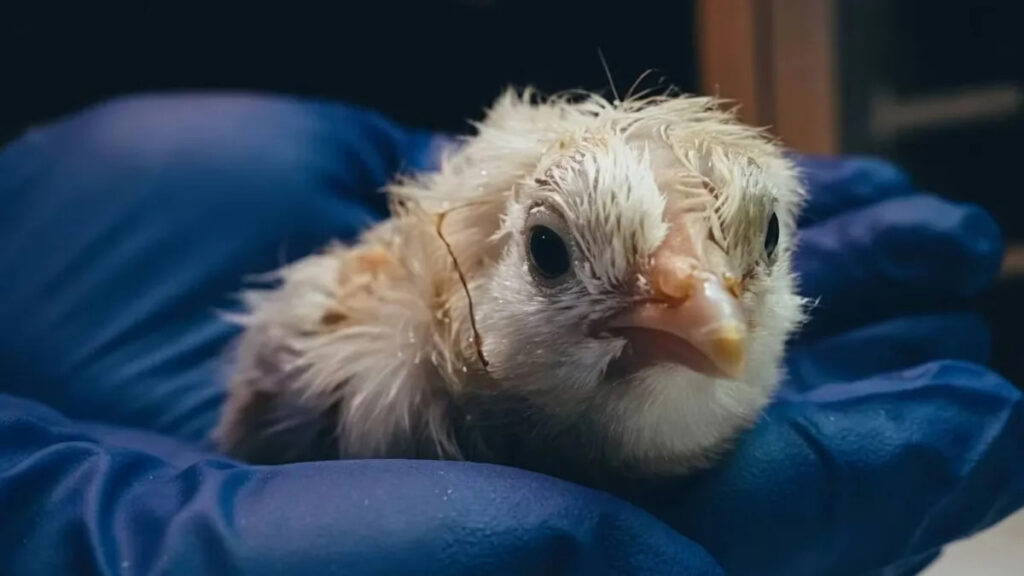
A de-extinction startup recently announced it hatched chickens in an artificial environment.
The 26 chicks were all hatched from 3d printed lattice structures which mimic an egg.
The company, Colossal Inc, has stated its goal is to resurrect extinct species. They’ve already generated headlines after genetically engineering wolves with white hair and muscular jaws to resemble the dire wolf. The species went extinct more than 10,000 years ago, and were larger than gray wolves—who are the largest current living species of wolves, and also a close relative.
This technology could one day be scaled up to tweak living birds to resemble New Zealand’s extinct South Island giant moa.
Per Colossal CEO, Ben Lamm, “We wanted to build something that nature has done a pretty good job of developing and make it better and scalable and even more efficient.”
Colossal’s artificial eggs have a membrane that allows just the right amount of oxygen to get in—like a real egg. This isn’t a perfect technology. The shells lack the temporary organs that come with an egg, and which help stabilize the chick and remove waste. Those steps are handled manually by lab technicians.
This also isn’t the first time artificial eggs have been used. In prior decades, researchers used transparent films as egg substitutes to study the embryonic development of eggs.
One of their stated goals is to bring back extinct animals like the dodo, which died out in the late 1600s due to human hunting and encroachment and other invasive species on Mauritius. Their most ambitious goal is to bring back the wooly mammoth, which they are doing by editing the DNA of Asian elephants to express traits akin to the species.
Colossal Inc said their long-term vision isn’t to create an identical wooly mammoth, but one that fills a similar geological niche.

Critics of the startup say this is not a true de-extinction process as it often relies on editing the genome of close relatives. The dodo would likely involve editing the nicobar pigeon, which is its closest living relative.
The artificial egg has become a central focus in de-extinction technologies, because a natural egg is often a barrier to manipulating the species during development. The current process of hatching eggs in this environment has a low success rate and requires constant interventions with a narrow ambient window.
Bioethicists are concerned that creating a species based on limited DNA and extinction-era myths could create animal welfare issues. They’ve argued that the startup is, in effect, playing god without fully understanding the consequences to the animals themselves, or the environments they may inhabit.
Critics have also argued that money sent to startups like Colossal Inc, which has received $620 million to date, could be better spent conserving actual at-species. Biodiversity is already declining and there are more than 172,600 species on The IUCN Red List, which also classifies 47,000 as threatened with extinction.
Colossal pushes back saying that resurrecting and protecting species are not mutually exclusive. They believe the technologies they’re using to bring back extinct animals could also be used to help preserve current ones.
It is still to be determined whether Colossal’s work leads to a conservation breakthrough or a costly technological detour.