
May 21, 2026
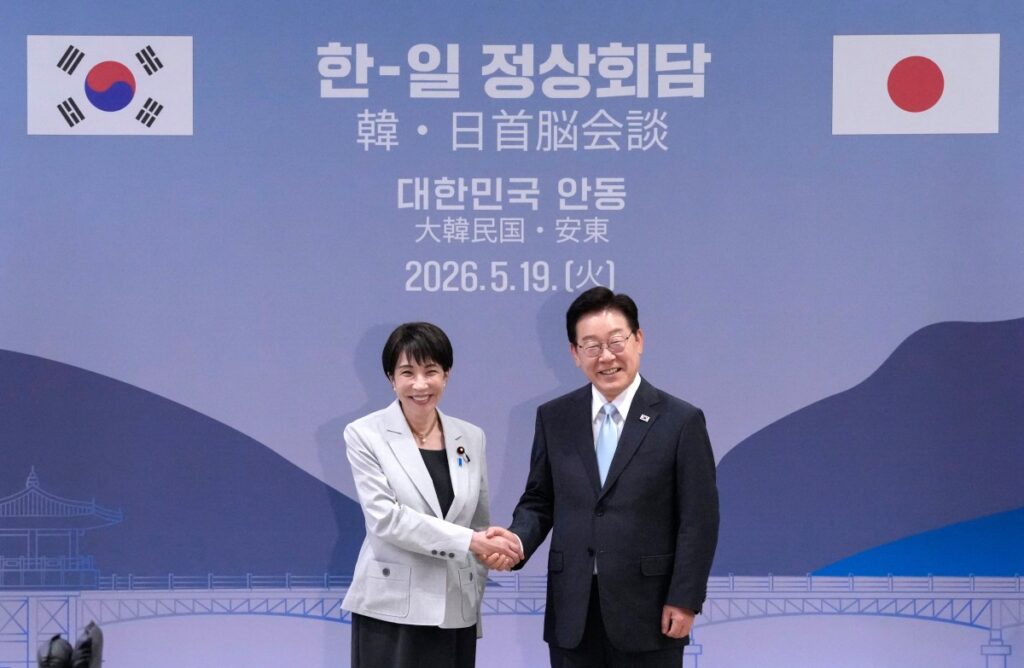
SEOUL/ANDONG – Prime Minister Sanae Takaichi received a state guest-level welcome on Tuesday at South Korean President Lee Jae Myung’s hometown, sending a powerful signal of the rapprochement between Tokyo and Seoul.
Amid a volatile international landscape marked by the warmer relations between the United States and China as well as the effective blockade of the Strait of Hormuz, Takaichi and Lee shared the recognition that a bilateral strategic partnership is essential, underlining the steady progress in strengthening their bond.
In Andong, southeastern South Korea, where numerous cultural assets from the Silla and Joseon dynasties remain, the prime minister’s vehicle arrived at the summit venue, led by an honor guard and a military band in colorful traditional costumes.
Greeting Takaichi with a broad smile and a handshake, Lee said he had been waiting for the prime minister’s arrival since the night before.
Lee visited Takaichi’s home prefecture of Nara in January, and the presidential office said it is the first time that the leaders of Japan and South Korea have made such hometown visits.
At the beginning of the meeting, Takaichi expressed her gratitude for Lee’s warm reception and described the Japan-South Korea relationship as a cornerstone for stabilizing the Indo-Pacific region, showing a strong commitment to deepening cooperation.
After dinner, the two leaders deepened their friendship by touring Hahoe Village, a World Heritage site featuring traditional houses, and watching a traditional performing arts program together.
The leaders highlighted more than just their personal rapport.
During the summit and at a joint press conference, both repeatedly expressed a sense of crisis regarding the security environment, with Takaichi saying that the international community is facing an extremely difficult period and Lee remarking that the international situation is like a storm.
In late February, following the previous Japan-South Korea summit meeting, the administration of U.S. President Donald Trump launched an attack on Iran, leading to a de facto blockade of the Strait of Hormuz.
Japan and South Korea, both heavily dependent on the Middle East for crude oil imports, face a serious supply crisis. During Tuesday’s summit meeting, Takaichi and Lee unveiled a plan to explore the mutual supply of petroleum products.
“This reflects a win-win relationship in which Japan and South Korea assist each other in areas of mutual concern,” said an aide to the prime minister.
This cooperative stance is underscored by Tokyo and Seoul’s shared anxiety that Washington’s focus on the Middle East could lead to a diminished U.S. presence in the Indo-Pacific.
During their meeting, Takaichi and Lee also discussed the outcomes of the U.S.-China summit held last week.
Amid worsening ties with Beijing, some within the Japanese government are wary that China might attempt to drive a wedge between Tokyo and Seoul, as well as the Japan-U.S. alliance. This is due to concerns held by those on the left in South Korea, Lee’s supporters, regarding the revision of Japan’s three security documents, which Beijing has criticized as “neo-militarism.”
In the joint press conference, Lee touched on the need for trilateral cooperation among Japan, China and South Korea, but made no further mention of China. It is believed that he intends to maintain his stance of observing the Japan-China confrontation from the sidelines.
“We need to cement our ties with President Lee to prevent those on the left in South Korea from aligning with Beijing’s assertions,” a Japanese Foreign Ministry official said.
Mutual consideration
The recent Takaichi-Lee meeting was the third since October.
Although their political stances differ — as a conservative prime minister and a left-wing president — they have much in common, including both rising through the ranks and maintaining high approval ratings.
Since taking office, both leaders have adhered to a pragmatic course and have consistently shown consideration for each other’s positions to bridge the gap.
Following the last summit, Takaichi opted not to dispatch Cabinet members to a ceremony marking Takeshima Day in February, despite having long advocated for such representation.
South Korea, in turn, agreed to launch vice-ministerial-level talks between the two countries’ foreign and defense ministries, a move it had long approached with hesitation.
After the inaugural session was held on May 7, Takaichi and Lee welcomed the new framework during their meeting, emphasizing the vital nature of the strategic partnership between their countries.
“We promised to hold phone talks frequently if we have any problems or concerns regarding our relations with other countries,” Takaichi said at the joint press conference, drawing laughter from Lee. “I’ll have him visit Japan next time — perhaps I’ll suggest a hot spring.”
While there are still differences regarding historical and other issues, the challenge now lies in creating tangible outcomes from the trust forged through reciprocal visits. The true mettle of the rapport built between the two leaders is yet to be proven.