
At the approaching holiday of Shavuot, we will read the beautiful words of Ruth, spoken after the death of her husband, to her mother-in-law, Naomi: “Where you will go, I will go.” It teaches us about identity, about connection and about what we mean by “home.”
A recent visit to Greece, which I made to meet with the Jewish community while addressing Holocaust restitution issues with government officials, gave me an opportunity to reflect on the meaning of “home.”
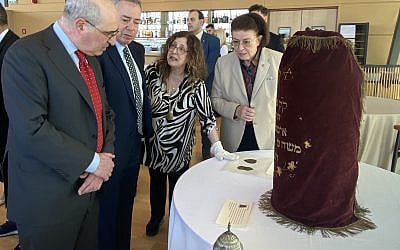
With Greek Minister of Culture Lina Mendoni and the Director of the Jewish Museum of Greece, Zanet Battinou. Credit: Author
The Greek Minister of Culture hosted us for a lunch to mark the recent return from Poland to Greece of 91 Judaica items that had been looted by the Nazis This hugely significant event came about as a result the efforts of the World Jewish Restitution Organization (WJRO). The items will now be housed at the Greek Jewish Museum.
With the Parthenon, one of the ultimate representations of Greek history, as a backdrop outside the window, on a table in front of us we pored over two Torah mantles (me’il), a powerful representation of Jewish life. One of them, in a deep, dark purple color, bore an embroidered Hebrew inscription, surmounted by the crown of the Torah, telling us that it was dedicated to the Holy Synagogue of Beit Saul by the widow of Moses M. Benveniste. That synagogue was one of the historic Sephardic synagogues of Saloniki, where over 90% of the Jewish community were killed in the Shoah.
Who was the widow of Moses? Who were the Jews who had once lovingly carried that Torah wrapped in that mantle around the sanctuary every Shavuot morning? Who was it who read from it the dramatic revelation of the Ten Commandments at Mount Sinai? Stolen by the Nazis and taken from Greece, what journey did it go on to end up after the Holocaust in a dusty basement in Poland, trapped there for decades until finally discovered and then after lengthy negotiations returned to Greece just a few weeks before? For all the tragic story and all the unanswered questions, there was a profound feeling in the room that this meaningful symbol of Jewish history and the Jewish people was finally home.
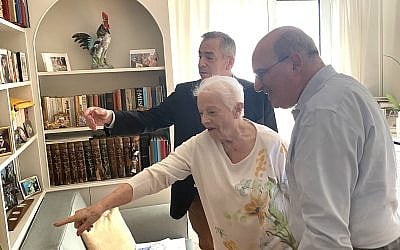
With Lola Credit: Author
Later that day, I visited the home of Lola, an 89 year-old Holocaust survivor originally from Saloniki. Her carer, provided with support from the Claims Conference, enables Lola to stay in her own apartment, to cook together with her carer and to continue working on her memoir.
Surrounded by photos on the walls and with the memoir’s loose pages spread out before us, she wanted to tell us the story of a world that had been destroyed, but also of one that had survived. Amidst the noise of the busy Athens street outside, she told us about her childhood in the vibrant Jewish community of Saloniki, the deportation of her family to Bergen-Belsen during the Holocaust, the unimaginable horrors she witnessed and the death train that was intercepted by US Ninth Army Troops, saving their lives.
On her wall was a family tree with a large family across the top, one crowded side continuing downward, showing the generations that had survived the Shoah, the other side a vast empty space. Yet her message to us was one of strength and resilience, a connection with her family and a determination to finish writing her memoir. How much we all have to learn from Holocaust survivors about what is really important in life.
A visit to the Etz Hayyim synagogue, a Romaniote synagogue built by Greek Jews in 1904, gives one a further sense of the depth of the Jewish community. Romaniote Jews are one of the world’s oldest Jewish communities, dating back more than two thousand years, predating the arrival of the Sephardic Jews expelled from Spain.
It was on the street outside the synagogue that the Nazis on March 24, 1944, rounded up the Jews in the city under a false pretense of a food handout. The Jews were sent to the Haidari concentration camp before being deported to Auschwitz and other camps. Families were torn apart; entire neighborhoods that had once echoed with Jewish life became devoid of Jews as voices were forever silenced. After the Shoah, the synagogue building served as a home for displaced survivors of the concentration camps.
Today, the synagogue still is a home for Jewish prayer..

Credit: Author
As we sat in the inner courtyard , one of the community members told us about the beautiful Greek Jewish tradition of planting a tree when a synagogue is built. We gazed upwards at the palm tree that had been planted when that synagogue was first built, now soaring above us – a living testament that, despite the tragic history, the commitment of a Jewish community to maintain a Jewish home endures. Literally and figuratively, the roots in the soil run deep.
This Shavuot, our collective responsibility remains entwined in Jewish history and in the reality of Jewish life today, helping ensure that the story of Jewish life before and during the Shoah continues to be told.
Gideon Taylor is the President of the Conference on Jewish Material Claims Against Germany and of the World Jewish Restitution Organization