
Across the United Kingdom, smart toilets are rapidly evolving from luxury products into practical household and commercial solutions driven by changing consumer lifestyles, hygiene priorities, and environmental concerns.
Once associated mainly with high-end hotels and premium residential properties, smart toilets are now gaining wider attention among homeowners, developers, businesses, and public institutions seeking advanced bathroom technologies that improve comfort, convenience, and water efficiency.
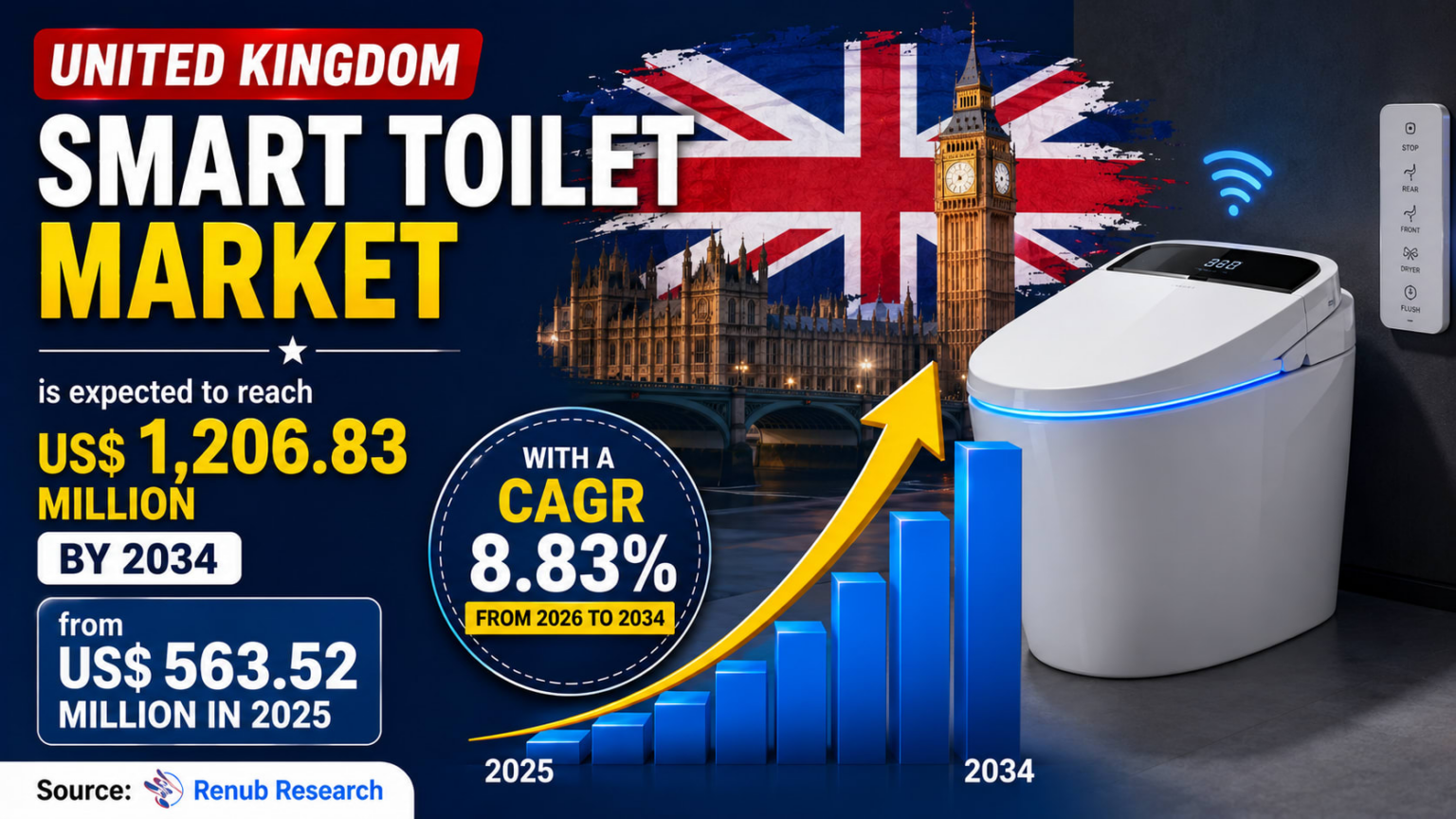
According to Renub Research, the United Kingdom Smart Toilet Market is projected to grow from US$ 563.52 Million in 2025 to US$ 1,206.83 Million by 2034, expanding at a CAGR of 8.83% between 2026 and 2034. The market’s rapid growth reflects increasing demand for touchless technologies, smart-home integration, and sustainable water-saving solutions across the UK.
Consumers are no longer viewing bathrooms simply as functional spaces.
Instead, bathrooms are increasingly becoming extensions of connected living environments where technology, hygiene, wellness, and environmental efficiency intersect.
From automatic flushing and heated seating to self-cleaning systems and app-based controls, smart toilets are reshaping what consumers expect from modern sanitation technology.
Hygiene Awareness Has Become a Powerful Market Driver
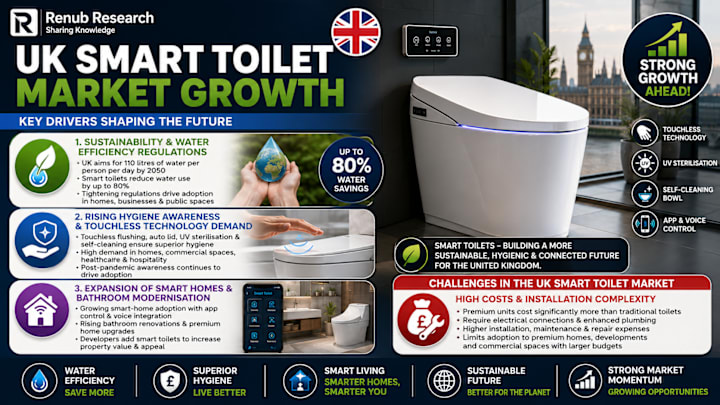
One of the biggest factors driving the UK smart toilet market is rising hygiene awareness.
The pandemic significantly changed how consumers think about cleanliness and surface contact in both public and private spaces.
Today, many consumers actively seek technologies that reduce physical contact while improving sanitation standards.
Smart toilets directly address these concerns through features such as:
- Touchless flushing
- Automatic lid opening and closing
- Self-cleaning systems
- UV sterilisation
- Built-in bidets
- Air purification systems
These technologies reduce the need for manual contact while creating cleaner bathroom environments.
Commercial establishments including hotels, offices, restaurants, airports, and healthcare facilities are increasingly investing in smart toilets to reassure visitors and improve hygiene standards.
Touchless technology has already become common across payment systems, automatic doors, and public facilities. As consumers grow more comfortable with automation in daily life, adoption of smart bathroom technologies is becoming increasingly natural.
Families with elderly individuals, children, or mobility limitations also appreciate the convenience and accessibility that smart toilets provide.
Hands-free operation and automated cleaning features improve usability while reducing maintenance effort.
As hygiene expectations continue evolving, demand for intelligent sanitation systems is expected to rise steadily across the UK.
 Water Efficiency and Sustainability Are Fueling Adoption
Sustainability has become another major growth driver for the UK smart toilet market.
The UK government has established ambitious long-term targets to reduce average water consumption to 110 litres per person per day by 2050. Smart toilets align closely with these goals through advanced water-saving technologies.
Many smart toilets feature:
- Low-flush systems
- Precision water control
- Automated leak detection
- Optimized flushing technology
- Energy-efficient operation
Advanced models can reduce water consumption by up to 80% compared to older high-flush toilet systems.
As concerns around climate change, water scarcity, and environmental sustainability continue growing, consumers and businesses are becoming more interested in technologies that reduce long-term resource consumption.
Property developers are also increasingly prioritizing sustainable building solutions.
Smart toilets are now being incorporated into:
- Luxury apartments
- Office developments
- Hotels
- Retail centres
- Public facilities
- Build-to-rent housing projects
The growing focus on green building certifications and sustainable infrastructure further strengthens market demand.
As environmental regulations become stricter, water-efficient smart toilets are expected to become even more important within future residential and commercial developments.
Smart Homes Are Expanding Into the Bathroom
The rapid growth of smart-home ecosystems across the United Kingdom is playing a major role in accelerating smart toilet adoption.
Consumers increasingly expect household technologies to integrate seamlessly into connected living environments.
Bathrooms are now emerging as one of the next frontiers of smart-home innovation.
Modern smart toilets offer features such as:
- Mobile app integration
- Personalized user settings
- Smart energy management
- Voice assistant compatibility
- Automated cleaning schedules
- Occupancy sensors
Younger consumers, especially Millennials and Gen Z homeowners, are particularly attracted to connected technologies that combine convenience, automation, and premium aesthetics.
As smart lighting, heating, security, and entertainment systems become increasingly common, consumers are naturally extending these expectations into bathroom spaces.
Bathroom renovation trends are also contributing significantly to market growth.
Urban homeowners across the UK are investing more heavily in modernizing bathrooms with contemporary designs and advanced technology features.
Smart toilets are increasingly viewed not only as practical upgrades but also as status-enhancing lifestyle products.
Developers and landlords are also using smart bathroom fixtures to differentiate premium residential properties in competitive housing markets.
London Continues Leading the Market
London remains the strongest and most mature smart toilet market in the United Kingdom.
Several factors contribute to the city’s leadership position, including:
- High disposable incomes
- Luxury housing development
- Strong smart-home adoption
- International tourism
- Commercial modernization projects
Luxury apartments, hotels, retail centres, and office buildings across London increasingly incorporate smart toilets to improve customer experience and meet sustainability objectives.
Affluent areas such as Kensington, Chelsea, and Canary Wharf show particularly strong demand for premium smart bathroom technologies.
International travellers also influence expectations around modern bathroom amenities, encouraging hotels and commercial venues to invest in advanced sanitation technologies.
London’s emphasis on environmental sustainability and water efficiency further supports adoption of smart bathroom systems.
Manchester Is Emerging as a Growing Smart Bathroom Hub
Manchester’s smart toilet market is expanding steadily alongside rapid urban development and residential construction activity.
The city’s growing population, strong student presence, and expanding build-to-rent sector are increasing demand for modern living spaces equipped with advanced technologies.
Developers in areas such as:
- Salford Quays
- Ancoats
- Manchester city centre
are increasingly incorporating smart bathroom fixtures into residential and mixed-use projects.
Manchester’s younger demographic and technology-oriented consumer base create strong potential for long-term adoption growth.
Commercial developments, hospitality projects, and office spaces are also upgrading bathroom facilities to improve hygiene standards and user experience.
While the market is still less mature than London, awareness and adoption are growing consistently.
Birmingham and Leeds Show Strong Future Potential
Birmingham and Leeds are also becoming important regional growth markets for smart toilets.
Ongoing regeneration projects, residential expansion, and commercial modernization are increasing interest in advanced bathroom technologies.
In Birmingham, areas such as:
- Digbeth
- Edgbaston
- Birmingham city centre
are experiencing significant redevelopment activity that supports demand for modern smart fixtures.
Leeds is similarly benefiting from strong residential growth, student housing expansion, and sustainability-focused urban development.
Hotels, office buildings, and public facilities across these cities are increasingly adopting touchless and self-cleaning bathroom technologies to improve hygiene and operational efficiency.
As affordability improves and awareness increases, adoption rates across regional UK cities are expected to strengthen considerably over the next decade.
High Costs Continue Limiting Mass Adoption
Despite strong growth momentum, smart toilets still face several important challenges.
One of the biggest barriers is cost.
Premium smart toilet systems remain significantly more expensive than traditional toilets.
Many advanced models require:
- Electrical connections
- Enhanced plumbing systems
- Specialized installation
- Ongoing maintenance support
For homeowners, these additional expenses can make adoption difficult during periods of economic uncertainty.
Commercial properties upgrading multiple bathrooms simultaneously also face substantial investment requirements.
Maintenance and repairs may require specialized technicians, adding further long-term cost concerns.
As a result, adoption currently remains strongest among:
- Higher-income households
- Luxury developments
- Premium hotels
- Commercial facilities with larger budgets
Reducing installation complexity and improving affordability will likely play a critical role in expanding mainstream adoption.
Older Buildings Create Installation Challenges
Another significant challenge is the compatibility of older UK properties with modern smart toilet systems.
A large portion of the UK housing stock was built long before connected bathroom technologies became available.
Many older properties lack the necessary:
- Electrical infrastructure
- Plumbing configuration
- Space requirements
needed for straightforward smart toilet installation.
Retrofitting can be expensive and disruptive, discouraging some homeowners from upgrading.
Commercial buildings with outdated infrastructure face similar modernization challenges.
Additionally, some consumers still view smart toilets primarily as luxury products rather than practical sustainability and hygiene solutions.
Privacy and data-security concerns surrounding connected devices also create hesitation among certain buyers.
These factors continue slowing adoption outside major urban markets.
Product Innovation Continues Accelerating
Manufacturers are rapidly introducing more advanced smart toilet technologies to strengthen market competitiveness.
Innovation is increasingly focused on:
- Enhanced hygiene features
- Improved energy efficiency
- Water conservation
- Better user customization
- Simplified maintenance
- Luxury comfort experiences
In October 2024, TOTO introduced the NEOREST NX smart toilet featuring automatic flushing, heated seating, air purification, integrated self-cleaning systems, and eWater+ sanitization technology using electrolyzed water for continuous bowl cleaning.
This launch highlights how smart toilets are becoming increasingly sophisticated while emphasizing hygiene and sustainability simultaneously.
Future innovation is likely to involve even deeper integration with AI-powered smart-home ecosystems.
Key Market Segments
By Product
- Integrated Smart Toilet
- Smart Toilet Seats
By Toilet Type
- Floor-Mount
- Wall Hung
- By End User
- Residential
- Commercial
By Distribution Channel
- Store-Based Sales
- Supermarkets/Hypermarkets
- Specialty Stores/Showrooms
- Online/E-Commerce
- Major Cities Driving Market Growth
Key cities contributing to UK smart toilet demand include:
- London
- Manchester
- Birmingham
- Leeds
- Liverpool
- Edinburgh
- Glasgow
- Bristol
These cities benefit from stronger smart-home adoption, higher renovation activity, and greater commercial investment in advanced sanitation infrastructure.
Major Companies Operating in the Market
Leading companies in the UK smart toilet market include:
- Kohler Co.
- TOTO Ltd.
- Xiaomi
- Roca Sanitario S.A.U.
- LIXIL Corporation
- Duravit AG
- Masco Corporation
- Wellis Inc.
- Villeroy & Boch Group
- JOMOO KITCHEN & BATH CO. LTD.
These companies continue investing heavily in connected technology, sustainability innovation, premium product design, and smart-home integration.
Final Thoughts
The United Kingdom smart toilet market is entering a period of rapid transformation driven by changing consumer expectations around hygiene, sustainability, and connected living.
What was once considered a luxury bathroom upgrade is increasingly becoming a practical solution aligned with modern environmental goals and smart-home lifestyles.
According to Renub Research, the market is forecast to grow from US$ 563.52 Million in 2025 to US$ 1,206.83 Million by 2034, reflecting strong long-term momentum across residential and commercial sectors.
As smart-home ecosystems continue expanding and consumers place greater emphasis on water efficiency and touchless hygiene, smart toilets are likely to become increasingly common across homes, hotels, offices, and public spaces throughout the UK.
The companies that successfully combine affordability, sustainability, advanced automation, and user-friendly design will likely shape the future of intelligent bathroom technology in the years ahead.