
The cold chain was engineered for summers that behaved predictably. They no longer do. As heat seasons grow longer and grid stress events hit more frequently, the transition points that were always the weakest links in temperature-sensitive logistics are failing at higher rates — and the consequences have gotten expensive enough that they belong on the operations and procurement agenda, not just the logistics team’s.
There is a version of a cold chain failure that is dramatic: a reefer unit breaks down on a highway in July, a full trailer of produce is lost, the write-off hits the P&L and everyone vows to check the maintenance schedule more carefully. That version gets attention. The version that is actually more common and more costly is quieter. A dock door stays open a few minutes too long during a busy receiving shift. A handoff between carriers runs long on a 95-degree afternoon. A storage facility runs a refrigeration unit that was due for service six months ago, and ambient temperatures push it past its operating threshold for the third consecutive day. The logs show compliant temperatures on paper. The product arrives compromised.
This is not a new problem. But the conditions creating it are getting worse, and they are staying worse for longer stretches of the calendar year. Operations and supply chain teams whose cold chain protocols were calibrated to the heat patterns of a decade ago are running those protocols against a different climate. The gap between what the infrastructure was designed for and what it is now being asked to do is where most of the losses are occurring.
Why Extended Heat Seasons Are the Cold Chain Risk That Contingency Plans Miss
Cold chain contingency planning has traditionally focused on acute events: equipment failure, power outages, major weather disruptions. Those scenarios are real and worth planning for. What is harder to plan for is the slow accumulation of stress that comes from an ambient temperature that stays five to eight degrees above seasonal norms for six weeks rather than seven days. Refrigeration units that cycle on and off efficiently in normal summer conditions run continuously under extended heat. They degrade faster. They draw more power. And when a grid stress event cuts power — even briefly — systems that were already running at capacity take longer to recover.
The industry loses roughly $35 billion annually to temperature excursions across pharmaceutical and food supply chains, according to data from IQVIA Institute and cold chain industry tracking. That figure covers lost product, replacement costs, root-cause analysis, and logistics write-offs. It does not fully capture the regulatory exposure that follows. For pharmaceutical and biological products, a single excursion outside the 35.6 – 46.4 degree Fahrenheit range can invalidate an entire batch regardless of how brief the deviation was. Under the Food Safety Modernization Act (FSMA) Rule 204, traceability requirements for high-risk foods including leafy greens, shell eggs, and certain seafood now require documented temperature and handling records at each stage of the chain. A gap in that record during an excursion event is a compliance problem, not just a product problem.
Where Cold Chain Breaks Actually Happen and Why Transition Points Are the Highest Risk
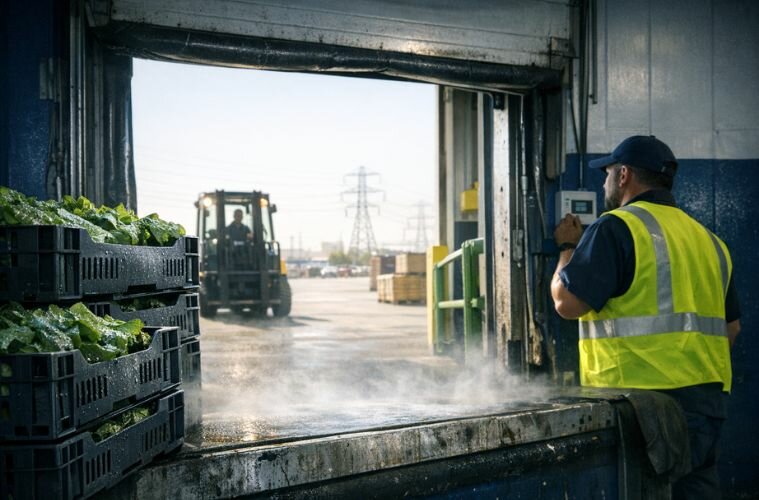
The data on where excursions occur is consistent across the industry and consistently surprising to operations teams seeing it for the first time. The break is rarely in the middle of a transit leg, where monitoring is active and equipment is dedicated. It happens at docks during loading and unloading. It happens during vehicle changeovers. It happens in last-mile delivery windows where a driver has no temperature measurement system and makes judgment calls about how long a door can stay open. Many cold storage facilities were built more than 40 years ago. They were not designed for the ambient temperatures they are operating in now, and their refrigeration systems were not sized for continuous operation under heat conditions that are becoming routine.
The risk is also shifting earlier in the calendar. Heat events that used to arrive in July are now occurring in late May and early June in multiple regions. That timing matters because seasonal protocols, equipment servicing schedules, and staffing plans for peak summer still tend to activate in response to July conditions. The gap between when the heat arrives and when the operational response kicks in is where early-season losses concentrate.
What the Grid Stress Picture Adds to Cold Chain Exposure This Summer
Cold chain infrastructure is energy-intensive by design. A temperature-controlled warehouse running 24 hours a day in a heat wave is drawing significant power continuously, and it has very little tolerance for interruption. Power fluctuations, even brief ones, can trip refrigeration compressors in ways that require manual reset and leave product unprotected during the recovery window. Facilities without backup generation, or with backup systems that have not been load-tested under actual summer demand conditions, carry a failure mode that does not show up in routine maintenance records.
The operations and procurement question heading into this summer is whether your cold chain infrastructure, your carrier agreements, and your contingency protocols were built for a heat season that starts in late May and may not end until October. If those plans were written when peak summer was a six-week window in July and August, they are probably due for review before the first major heat event of the season makes that review urgent.