
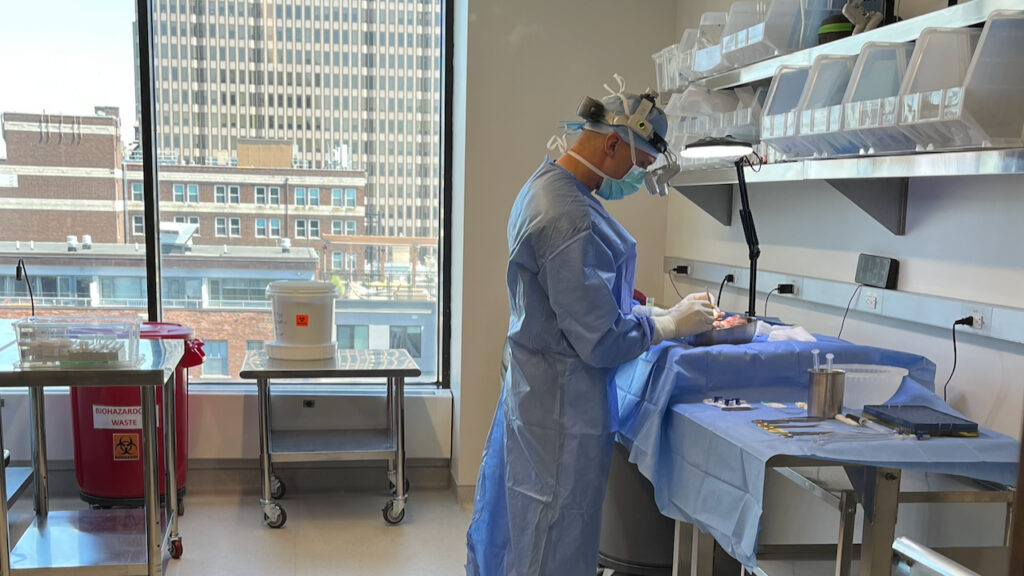
The 43-person startup has built out labs, office space and testing facilities in a 13,400-square-foot space at 55 Church Street.
Bexorg, a Yale spin-off focused on neuroscience drug research using donated human brains, has relocated to a larger New Haven headquarters.
The 43-person startup has built out labs, office space and testing facilities in a 13,400-square-foot space at 55 Church Street.
Bexorg’s core platform, known as BrainEx, restores certain molecular functions in postmortem human brains, creating a model the company says that can help demonstrate how pharmaceuticals might act in living tissue.
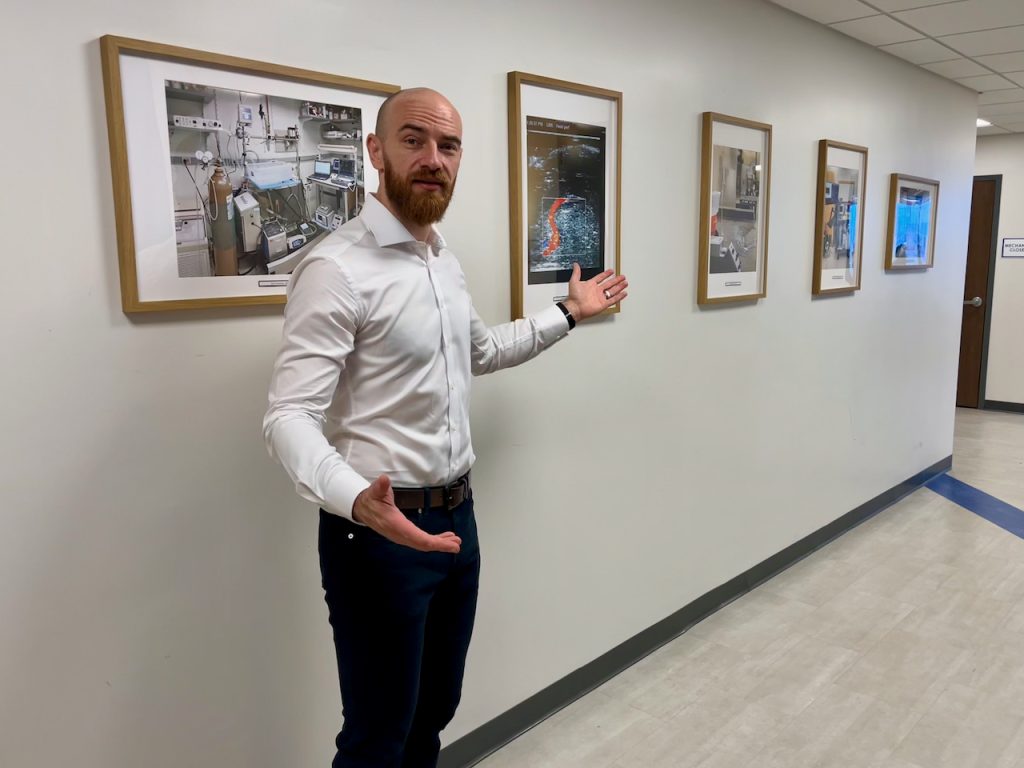 Bexorg CEO Zvonimir Vrselja shows off photos at the company’s New Haven headquarters. The artwork documents the company’s ten year history. HBJ Photo | Harriet Jones
The company tests drug candidates on both diseased and healthy brains obtained through established organ-donation networks. It is currently evaluating eight drug candidates targeting neurodegenerative diseases, including Parkinson’s and Alzheimer’s.
Bexorg also generates revenue by providing access to its testing infrastructure and data to other bioscience companies.
The Church Street move was supported by a $23 million Series A financing round completed last October, bringing the company’s total fundraising since its 2021 Yale spinout to $42.5 million.
The expanded headquarters has allowed Bexorg to double the number of whole-brain tests it can run simultaneously while adding capacity for earlier-stage testing using small slices of brain tissue.
In fact, the company is about to install a robotic arm to automate the tissue slicing procedure.
“You can make hundreds of slices from one brain,” CEO Zvonimir Vrselja said. “Because we need to ask a lot of questions, a lot of diseases, we needed a scalable approach.”
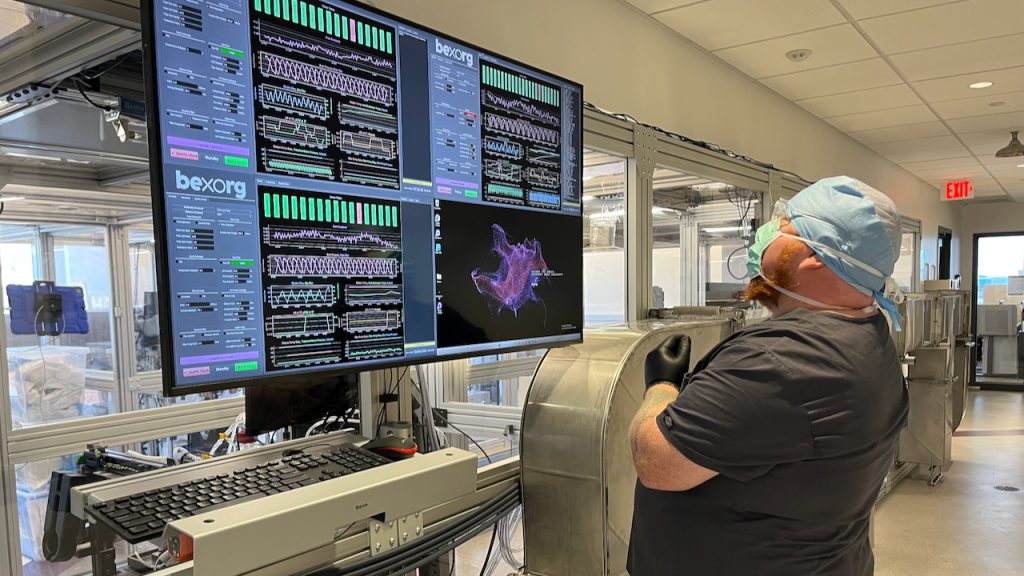 A technician monitors data being harvested from experiments run on donated human brains on Bexorg’s BrainEx platform. HBJ Photo | Harriet Jones
The data from the tests is captured in an AI-enabled platform. Bexorg expects to have data from 700 brains by the end of this year, according to Chief Technology Officer Sean Murphy, who said artificial intelligence has significantly reduced analysis time.
“There’s been a quiet revolution here,” he said. “Until very recently scientists would have to spend days or weeks writing code to analyze results that can be done almost instantly today.”
The company also sees an opportunity as the scientific world begins to move away from testing drugs in animals before human trials, and believes its process provides a more reliable predictor of whether clinical trials should proceed.
Currently, 95% of drug candidates for neurodegenerative diseases do not make it out of human clinical trials.
Last month the Food and Drug Administration announced it would phase out animal testing for a range of therapies in an effort to find more reliable models.
“The shift is going to take time, but we’re in an important moment here,” said Brendan Parent, the director of medical ethics at NYU Langone Health and a member of the company’s independent ethics board. “Bexorg can capitalize on this.”