
NEW YORK—A 28-year-old credit union member walks into a branch with a simple question: Can she buy bitcoin? Minutes later, she’s in her car completing the transaction on a crypto app—because her credit union couldn’t help.
That moment, drawn from a new Velera/PYMNTS Intelligence report, captures what may be one of the most quietly consequential gaps facing credit unions today: strong member interest in digital currency paired with limited access inside the cooperative system.
The report, “Digital Currency at the Credit Union: The Gap Between Interest and Access,” finds the issue is not demand—especially among younger members—but a growing disconnect between what members expect and what credit unions offer. Roughly one-third of millennials express strong interest in using cryptocurrency for payments, yet most are unsure whether their credit union supports it at all.
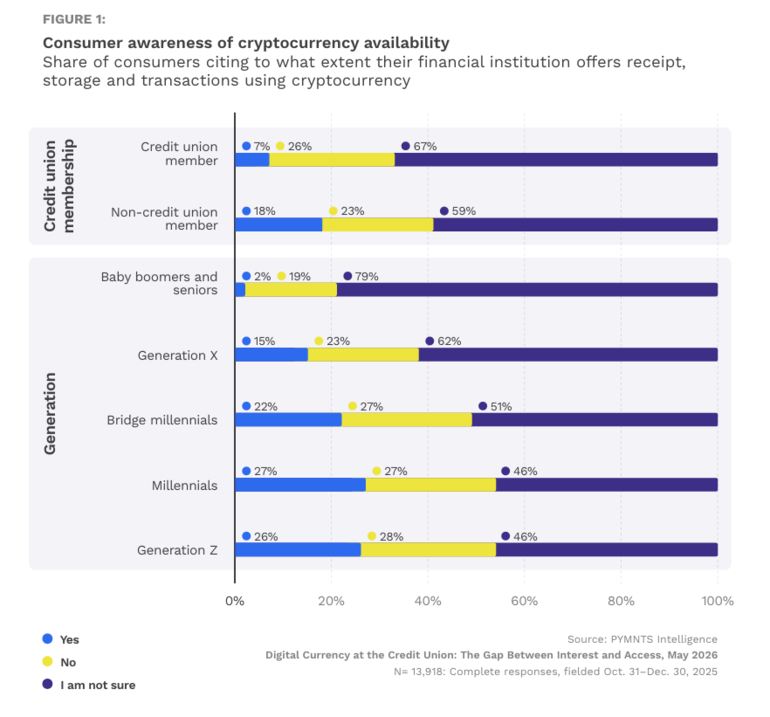
That uncertainty is not accidental. According to the research, just 7% of credit union members say their institution allows them to send, receive or store cryptocurrency, while two-thirds simply don’t know. The implication is real: members who care about digital assets are already looking elsewhere—and finding answers with fintech platforms like Coinbase, Robinhood and Cash App.
The risk for credit unions is not immediate disruption but something more gradual—and potentially more damaging. Younger members may begin building financial relationships outside the cooperative system long before making major decisions about borrowing, investing or saving. By the time those moments arrive, the primary financial relationship may already be gone.
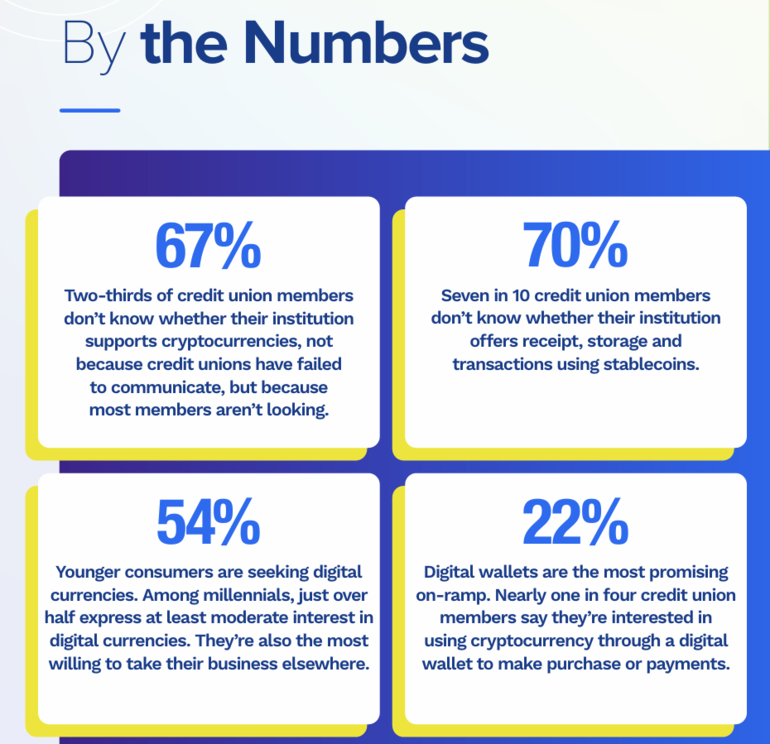
At the same time, the report makes clear that rushing headlong into crypto is not the answer. Interest remains concentrated among younger demographics, while most members—particularly older cohorts—show limited engagement. Stablecoin, often positioned as a safer, payments-oriented alternative, hasn’t yet gained meaningful traction either, with awareness and interest trailing even crypto levels.
Instead, the most compelling finding may lie in what researchers call the “wallet effect.” When digital currency is presented through a familiar interface like a digital wallet, member interest rises across nearly every demographic group. Among Millennials, strong interest in crypto increases when accessed via a wallet, and for stablecoin, interest among credit union members more than doubles in some cases.
That insight points to a more measured strategy. Rather than building full-scale crypto platforms, credit unions may be better positioned to focus on digital wallet infrastructure—often through partnerships—that integrates digital assets into existing experiences members already trust. The takeaway, the report suggests, aligns with a broader industry shift: the competitive battleground is increasingly about access and integration, not ownership of the asset itself.
Section: Standard
Word Count: 581
Copyright Holder: CUToday.info
Copyright Year: 2026
Is Based On:
URL: https://www.cutoday.info/Fresh-Today/The-Crypto-Gap-Why-Younger-Members-Are-Looking-Beyond-Credit-Unions