
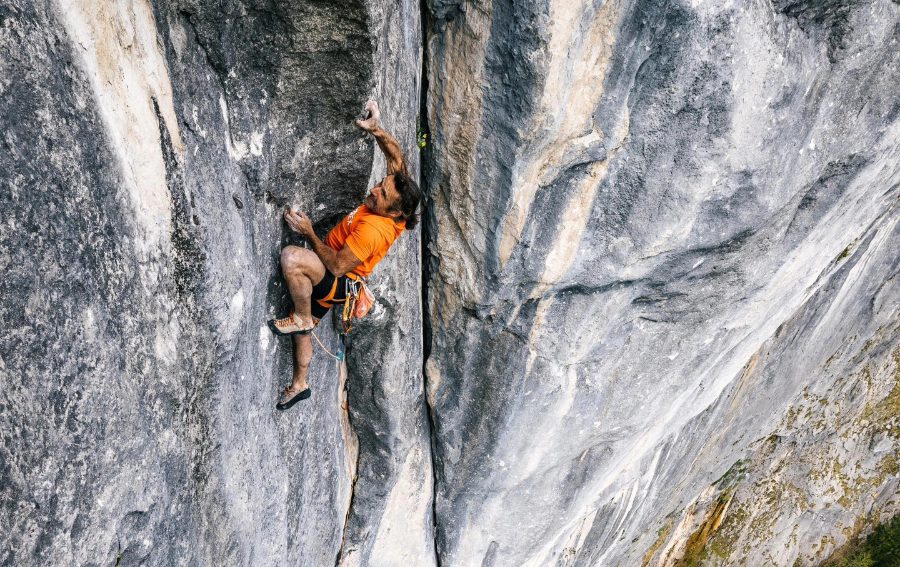
Two decades ago, Alexander Huber and his brother Thomas established Via Gabrielli on the Gösslerwand above Lake Grundlsee in Austria. That route, however, was never their original objective, as the brothers had envisioned a more direct line up a steeper section of the limestone wall.
Despite several attempts, they were unable to complete the harder route, leaving the project unfinished for years until Alexander recently felt inspired to return. Revisiting the climb with renewed focus, he searched for a way through a particularly blank section of rock. Describing the third pitch, Huber explained: “Either you have a good hold or a good foothold, but never both at the same time, and this causes some delicate movement on limestone which is as smooth as granite.”
He named the new 10-pitch route Feuersalamander. The climb features five pitches graded 5.13, with the crux checking in at 5.13d. Huber also kept the route serious, with long runouts and at times marginal protection; there are only 15 bolts on the entire climb.
About Feuersalamander, which together with Via Gabrielli remains one of only two routes on the Gösslerwand, Alexander said: “The exposure is lovely and the climbing simply fantastic.”
Over the past 30 years, Alexander has built a reputation as one of the most versatile climbers in the world, excelling across sport climbing, big walling, high-altitude expeditions, and free solos.
Sport Climbing
In 1991, he made the first ascent of Shogun in Bavaria, marking his first 5.14b. A year later, he sent Om in Bavaria 5.14d, it became only the second route in history to reach that grade and confirmed Huber as one of the strongest climbers of his era.
In 1994, he established Weisse Rose in Austria and also made the first ascent of the original version of La Rambla in Spain. The route later evolved into one of the most famous hard climbs in the world. Huber maintained that his original line was already comparable in difficulty to the upgraded version that would later receive a higher grade.
One of his most influential achievements came in 1996 with Open Air in Austria. Originally considered extremely difficult, the route was later confirmed as one of the earliest true 5.15a climbs in history. The ascent was years ahead of its time.
Big Wall Climbing
By the late 1990s, Huber shifted his focus toward big wall free climbing, especially on the massive granite walls of Yosemite Valley. He became one of the defining figures of the discipline, helping transform El Capitan into a proving ground for free climbing progression.
In 1995, he made the first redpoint ascent of the legendary Salathé Wall on El Capitan – read about it here. Huber’s creativity exploded in 1998 when he established El Niño and Freerider. Freerider became especially historic, not only as a groundbreaking free route but also as the first El Capitan climb made in under 24 hours. Huber described it as the “Astroman of the new millennium,” recognizing its potential to become a future classic. Years later, the route gained worldwide fame when Alex Honnold free soloed it.
In 2000, Huber added another masterpiece with Golden Gate, linking difficult sections across El Capitan into a sustained free climbing challenge. He continued to expand the possibilities of multi-pitch climbing with routes like El Corazon, and Free Zodiac, all of which demanded elite endurance and technical mastery.
His work was not limited to Yosemite. In the Alps and Dolomites, Huber created visionary free climbs on huge overhanging faces. Routes such as Pan Aroma and Nirwana became benchmarks for hard alpine rock climbing, combining severe difficulty with massive exposure and commitment.
Expeditions
Huber also became known for ambitious expeditions in some of the harshest mountain environments on Earth. Often climbing alongside his brother Thomas Huber, he embraced alpine-style ascents that emphasized speed, self-reliance, and minimal equipment.
In 1997, Huber joined an expedition to the Karakoram, making the first ascent of Tsering Mosong on the towering west face of Latok II. The route began above 6,000 metres and demanded technical climbing in extreme altitude conditions. To better understand the effects of altitude, he later climbed Cho Oyu, one of the world’s 14 8,000-meter peaks. The experience helped prepare him for future expeditions in Patagonia and Antarctica.
Patagonia became another proving ground for Huber’s adventurous spirit. Throughout the early 2000s, he climbed iconic peaks including Cerro Torre and Fitz Roy while establishing bold new routes in fierce weather conditions.
In Antarctica, Huber explored remote granite towers covered in snow and ice. Climbs such as Eiszeit, Skywalk, and Sound of Silence highlighted his willingness to operate in isolated environments where storms, freezing temperatures, and logistical challenges added enormous risk.
One of his most celebrated expedition achievements came in 2009 with the free ascent of Eternal Flame on Pakistan’s Nameless Tower. The route had long been considered one of the world’s great unfinished climbing challenges, and Huber’s success represented a landmark moment in big wall history.
Free Solos
Beyond roped climbing, Huber also earned recognition as one of the few climbers capable of free soloing extremely difficult routes. In 2002, he free-soloed Brandler-Hasse Direttissima in the Dolomites, establishing a new standard for difficult big wall soloing.
Huber’s solo of Der Opportunist in Austria became one of the earliest free solos of a 5.13d. Shortly afterward, he raised the standard again with Kommunist, becoming the first climber to free solo a 5.14a. Huber later described the climb as the moment he discovered his personal limit.
Despite these achievements, he often spoke openly about fear and risk. He described his solo ascent of Mescalito in Germany as one of the scariest experiences of his climbing life due to the exposed starting position high above the ground.