
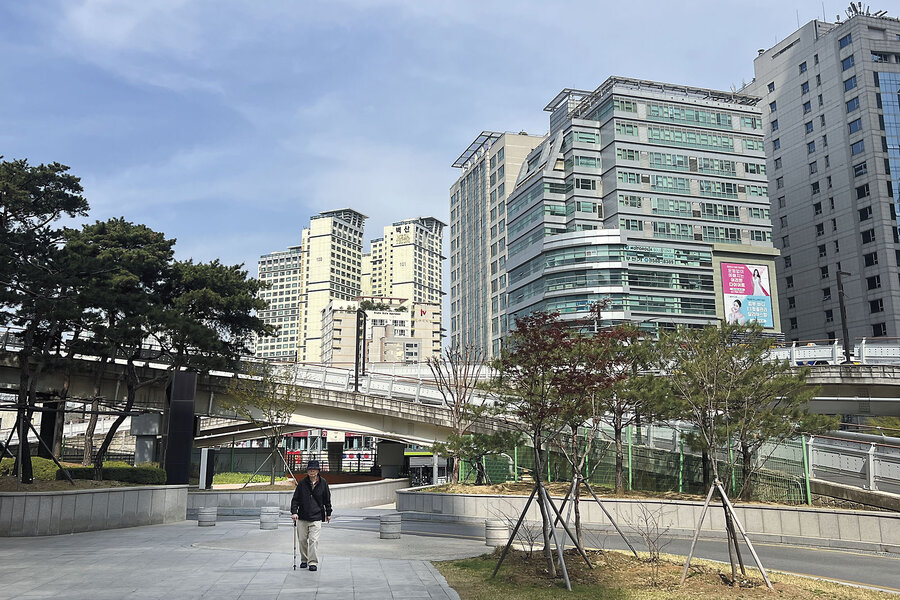
Unlike many in her generation, Woo Ye-wan was able to purchase a sleek apartment in southeastern Seoul three years ago at age 27. But as she cuts a slice of German butter cake into bite-size pieces with kitchen scissors, she laments that it’s not the kind of place where she could ever raise a family.
Her minimalist studio flat is just 450 square feet, with a kitchen counter only a few short steps from her dining table, which is only a couple of steps from her bed. Ms. Woo, who works long hours as a nurse, worries that the investment – which amounted to 15 times her annual salary – might not be the launching pad she had hoped.
“These days, I’ve reached the point where I just hope I don’t end up losing money on it,” she says.
In South Korea, President Lee Jae-myung sees housing affordability as top priority, talking about it as an existential challenge for the country. For many Koreans, finding a place to live is a major factor when making big life decisions like getting married and planning to raise a family.
Many young Koreans are glum about their future, with housing at the center of a generation’s angst. This is why the country’s president, Lee Jae-myung, is waging a policy war on the housing market. Throughout his first year in office, he has blamed property speculation and greed for Seoul’s runaway housing prices, and promised to do everything he can to fix it.

President Lee even went so far as listing his own Seoul apartment for sale at below market value. The message he wanted to send was that real estate is about finding a home, and is not simply an investment vehicle. He says South Korea has turned into a “property-speculation republic.” And the president vows to “eradicate” the problem, in order to fuel “South Korea’s great transformation.”
In a nation with the lowest birth rate in the world, and where many view homeownership as a prerequisite for raising a family, this affordability crisis is seen as an existential problem, jeopardizing South Korea’s social and economic stability.
President Lee said in a social media post earlier this year, “Don’t you see the blood and tears of millions of young people who are giving up on marriage and childbirth due to the high housing costs?”
Housing in Korea
The number of Koreans in their 20s and 30s who own their homes has reached record lows. And that is hardly surprising in Seoul, where apartment prices rose nearly 19% in just the last year, according to the country’s Ministry of Land, Infrastructure and Transport. It has also become more difficult for young people to find steady employment in South Korea, where there are just 39 jobs for every 100 job seekers, according to data from June of last year.
This all makes Ms. Woo something of an outlier.
“When I became an adult, I just assumed that once I started earning money, I’d naturally be able to buy a real home where I could raise a family,” she says. But getting into her own place was no easy feat.
Ms. Woo went to after-work real estate study groups to educate herself about the housing market. She whittled down her overall living costs by quitting the gym and ruling out vacations abroad. She also started buying almost all of her clothes from a cheap wholesale market in an underground tunnel of Seoul.
But three years ago, she made the leap, signing up for a monthly mortgage payment that would, on a good month, swallow about two-thirds of her income – so long as she took on extra shifts. Ms. Woo commutes an hour and 20 minutes each way by city bus to and from the hospital where she works at least five days a week.

For decades, many Koreans have relied on a system called jeonse, in which landlords offer a residential lease in exchange for an up-front fee from tenants. That fee could be as high as 80% or 85% of the value of the property. The landlord can invest that money during the term of the lease, while the tenant lives essentially rent-free. The full deposit is meant to be returned by the landlord at the end of the term of the lease.
But with property values running so high, the typical jeonse deposit for an apartment in Seoul runs into the $400,000 range. Nowadays, more people are opting to pay monthly rent, to avoid having to come up with such a large lump sum under the old jeonse system.
President Lee blames lenders for providing large loans to buy multiple investment properties and wants them to put a stop to the practice. He has also floated the idea of reducing tax benefits for those who own more than one home.
Hyojung Lee, an associate professor at Seoul National
University’s department of urban planning, says that housing has been young Koreans’ go-to investment for the last 30 to 40 years. “Some may call it speculation, but to me, it is a pretty rational and reasonable investment,” he says.
Property prices nationally, for example, rose by about 9% last year. That’s a good return on investment, but Professor Lee – no relation to the president – says the government is trying to “freeze” the real estate market, while it scrambles to increase Seoul’s housing supply. He himself had to cancel plans to buy a home last year after policy changes caused him to lose access to a loan.
“It’s not a good idea in the long term, but it could be a short-term measure to address this speculative approach to the housing market,” Professor Lee says. “To me, the ultimate policy solution is to convince the public that there are better parts of your life than raising your kids in elite neighborhoods and sending them to elite universities.”
Expectations and aspirations
About half of South Korea’s population lives in Seoul and nearby satellite cities, their lives anchored to the metropolis that has become the nation’s outsize center of economic life. This drives real estate prices up. And surveys show that many Koreans believe buying a home is an important factor in deciding to get married or have children.
Andrew Eungi Kim, a sociology professor at Korea University’s Graduate School of International Studies, says it is hardly a surprise that many young people feel under pressure.
“I don’t think there is any room for optimism for the younger generations, because the jobs they can look forward to are not that high-paying,” says Professor Kim. “And the housing prices are not coming down anytime soon.”
South Koreans are hardly alone in their housing woes. The World Economic Forum has identified the problem as “a global housing mismatch” among property supply, demand, affordability, and access. Many young people in India, for example, are finding themselves priced out of middle-class housing. And in the United States, the median age of first-time homebuyers has climbed above 40, according to the National Association of Realtors.
James Lee, a local real estate agent, says part of South Korea’s problem is about expectations.
He says many families – including his own – are trying to save up to buy property in an upscale neighborhood of Seoul, where people are “well mannered” and “somewhere important” in South Korean society. In some of these highly sought-after districts, the cost of an apartment has nearly doubled since 2020.
“You feel like there’s more opportunity for your daughter, maybe, growing up somewhere like that,” he says. Yet for most buyers, that’s not realistic, he adds, which leads to frustration.
Still, some residents have more modest goals.
About an hour away from the tiny studio apartment owned by the nurse, Ms. Woo, Kim Keum-hye, who is the same age, rents a poorly insulated basement apartment in northern Seoul. A former social worker who now bartends part time, Ms. Kim says she has ditched her “naive” goals of buying her own flat in Seoul one day.
“I don’t think I could ever achieve owning a home, to be honest,” she says. “Thinking about Korean society, everything is so hard to afford.”
“I don’t know about having kids, either,” she adds, expressing concern about raising children on her current salary.
At this point, she says, she only dreams about renting a place with some natural sunlight.