
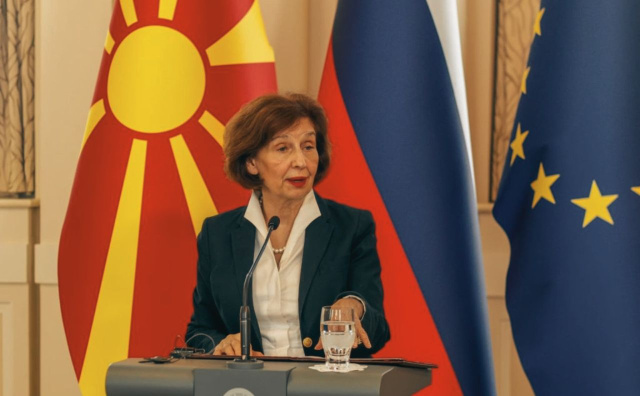
Gordana Siljanovska-Davkova
A public lecture in Ljubljana involving North Macedonia’s President Gordana Siljanovska-Davkova triggered sharp reactions among European diplomatic representatives after comments criticizing Bulgaria’s constitutional framework and broader EU policy approaches to minority rights, BGNES reported.
The exchange took place at the Faculty of Law during a discussion on constitutional reforms and EU accession. According to reports, tensions escalated after the Bulgarian ambassador to Ljubljana, Krasimir Bojanov, questioned how the inclusion of Bulgarians in North Macedonia’s constitution could threaten national identity.
Instead of directly addressing the question, Siljanovska shifted into a broader lecture on constitutional law, including comparisons between the Macedonian and Bulgarian legal systems. She argued that North Macedonia provides stronger constitutional guarantees for minority rights than Bulgaria, claiming that the Bulgarian Constitution only establishes general equality among citizens.
“Every citizen is equal regardless of gender, race, or ethnic origin,” she noted, referring to Bulgaria’s constitutional provisions, while arguing that this framework does not explicitly define minority rights in the same way as some other states.
Her remarks, however, were viewed by several European diplomatic participants as avoiding the core issue linked to North Macedonia’s EU accession process, particularly the requirement to include Bulgarians in the constitution as part of the negotiated framework for starting accession talks.
Siljanovska also broadened her criticism to the European Union, claiming there is no unified approach to minority rights across member states. She pointed to countries such as France and Greece, arguing that they have not signed certain minority-rights conventions, and suggested that most EU constitutions do not explicitly regulate minority protections.
According to her, this creates inconsistencies in how rights are defined and protected across Europe. At the same time, she stated that while minority rights may not always be explicitly written into constitutional texts, they are still, in her view, effectively guaranteed through broader human rights frameworks.
She also repeated the position that rights of Macedonians in Bulgaria are not adequately respected, a longstanding point of political dispute between the two countries.
European diplomats reportedly interpreted her intervention as reflecting continued resistance within Skopje to fully implementing the conditions tied to EU accession negotiations. The requirement to include Bulgarians in North Macedonia’s constitution stems from the so-called “French proposal,” agreed by EU member states in 2022 as part of the negotiation framework.
Under that arrangement, constitutional changes are a prerequisite for the formal opening of accession talks, alongside commitments under the 2017 Treaty of Friendship, Good Neighborliness and Cooperation between Bulgaria and North Macedonia.
Formal statements from a joint intergovernmental conference confirm that Skopje accepted the principle that no constitutional provision would be used to justify interference in Bulgaria’s internal affairs regarding the status of individuals outside North Macedonia. The agreement also effectively rules out claims for recognition of a Macedonian minority in Bulgaria.
The protocol further outlines additional obligations, including measures to counter hate speech against Bulgarians, steps toward rehabilitation of victims of the former communist period in North Macedonia, and the opening of historical archives linked to former Yugoslav-era security services.