
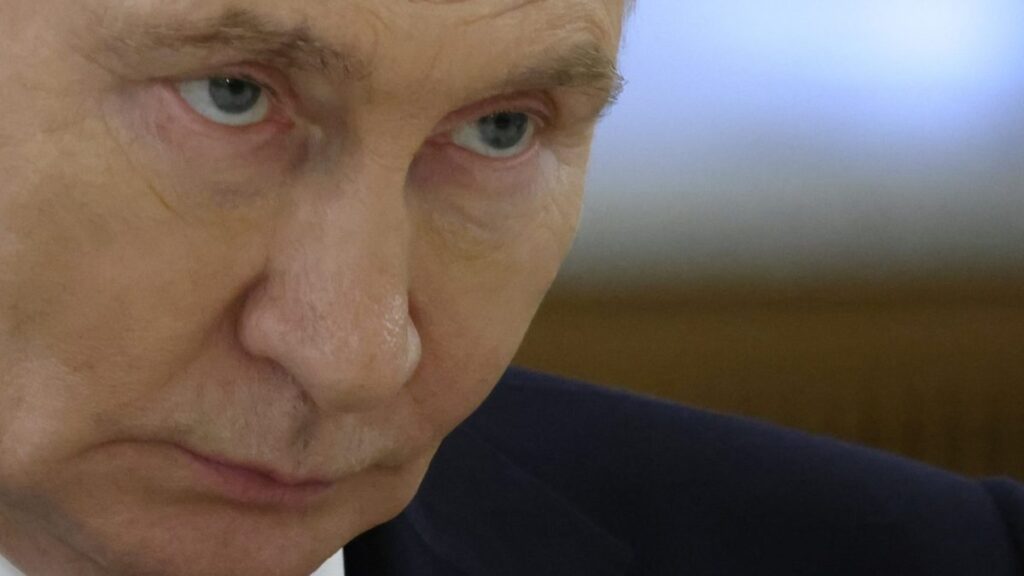
As the United States Navy enforces a shocking military blockade of Cuba, Russian President Vladimir Putin sits thousands of miles away in Beijing, quietly accepting his new reality as a subservient junior partner to Chinese President Xi Jinping. The global geopolitical order is fracturing in real time, driven by dual crises that expose the catastrophic collapse of Russian deterrence and a radical resurgence of American interventionism.
The stakes of this diplomatic realignment are unprecedented since the height of the Cold War. Four and a half years after launching a disastrous invasion of Ukraine, the Kremlin has decimated its own military capacity, suffering an estimated one million casualties. This attritional nightmare has not only permanently crippled Moscow’s superpower status but has also greenlit aggressive foreign policy maneuvers by a newly emboldened Donald Trump administration, which now seeks regime change in the Caribbean.
The Attritional Nightmare and Drone Warfare Dominance
The Russian military apparatus is paralyzed on the Ukrainian steppes, trapped in a bloody stalemate barely miles from its 2022 starting lines. What Putin originally envisioned as a lightning decapitation of the Kyiv government rapidly devolved into the greatest military humiliation in Russian history. The legacy of the conflict is a gruesome war of attrition that heavily favors the defending forces, fundamentally altering the calculus of modern conventional warfare.
Drone warfare is the primary architect of this gridlock. Thousands of unmanned aerial vehicles hover constantly over the frontline, creating a 30-mile kill zone that renders traditional mechanized assaults obsolete. The proliferation of cheap, highly lethal drones makes medical evacuation via helicopter or ambulance virtually impossible. Consequently, injuries that would otherwise be survivable are left untreated for days, driving the ratio of wounded to fatalities down to an apocalyptic three-to-one.
Despite possessing overwhelming advantages in population and raw materials, Putin has proven entirely incapable of mobilizing his nation’s industrial base to secure victory. His isolation from the reality of the battlefield draws inevitable comparisons to Germany’s Kaiser Wilhelm II in 1914—a leader whose hubris launched a catastrophic war that ultimately destroyed his own empire while uniting the continent against him.
A Superpower Reduced to a Junior Partner
The geopolitical fallout of the Ukraine disaster extends far beyond the borders of Eastern Europe. In a desperate bid for economic and military survival, Moscow has mortgaged its strategic autonomy to Beijing. Putin’s recent diplomatic pilgrimage to China confirmed what international observers have long suspected: Russia is no longer an equal ally, but a dependent vassal state relying on Chinese industrial output to sustain its war machine.
This capitulation marks the definitive end of Russia’s three-decade quest to regain the superpower status lost during the 1991 Soviet collapse. The war has achieved the exact opposite of Putin’s stated objectives. Instead of fracturing Western alliances, he has provoked a massive remilitarization of Europe, driving historically neutral nations like Sweden and Finland directly into the arms of NATO.
The economic devastation is equally severe. Suffocated by unprecedented international sanctions, the Russian economy has pivoted entirely to wartime production, cannibalizing civilian sectors to feed the artillery duels in the Donbas. Whatever the ultimate territorial settlement, Russia faces decades of economic stagnation, demographic collapse, and profound international isolation.
America’s Caribbean Gambit: The Blockade of Cuba
Sensing the total paralysis of Russian power projection, the Trump administration has launched an audacious military campaign in the Caribbean. For nearly 75 years, the threat of Soviet and later Russian retaliation shielded Havana from direct American military intervention. Today, that protective umbrella has vanished, prompting the US to indict 94-year-old former Cuban President Raul Castro and deploy naval assets to enforce a comprehensive blockade.
The implications of the Cuban blockade are staggering, signaling a volatile new era of American foreign policy:
- The US Navy has established heavily fortified exclusion zones, threatening to intercept international shipping attempting to supply the island.
- The administration has explicitly stated that regime change is the ultimate objective, discarding decades of diplomatic normalization efforts.
- Russia’s complete inability to protect its historic ally exposes the hollowness of its global security guarantees, further terrifying its remaining partners in Syria and Venezuela.
- The escalation risks sparking a severe humanitarian crisis mere miles from the Florida coast, severely testing international maritime law.
Shockwaves Reaching the Global South
The disintegration of Russian influence and the resurgence of aggressive American unilateralism send terrifying shockwaves through the Global South. For nations in East Africa, the consequences are immediate and severe. Kenya, which heavily relied on Russian fertilizer and Ukrainian grain, continues to navigate the economic fallout of disrupted Black Sea supply chains, a crisis that has driven millions into food insecurity.
More profoundly, the collapse of Russia as a counterweight to Western hegemony forces African nations to rethink their non-alignment strategies. If Moscow cannot protect Cuba, it certainly cannot guarantee security for emerging economies in the Sahel or the Horn of Africa. The geopolitical vacuum is rapidly being filled by China, which is aggressively expanding its economic and military footprint across the continent.
As the conflict in Ukraine grinds relentlessly onward, the world is witnessing the violent birth of a new multipolar reality. Putin’s disastrous miscalculation has not only destroyed the Russian military but has fundamentally rewritten the rules of global engagement. The consequences of this arrogance will dictate international security dynamics for generations to come.