
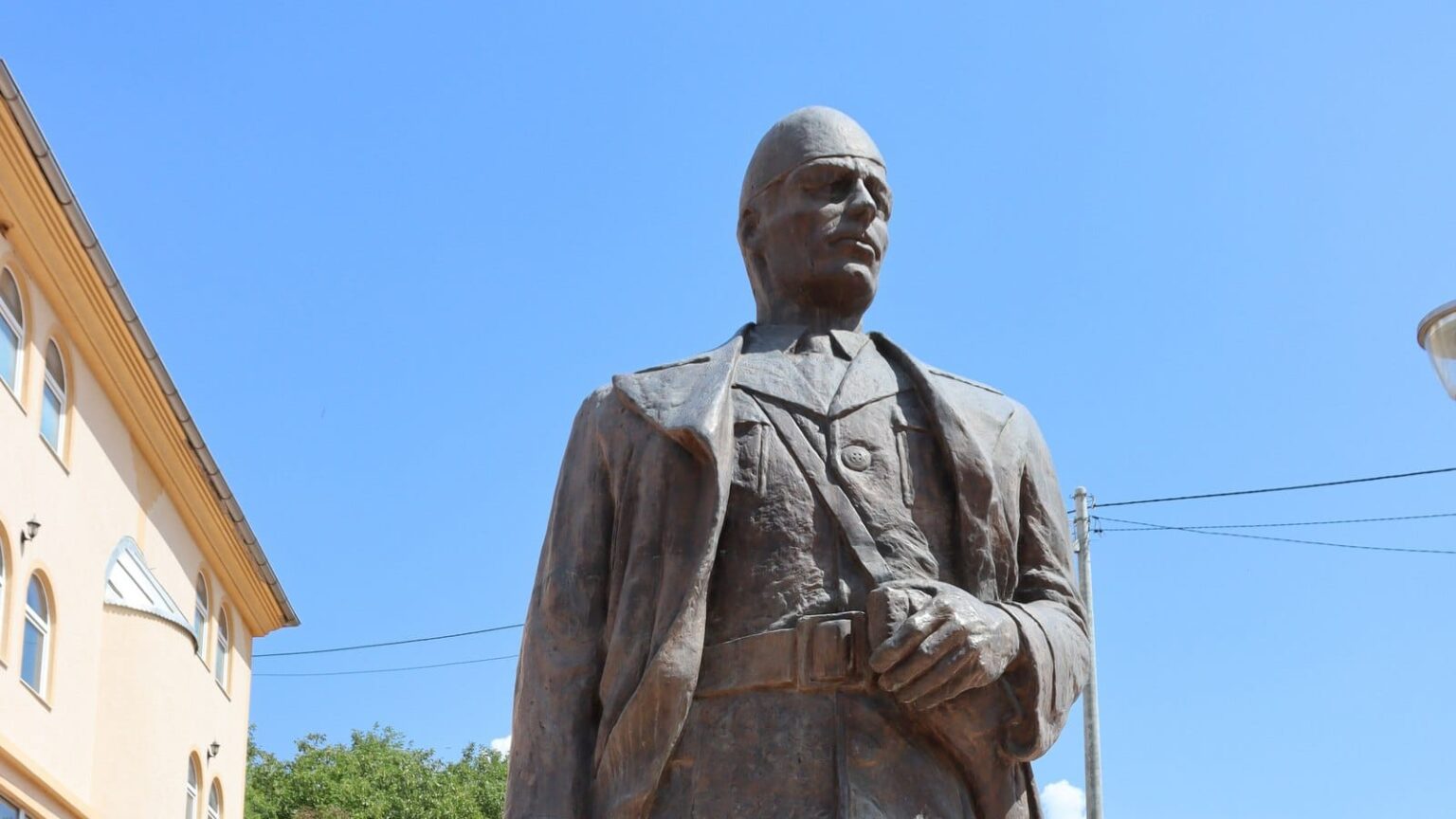
Fatmir Lumani, who is ethnic Albanian and a historian based in Skopje, said the controversy misses the point.
“There is so much history of cooperation between Albanians and Macedonians,” he said, citing their shared goal of liberation from Ottoman rule and the example of Dervish Hima, an activist of the Albanian liberation movement who gave a speech at a meeting of the VMRO, the Internal Macedonia Revolutionary Organisation, in Ohrid, the lakeside town near where he was born.
“He said that Albanians and Macedonians have the same interests,” said Lumani. “To liberate themselves and to achieve self-government, and to that end they should cooperate.”
Subsequently, joint Macedonian and Albanian armed detachments appeared in 1909-1910 in the regions of Kicevo, Debar and elsewhere, said Lumani.
“Just like in any national movement, in the Macedonian likewise, there are historical characters who are universally regarded as positive and then there are some who are part of the same corpus, but who due to some of their actions or leanings, are marred with controversy or deemed unacceptable by some,” he told BIRN.
“History cannot be remade, but what you emphasise from it is very important.”
Lumani noted too that Hasan Prishtina, a major figure in the Albanian Uprising of 1912 and later prime minister of Albania, was in direct contact and conducted joint activities with leaders of the VMRO at the time, including Todor Aleksandrov and Petar Chaulev, including bases on the territory of modern-day Albania from which VMRO could operate.
“These are lesser-known facts about our history,” he said.
BIRN tried unsuccessfully to contact the Institute for Spiritual and Cultural Heritage of Albanians, a state-supported academic and cultural research institute in North Macedonia, and its director, Skender Asani.
Litovski argued: “We have moments of connection, especially with the Albanians. Many Albanians joined the partisan movement and greatly helped in the liberation of western Macedonia. Take for example the female partisan Ibe Palikuqi. Then came the civilisational achievements after World War Two, such as the mass literacy of the population, including the Albanians.”
Palikuqi was an Albanian communist partisan from Debar who became one of the best-known female resistance fighters in Macedonia during World War Two. She died in September 1944 during fighting near Kicevo against forces of the Balli Kombetar and was subsequently declared a People’s Hero of Yugoslavia.
“If you sit and ask Macedonian and Albanian historians about these issues, they will each come out with arguments supporting their own side and ethno-centric views,” said Litovski. “But there is almost no effort to bring these two narratives closer together.”
“Admittedly, that is going to be very hard, especially now when politics, for its own reasons, tends to hold a monopoly on memorialisation of history, and is the loudest voice that people hear.”