
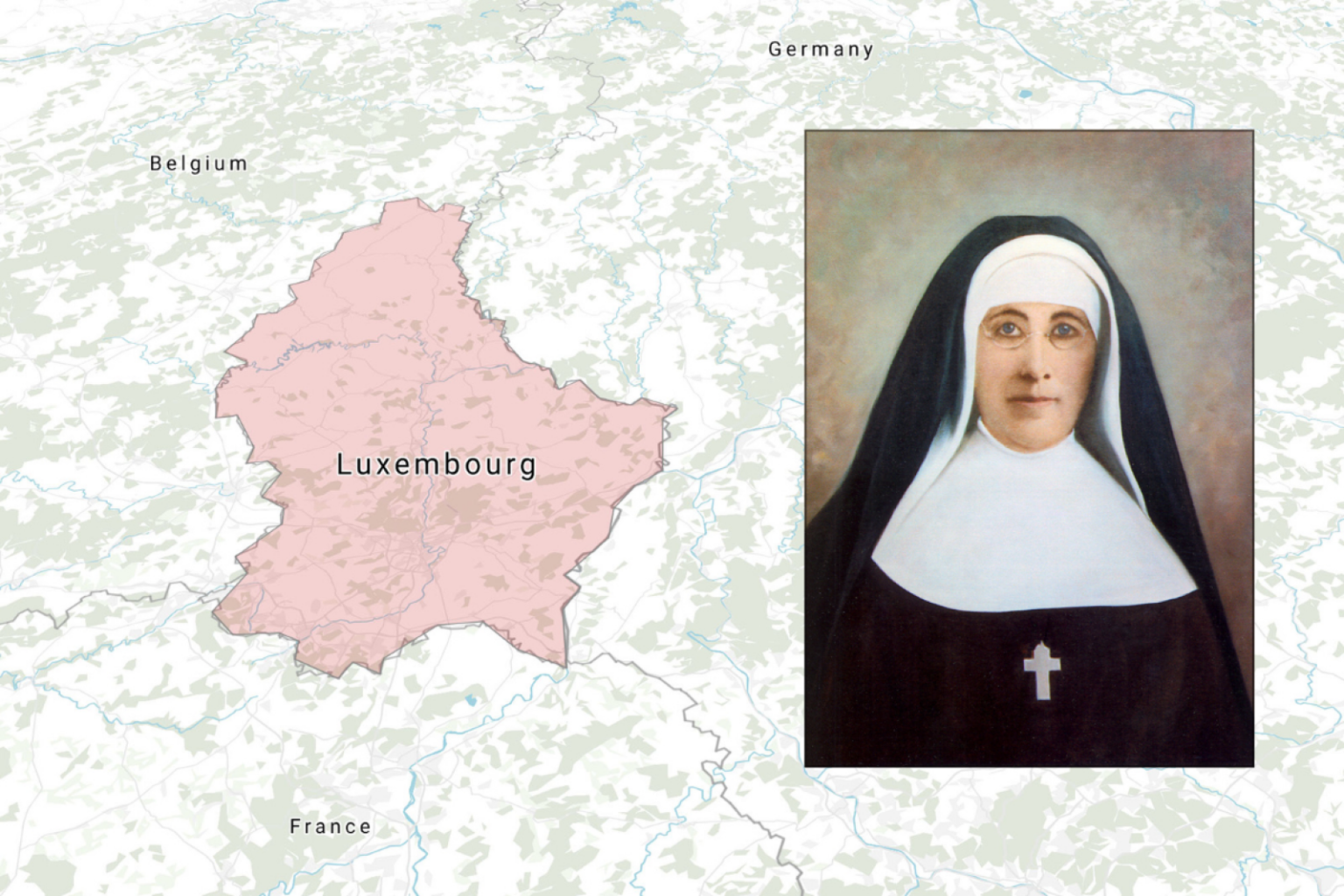
ROCHESTER — When you close your eyes and think of Luxembourg, what do you see?
Nothing?
Well, that’s a shame. Some would say it’s not right. This tiny European country deserves something more than a Rodney Dangerfield reputation.
Just think: If not for tiny Luxembourg, Mayo Clinic, Rochester … Well, one shudders to think. Think of a “Back to the Future” scenario. History would be very different, indeed.
Sister Mary Alfred Moes came from Luxembourg. And if not for this doughty, headstrong woman, who knows? Who would have suggested to William Worrall Mayo that a hospital be built after a tornado tore through Rochester in 1883? Thus began Saint Marys Hospital, which later joined Mayo Clinic.
Think more broadly. Who would have founded Rollingstone, Elba and other communities along the Mississippi River valley if the ethnic Germans from Luxembourg hadn’t done it? Drawn to the limestone bluffs and narrow valleys that eerily mimicked the topography of the home country, they raised up distinctive stone homesteads and ran small family farms.
And the linkage between the U.S. and Luxembourg runs both ways. Gen. George Patton is buried in Luxembourg, as are more than 5,000 service members killed during World War II.
Luxembourg is a country that punches above its weight class. Smooshed between Germany, France and Belgium, Luxembourg is tiny — about the size of Winona and Olmsted counties put together.
“It’s very small,” said Linda Kreidamacher, a Rollingstone resident of Luxembourg heritage who has visited the country twice. “You can travel it in just about a day.”
Luxembourg was once a very poor agrarian nation. It saw as much as one-third of its population emigrate to other countries in the late 1800s. Many ended up in Southeast Minnesota.
It was Kreidamacher’s great-great grandfather, Peter Stoos, who founded Rollingstone and it was her dad, Arthur, who founded the Rollingstone Luxembourg Museum. It is believed to be the first of its kind established in the U.S. with the “explicit purpose of education, preservation and encouragement of Luxembourg culture and heritage,” according to its website.
Kreidamacher said Rollingstone, a Southeast Minnesota community of 680, was almost entirely made up of people of Luxembourg descent in the 1960s. Today, she would put the makeup at roughly 50-50.
In May, the Luxembourg Heritage Society of Elba, Minnesota, in partnership with Luxembourg ambassador to the U.S. Nicole Bintner-Bakshian, hosted a day-long event in Rochester celebrating the Luxembourg-Minnesota connection. The event was also a fundraiser to help refurbish and make improvements to the Marnach House, a 1850s “old country” stone house near Elba.
“I grew up with the tradition, but most people have not,” said Kristin Speltz, Minnesota’s Honorary Consul for Luxembourg. “There’s a lot of people of Luxembourg ancestry here.”
Bintner-Bakshian, the Luxembourg ambassador, said her visit to Rochester would highlight the “meaningful role Luxembourg’s diaspora has played in building” the U.S.
“The generations who settled here carried with them values of hard work, community, and resilience that helped shape the American story,” Binter-Bakshian said in a statement. “It is important to keep honoring and celebrating these contributions today, reflecting a shared history that continues to unite Luxembourg and the United States.”
Nancy Roberts of Elba, whose ancestors came from Luxembourg, recalled feeding the Luxembourg workers who traveled to Elba to fix and restore the Marnach House in the early 1990s. It was the last time the building has undergone a major renovation.
The Luxembourg ambassador was also in attendance. Scanning the large crowd at the Marnach House, he joked how there were more Luxembourgish faces arrayed in front of him than there were in Luxembourg. It was a reference to Luxembourg’s cosmopolitan character as one of Europe’s major crossroads. Wedged between three hulking countries, people representing 170 nationalities live there today. There are three official languages.
Luxembourg’s role in shaping the history and culture of Southeast Minnesota also illustrates one of history’s lessons: the difference one person can make.
The passage of time has softened and glamorized the role Sister Mary Alfred Moes played in helping launch what would become a world-renowned health institution. But the record is replete with examples of how she clashed with superiors. It illustrates what locals say is a defining characteristic of Luxembourgers: stubbornness.
Before coming to Minnesota, Sister Alfred — later Mother Alfred — became the superior of a congregation of Franciscan sisters in Joliet, Illinois. When the bishop there tried to interfere in her work, she left and ended up in Rochester to start a school.
That trait more than any other may explain how her advocacy in healthcare made a difference. When Moes approached William Mayo about her idea for a hospital that would serve the world, Mayo countered that she would need to raise $40,000 to build such a facility. Mayo may have thought that raising such an astronomical sum would be impossible.
But Moes did it.
Roberts said that when she went to visit Moes’ Luxembourg home during an excursion there, she discovered there was no memorial, no plaque of Moes anywhere to commemorate her. It shocked and dumbfounded her how there could be no honor for such a world historical figure in her hometown.
“It was kind of explained that she really didn’t have a lot of people that thought much of her over there,” Roberts said. “She had been in and out of different convents.”
She was headstrong.
“She was a Luxembourger,” Roberts said.