
North Macedonia is grappling with a serious espionage scandal that has exposed deep fractures within its state institutions. Revelations published by Sloboden Pečat suggest that confidential information from the presidential office may have been copied, encrypted, and potentially prepared for transmission to foreign intelligence services.
The case has ignited a fierce confrontation between the Prosecutor’s Office for Combating Organized Crime and Corruption and the Ministry of Interior, while casting a shadow over the country’s ability to safeguard classified information, including data linked to its NATO membership.
At the heart of the allegations is an IT administrator in President Gordana Siljanovska-Davkova’s office. According to an anonymous criminal complaint filed by a group of Interior Ministry employees, the administrator is suspected of unauthorized copying and encryption of sensitive state data. The complaint, submitted to both prosecutors and other institutions, also points to possible involvement by other cabinet and intelligence officials in efforts to suppress evidence. It further alleges that high-ranking government figures urged the president and the attorney general to drop the investigation.
Prosecutorial frustration and evidence delays
The Prosecutor’s Office has confirmed it opened a preliminary investigation in late 2025 following a signal from the Ministry of Interior’s Cybercrime Sector. Investigators have requested court warrants to search computer systems, to seize equipment including mobile phones, and ordered forensic analyses. However, progress appears stalled. Months after orders were issued, the prosecutor’s office reports it has not obtained critical results, including full analysis of seized devices and decryption of potentially compromised data.
Particular tension surrounds the absence of security camera footage from the presidential office. Prosecutors requested copies from both the Presidency and the Government’s Office for General and Administrative Affairs (SOZR). The Presidency stated it does not hold copies, noting that the equipment was procured through SOZR and that storage falls under the Ministry of Interior’s responsibility. SOZR confirmed it only purchased the hardware and does not possess recordings. Despite repeated requests, the Interior Ministry has yet to deliver the footage, further fuelling suspicions of deliberate delays or obstruction.
These bottlenecks have intensified the institutional standoff. The complainants have called for comprehensive digital forensics on all relevant devices, servers, and communications, with special attention to any exposure of NATO-related classified information. As of now, the President’s Office has issued no public statement on the allegations, leaving the political and diplomatic pressure to mount.
The scandal carries significant weight because of the presidency’s central role in handling highly sensitive national security matters. In a NATO member state, the office regularly deals with information that, if leaked, could compromise not only North Macedonia but also alliance partners. The case has therefore moved beyond a domestic administrative issue to one with potential international repercussions.
Political fallout and echoes of past scandals
Opposition voices have been quick to weigh in. Oliver Spasovski, MP for the Social Democratic Union of Macedonia (SDSM) and former Minister of Interior, described the affair as deeply damaging to the country’s credibility. Speaking on 4TV’s “Night Studio,” he emphasized that the presidency represents one of the highest security ranks in the state. Any breach, he argued, sends a catastrophic signal to citizens and strategic allies alike.
Spasovski drew parallels with the massive illegal wiretapping scandal that rocked North Macedonia until 2016 under Nikola Gruevski’s VMRO-DPMNE government. That crisis eventually led to major reforms, including the creation of the Operational-Technical Agency (OTA) as a neutral intermediary between telecom operators and law enforcement. The goal was to eliminate direct partisan access to surveillance capabilities and restore institutional integrity.
He contrasted the old system, in which the Interior Ministry held direct access to operators and allegedly used it for political purposes, with the current OTA framework designed to minimize abuse. Yet Spasovski expressed fresh concern over recent statements by current Interior Minister Panče Toškovski regarding possible acquisition of equipment for direct access to citizens’ phones. Such moves, he warned, must strictly adhere to legal requirements, limited to the Public Prosecutor’s Office and authorised only by court order.
The political dimension is unmistakable. Spasovski questioned whether professionalism and loyalty to constitutional order are properly valued under the current VMRO-DPMNE-led administration, suggesting recurring vulnerabilities in security governance whenever that party holds power. Government supporters, however, would likely view such criticism as partisan opportunism aimed at destabilising the presidency.
As the investigation drags on, the case highlights longstanding weaknesses in North Macedonia’s institutional resilience, cybersecurity protocols, and inter-agency cooperation. The handling of classified information remains a persistent challenge in the Western Balkans, a region marked by geopolitical rivalry and hybrid threats.
Should the allegations prove substantiated, the consequences could extend far beyond domestic politics. Allies in NATO and the European Union may demand greater transparency and reforms to restore confidence. Even if the probe ultimately clears those involved, the perception of dysfunction, marked by delayed evidence, finger-pointing between institutions, and political recriminations, already risks eroding public trust and international standing.
Sources: IBNA, Sloboden Pečat
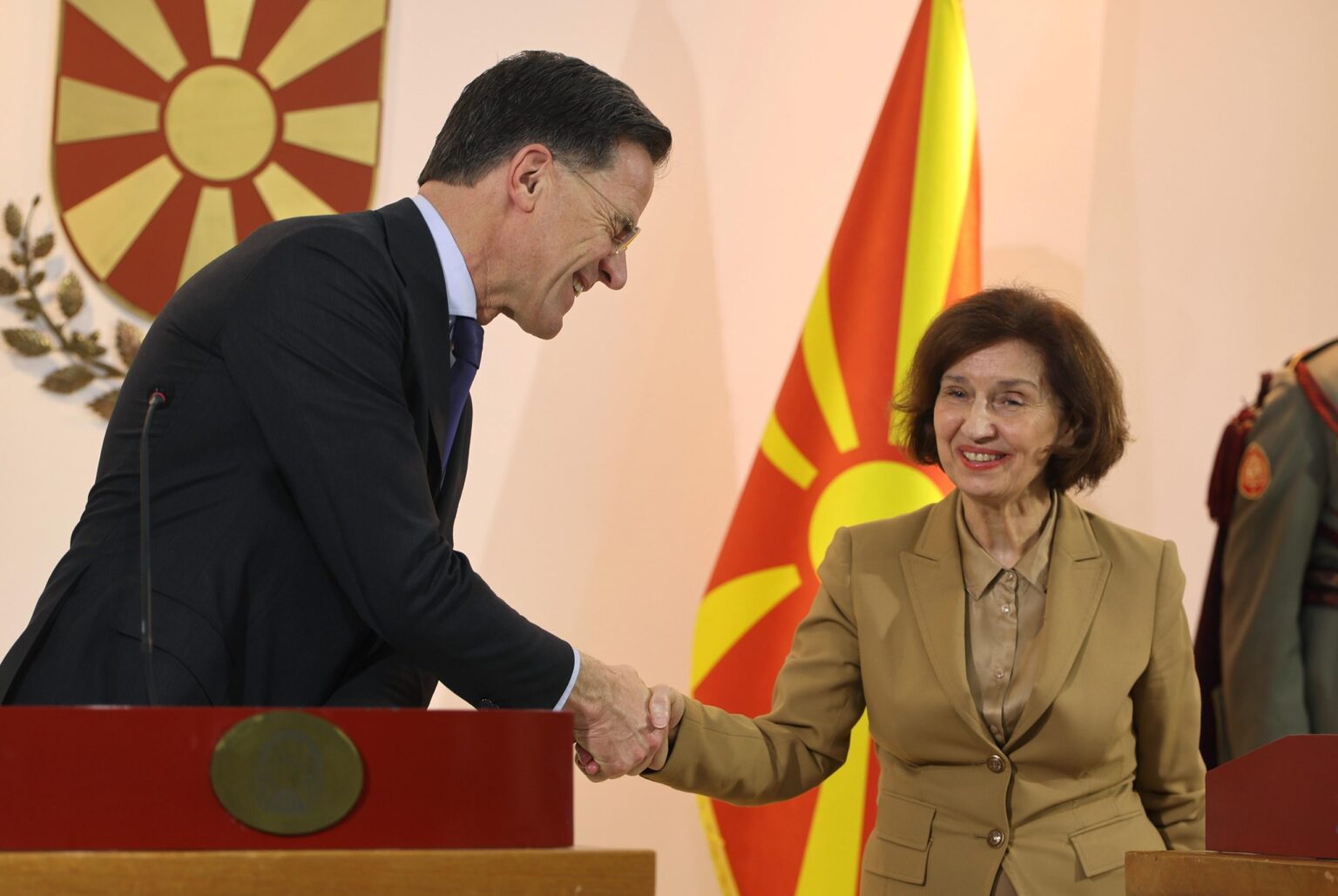
Caption: North Macedonia’s President Gordana Siljanovska Davkova (R) and NATO Secretary General Mark Rutte (L) shake hands after their meeting in Skopje, North Macedonia, 03 March 2026. Rutte is on an official visit to North Macedonia. EPA/GEORGI LICOVSKI
Updated: May 20, 2026 – 12:21