
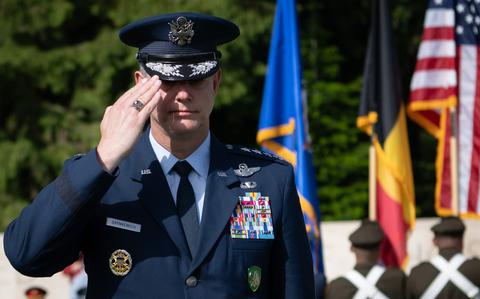
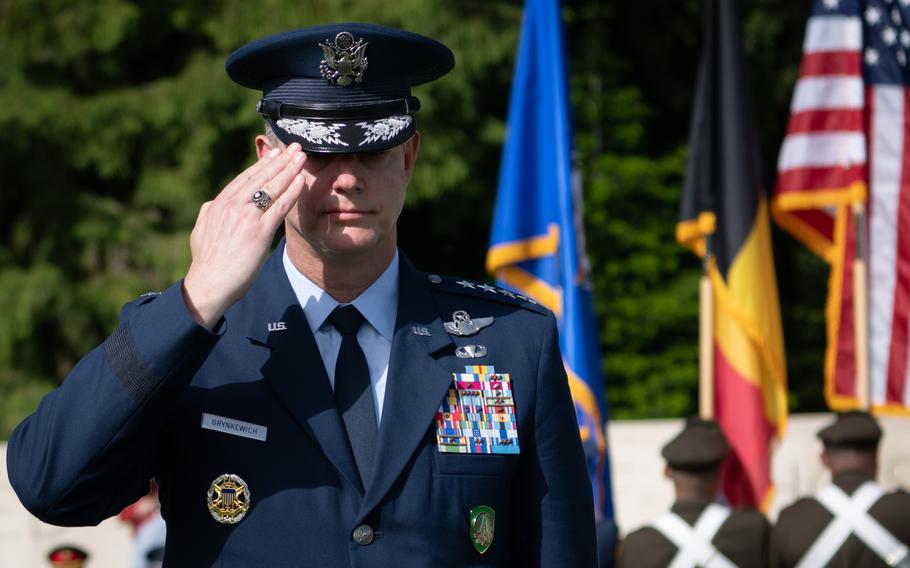
Gen. Alexus Grynkewich, speaking at the Henri-Chapelle American Cemetery in Belgium on Saturday, May 23, 2026, said U.S. history “is not just our history.” (Phillip Walter Wellman/Stars and Stripes)
HENRI-CHAPELLE, Belgium — Americans honoring their war dead should also remember the enduring bond between the United States and Europe, the head of U.S. European Command said Saturday at a Memorial Day ceremony in eastern Belgium.
Gen. Alexus Grynkewich, speaking at the Henri-Chapelle American Cemetery, said U.S. history “is not just our history.”
“We share a common past, one that unified free peoples on both sides of the Atlantic Ocean to defeat tyranny,” Grynkewich said. “That past and that history still connects us today.”
Grynkewich, an Air Force four-star general who also serves as NATO supreme allied commander Europe, was among several American and Belgian officials who spoke at the cemetery, where nearly 8,000 Americans killed in World War II are buried.
Some 20,000 Americans were killed in the Battle of the Bulge, one of the deadliest battles for Americans during the war, which was fought in Belgium and neighboring Luxembourg. More than 1,000 Americans also were killed in Belgium during World War I.
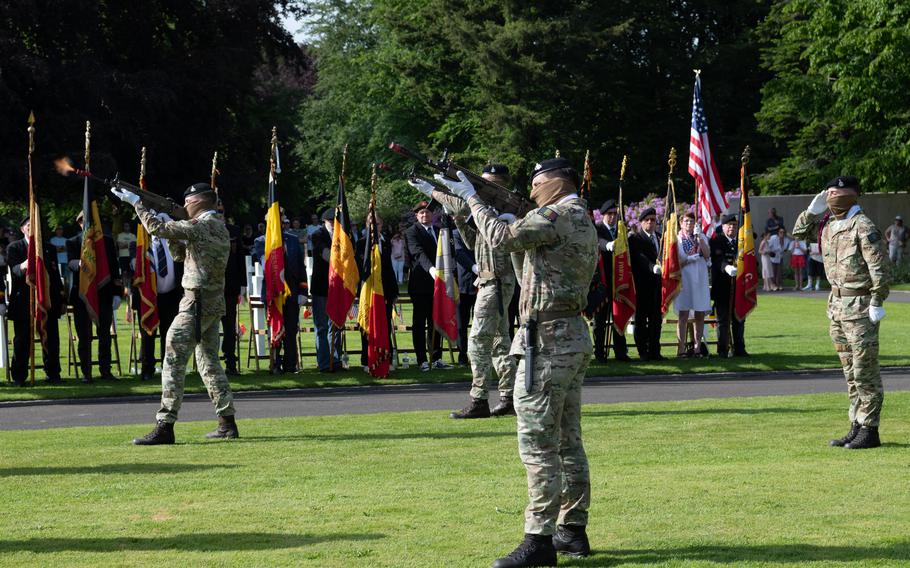
The Belgian Army’s 4th Engineer Battalion performs a volley solute during a U.S. Memorial Day ceremony at Henri-Chapelle American Cemetery in Belgium, May 23, 2026. (Phillip Walter Wellman/Stars and)
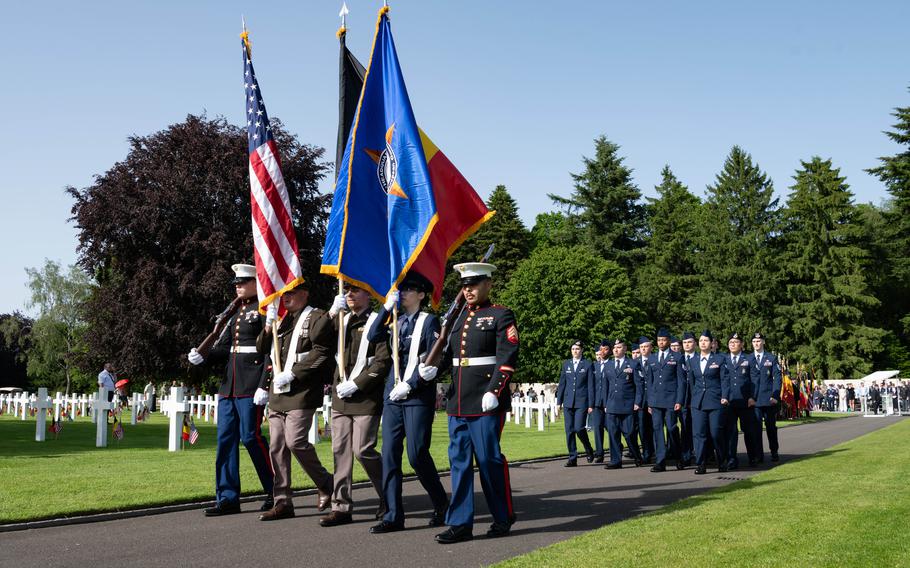
The EUCOM color guard and a 52nd Fighter Wing honor platoon march at a Memorial Day ceremony at Henri-Chapelle American Cemetery in Belgium, May 23, 2026. (Phillip Walter Wellman/Stars and)
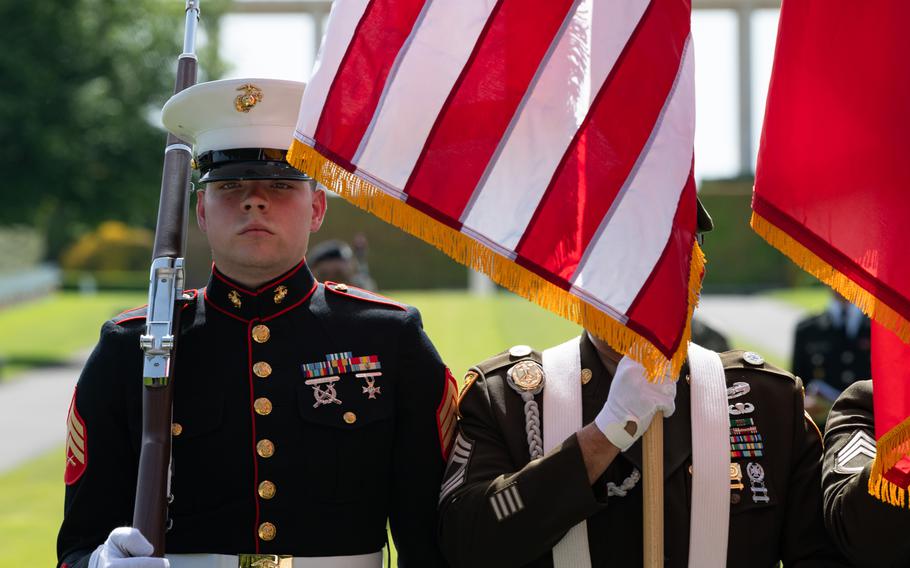
Marine Sgt. Brevyn Nolan, a member of the joint-service EUCOM color guard, participates in a Memorial Day ceremony at Henri-Chapelle American Cemetery in Belgium, May 23, 2026. (Phillip Walter Wellman/Stars and)
“As we remember the American service members laid to rest here on Belgian soil, we should also reflect on our transatlantic bond,” Grynkewich said, describing the bond as “unbreakable.”
Grynkewich’s remarks came amid uncertainty in Europe about the future U.S. military posture on the continent.
President Donald Trump recently said thousands of American troops would be withdrawn from Germany. However, on Thursday, he announced on his Truth Social website that an additional 5,000 troops would be sent to Poland, to the surprise of Polish officials.
The families of 15 service members buried at the Henri-Chapelle cemetery attended Saturday’s ceremony, along with one family whose relative was later repatriated to the United States.
The cemetery is the final resting place for Americans who died during two major campaigns: the U.S. First Army’s advance in September 1944 through northern France, Belgium, the Netherlands and Luxembourg into Germany, and the Battle of the Bulge.
“To all of them, to those who lie here, and to those who never came home, we say: ‘Belgium will never forget,’ ” Gen. Frederik Vansina, Belgium’s chief of defense, told attendees. “We remember not only their sacrifice, but the values for which they stood: freedom, democracy, and solidarity among nations.”
Marine Sgt. Brevyn Nolan, a member of the joint-service EUCOM color guard, participates in a Memorial Day ceremony at Henri-Chapelle American Cemetery in Belgium, May 23, 2026. (Phillip Walter Wellman/Stars and)
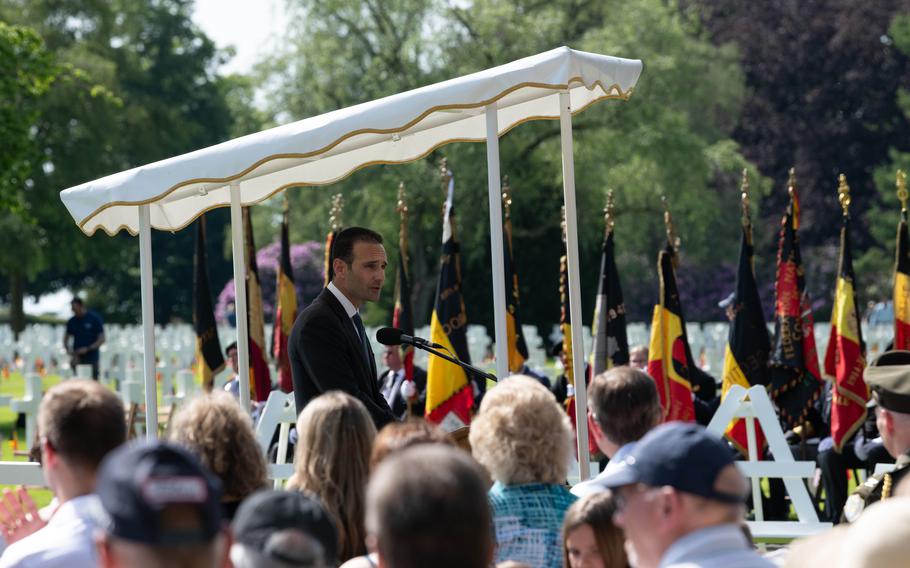
David Americo, chief of cemetery operations at the American Battle Monuments Commission, speaks at a Memorial Day ceremony at Henri-Chapelle American Cemetery in Belgium, May 23, 2026. (Phillip Walter Wellman/Stars and)
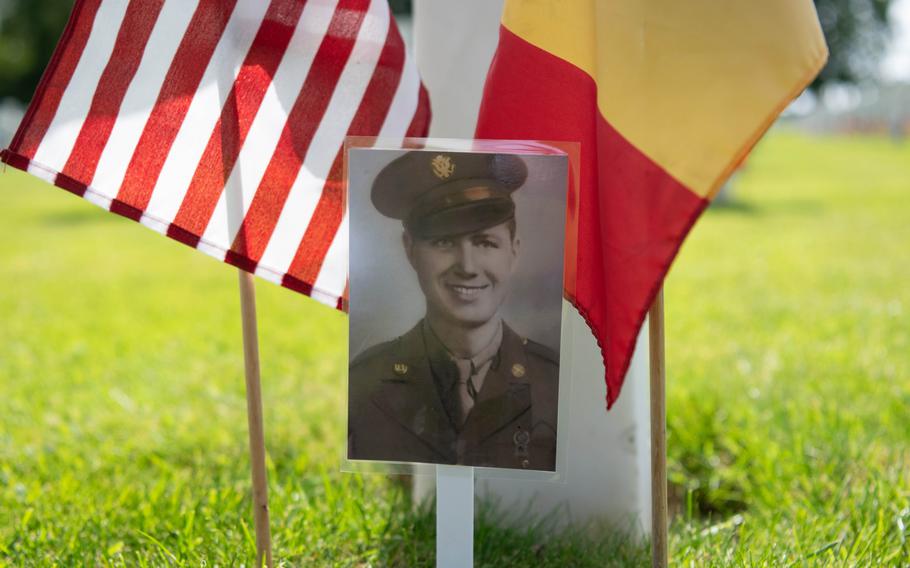
A photograph of Army Pfc. Dee L. Martin, who was killed on Dec. 21, 1944, stands next to his grave at Henri-Chapelle American Cemetery, along with a U.S. and Belgian flag on May 23, 2026. (Phillip Walter Wellman/Stars and)
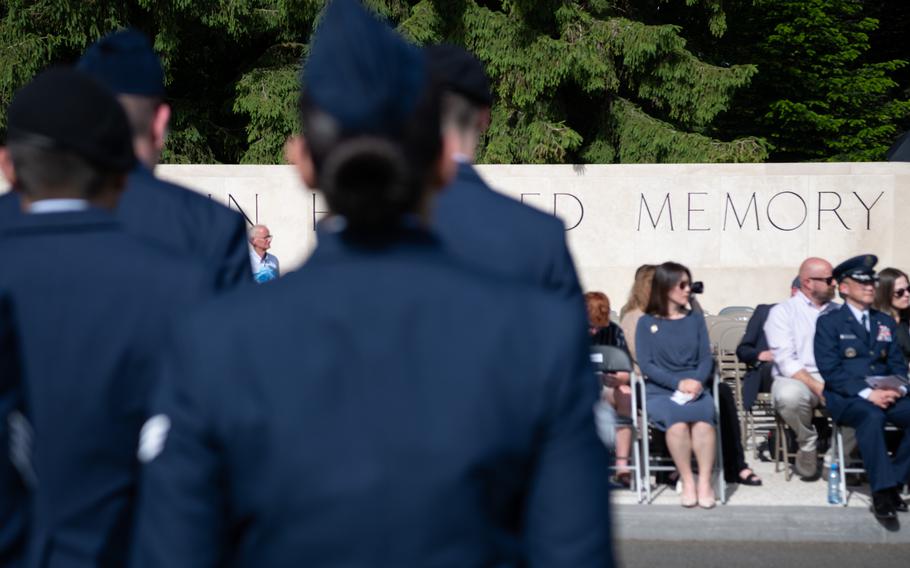
An honor platoon comprised of airmen of the 52nd Fighter Wing, based at Spangdahlem Air Base, in Germany, stood at formation during a Memorial Day ceremony at at Henri-Chapelle American Cemetery in Belgium, May 23, 2026. Nearly 8,000 American World War II troops are buried at the cemetery. (Phillip Walter Wellman/Stars and)
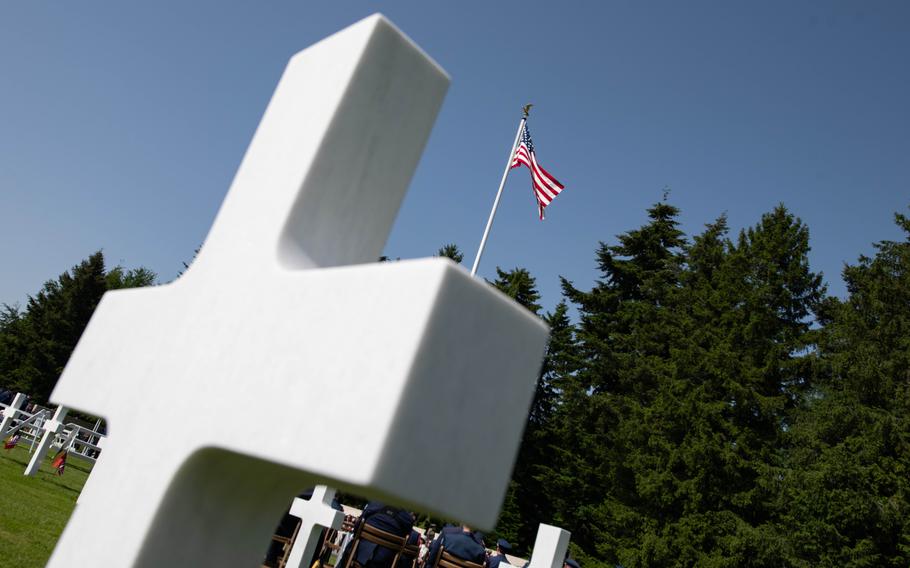
The U.S. flag towers over the headstones of Henri-Chapelle American Cemetery in Belgium, May 23, 2026. Nearly 8,000 Americans who died in World War II are buried at the cemetery. (Phillip Walter Wellman/Stars and)
“It is our duty not only to remember, but to be worthy of their sacrifice,” Vansina added.
Yves Trillet, of Soumagne, Belgium, attended the ceremony with his wife and their three young children.
“It’s very important to show this to the new generation,” Trillet said. “We are lucky to be living now, and it’s possible because many people died for the freedom of our country.”
One of those buried at the cemetery is Capt. Victor H. Briggs, who landed on Omaha Beach in Normandy on D-Day, June 6, 1944, and was awarded the Distinguished Service Cross for leading his men across a deadly minefield after storming the beach.
In November that year, after helping U.S. forces push into Germany, Briggs came under Nazi fire and was killed. He was 24.
“Let us never forget that the freedoms we enjoy today — the right to speak freely, to worship as we choose, to live without fear — were won by Americans like Capt. Victor Briggs, who crossed an ocean to fight for people they had never met, in a land they had never seen, for a cause greater than themselves,” U.S. Ambassador to Belgium Bill White said.
“Their sacrifice was not in vain,” White added. “Their memory lives on, and our gratitude is eternal.”