
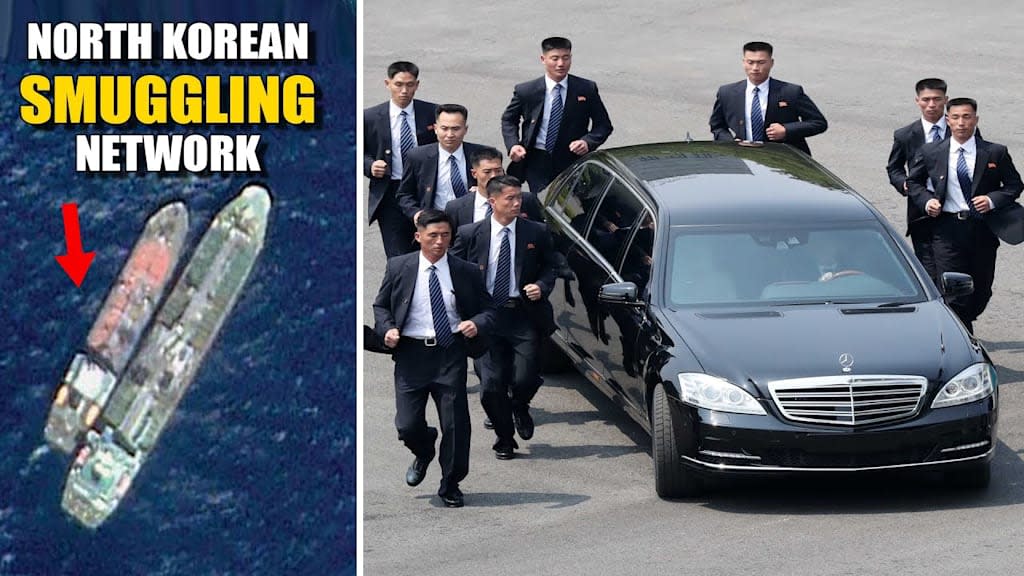
How This ship is Secretly Smuggling Luxury Cars in
During the investigation of a high-profile case, it was noticed that a container ship departed from a South Korean port heading toward a Russian port. However, midway through its journey, the ship suddenly disappeared from radar.
Now, if you think the ship was hijacked or attacked, that’s not the case at all. This was actually a high-level smuggling operation, and the ship was deliberately made to disappear.
As we all know, many countries—especially the United States—have imposed strict sanctions on North Korea. This means most countries are not allowed to trade with North Korea. These sanctions are believed to be due to North Korea’s nuclear weapons program, but in reality, the strict and aggressive behavior of its leader is also a major reason.
Kim Jong Un, the leader of North Korea, lives a life of extreme luxury. From Swiss watches to private yachts, he owns everything. Despite sanctions preventing imports of luxury goods, he still manages to acquire them. For example, he owns high-end luxury vehicles like armored Mercedes-Maybach models, which are bulletproof and equipped with top-level presidential features.
But the big question is: how does North Korea import such luxury items despite global sanctions? And which companies are bold enough to sell to a sanctioned country?
It turns out North Korea uses extremely sophisticated smuggling networks.
Take the case of Mercedes-Maybach cars. These are manufactured in Germany. When the company was asked how their vehicles ended up in North Korea, they claimed they had no records of such sales. Even the company’s management was puzzled.
After years of investigation, the truth finally came out.
The journey of these cars started in Rotterdam, Netherlands. Records showed that the cars were packed in sealed containers and shipped on June 28, 2018. They were transported via a Chinese shipping company and reached the port of Dalian, China, after 41 days.
The containers stayed there for some time, and on August 26, they were loaded onto another ship and sent to Osaka, Japan. From there, they were transferred again and sent to Busan, South Korea.
Up to this point, everything seemed normal.
But things started to get suspicious afterward.
From South Korea, the containers were loaded onto a ship named DN5505. On October 1, it departed for a Russian port. The journey was expected to take about five days.
However, just one day into the trip, the ship suddenly disappeared from radar.
After 18 days, the ship reappeared—but now it was heading back to South Korea. This time, it was carrying 2,500 tons of coal instead of the original containers.
So what happened to the containers?
According to ship officials, the containers were unloaded in Russia, and coal was loaded there. But when investigators checked Russian port records, there was no entry of this ship at all.
This meant the ship never officially reached Russia.
Something was clearly wrong.
Further investigation revealed that the ship’s ownership had been transferred during its journey. It was bought by a company called Do Young Shipping, linked to a Russian businessman. The company was registered in the Marshall Islands but operated under the flag of Togo—clearly a setup designed to confuse investigators.
Then came a major clue.
Three days after the ship was supposed to arrive in Russia, North Korean military cargo planes landed in Vladivostok, Russia. These aircraft are only used for heavy cargo transport.
There was no official record of what they carried.
Coincidentally, the businessman connected to the ship was also based in Vladivostok.
Everything started to make sense: the luxury cars had likely been transferred secretly at sea or through unofficial channels, then flown into North Korea.
Although there’s no direct proof, the pattern strongly suggests a well-planned smuggling operation.
And this is just about cars.
North Korea also smuggles oil using similar methods.
In one investigation by the United Nations and The New York Times, a ship named Diamond 8 was tracked. Satellite data showed it receiving oil from other ships in the middle of the sea—far from any port.
Ships like “Super Star” and “Ever Grandeur” were involved in these transfers.
After loading oil, Diamond 8 avoided ports and moved around the sea before eventually heading toward North Korea. Near the coast, it turned off its radar system for several days, effectively disappearing.
Satellite imagery later confirmed it was at a North Korean port.
This wasn’t a one-time event. In 2020 alone, Diamond 8 was seen visiting North Korea multiple times.
The ownership of this ship was also suspicious. It was linked to multiple companies and eventually traced to an Indonesian man who claimed to be a retired sailor with limited financial means—yet records showed he owned a vessel worth $1.5 million.
Clearly, he was just a front.
All of this shows that despite international sanctions, North Korea has developed highly complex and secretive smuggling networks that are extremely difficult to stop.