
In today’s hyper-analytical footballing world, a 3-0 victory is often hailed as a masterclass. Managers armed with tablets analyze heat maps, deploy sophisticated “low blocks,” and orchestrate pressing traps. Defenses are drilled to absolute perfection, and the margin for error is razor-thin.
But rewind the clock a few decades, and the World Cup was an entirely different beast. It was a romantic, chaotic, and defensively oblivious era where teams stepped onto the pitch with one singular, reckless instruction: score more than the other guys. Welcome to “Beyond the Scoreline” a nostalgic look at the untouchable scorelines of football history—a time of 10-1 blowouts, 12-goal thrillers, and a beautiful madness we will likely never see on the global stage again.
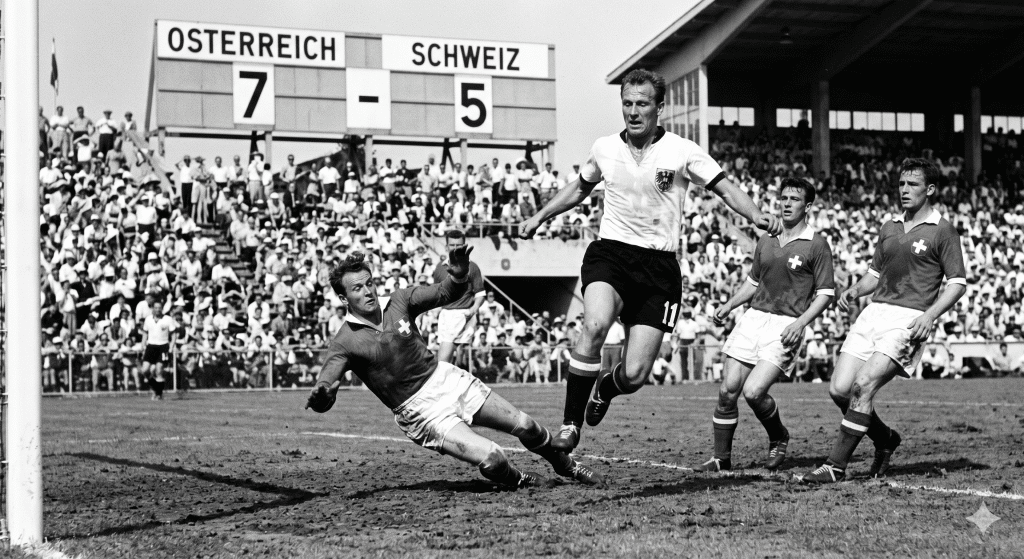
The 12-Goal Inferno: Austria vs. Switzerland (1954)
If there is one tournament that defines the era of nonexistent defensive tactics, it’s the 1954 World Cup in Switzerland. The absolute pinnacle of this offensive anarchy took place in Lausanne during a quarter-final clash between Austria and host nation Switzerland.
Played during a sweltering 104°F (40°C) heatwave, the match—forever known as the Hitzeschlacht von Lausanne (The Heat Battle of Lausanne)—ended in a mind-boggling 7-5 victory for Austria.
The Madness by the Numbers:
- 12 Goals: The highest-scoring match in World Cup history.
- A 4-Minute Blitz: Switzerland shocked the Austrians by jumping to a 3-0 lead in a span of just four minutes (16′, 17′, 19′).
- 3 Goals in 3 Minutes: Refusing to fold, Austria launched a legendary comeback, scoring three times in just three minutes (25′, 26′, 27′) to instantly tie the game at 3-3.
- The 11-Minute Hurricane: Between the 16th and 27th minutes, an unfathomable six goals were scored.
- The Highest-Scoring Half: The teams went into the locker room with the score at 5-4 in favor of Austria, making it the highest-scoring single half in tournament history.
With no substitutions allowed, players on both sides were practically melting. Austrian goalkeeper Kurt Schmied even suffered from severe hyperthermia early in the match, which contributed to the early Swiss onslaught before he was revived by the team masseur while play continued! The concept of “parking the bus” simply didn’t exist; it was end-to-end, sun-baked warfare.
The Double-Digit Demolition: Hungary 10-1 El Salvador (1982)
While the 1950s were known for high scores, breaking the double-digit barrier in a modern-era World Cup seemed impossible. Enter Hungary in 1982.
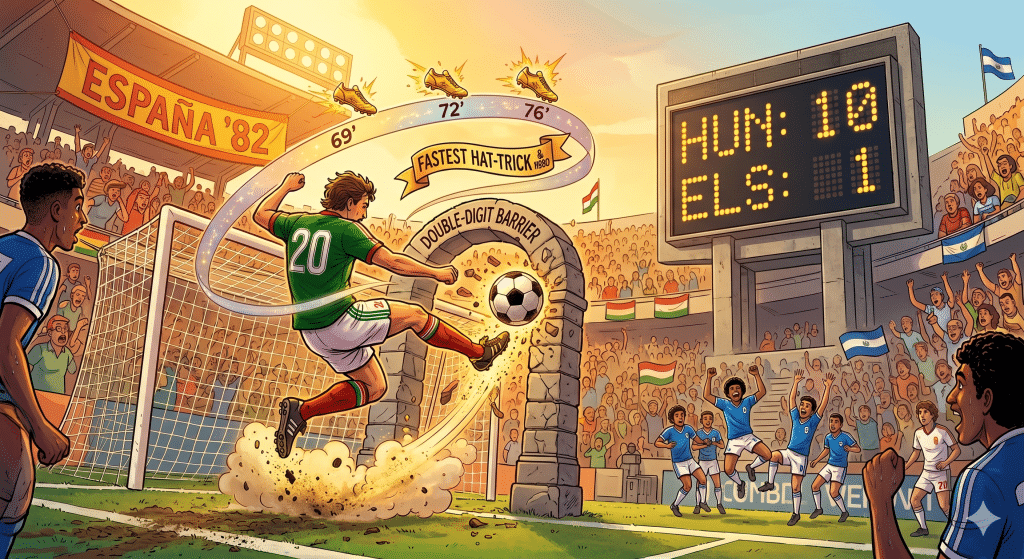
Facing El Salvador in the group stages in Spain, the Hungarians orchestrated the most ruthless attacking display the tournament has ever witnessed, culminating in a 10-1 massacre.
The undisputed star of the show was Hungarian striker László Kiss. Coming off the bench in the 55th minute, Kiss achieved two historic feats that still stand today:
- The Fastest Hat-Trick: He scored three goals in just seven minutes (69′, 72′, 76′).
- The Substitute Hero: He remains the only substitute to score a hat-trick in a World Cup match.
El Salvador’s solitary goal was celebrated wildly by their players, a brief moment of joy amidst a historic collapse.
The 9-0 Club: A Brutal Benchmark
If 10 goals feels like a video game on the easiest difficulty setting, the 9-0 scoreline is its slightly more common cousin. Only three times in men’s World Cup history has a team won by a nine-goal margin, and two of them perfectly encapsulate the talent gap of the bygone eras:
- Hungary 9-0 South Korea (1954): The legendary Magical Magyars, featuring Ferenc Puskás and Sándor Kocsis, dismantled a South Korean team that had traveled for days just to reach the tournament, arriving exhausted and tactically outmatched.
- Yugoslavia 9-0 Zaire (1974): Yugoslavia ruthlessly picked apart Zaire (now DR Congo). Zaire’s players were dealing with internal unrest, unpaid bonuses, and immense political pressure back home, resulting in a disorganized collapse on the pitch.
(Note: Spain also defeated Tahiti 10-0 in the 2013 Confederations Cup, but the World Cup record remains capped at these historic 9-0 and 10-1 margins).
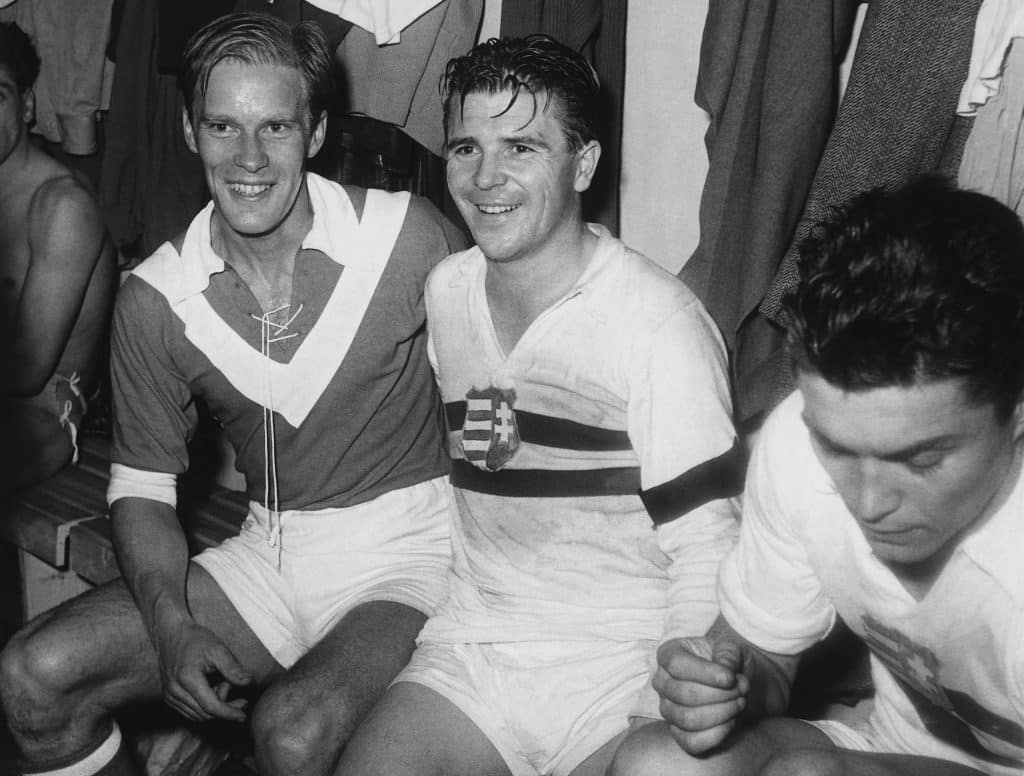 (Photo by Fritz Fischer/picture alliance via Getty Images)
Why the Goal Fest is Gone Forever
Will we ever see a team hit 10 goals in a World Cup match again? Almost certainly not. Here is why the golden age of double-digit scorelines is firmly in the rearview mirror:
- The Professionalization Gap: In 1954 or 1982, the gap between heavyweights and minnows was astronomical. Part-time amateurs frequently faced full-time legends. Today, global scouting networks and academies mean even the lowest-ranked nations boast players competing in professional European leagues.
- Tactical Evolution: Football has shifted from man-to-man marking and heavy attacking formations (like the old 2-3-5) to compact, zonal defending. Modern coaches prioritize defensive solidity; a contemporary underdog will deploy a rigid 5-4-1 formation, making it mathematically agonizing to find open space.
- Elite Athleticism: Modern players are supreme athletes capable of pressing for 90 minutes. The fatigue that once led to late-game defensive collapses is largely mitigated by elite sports science, nutrition, and the introduction of five substitutions.
We can marvel at the tactical sophistication of modern powerhouses like Manchester City or PSG, but there will always be a special place in footballing folklore for the days when defenses were optional, and the scoreboard simply couldn’t keep up.
Check out