
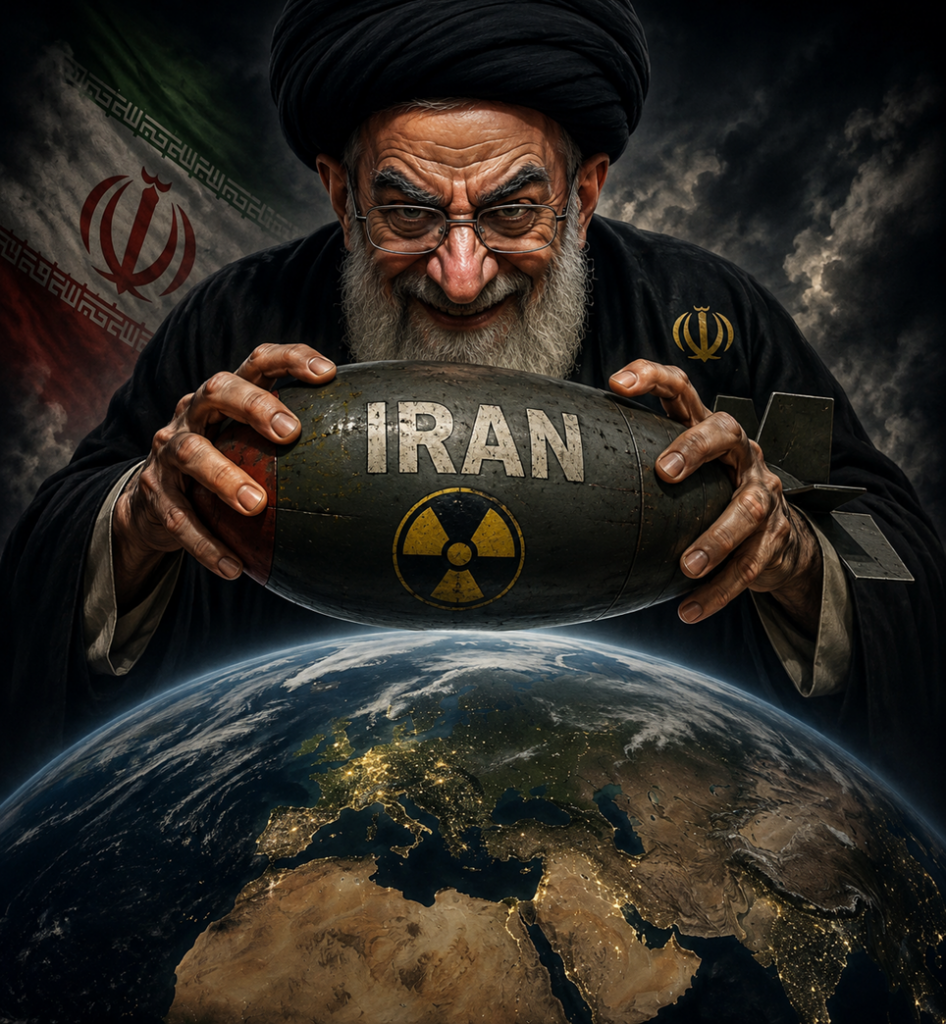
The proposed settlement now taking shape between Washington and Tehran is being sold as a triumph of diplomacy. President Trump claims the agreement is “largely negotiated.” Iranian officials hint at compromise. Oil markets are already breathing easier at the possibility that the Strait of Hormuz could reopen fully. But beneath the optimistic headlines lies a deeply uncomfortable reality: this deal appears built on assumptions, estimates, and wishful thinking rather than hard verification.
And if those assumptions are wrong, the consequences may be catastrophic.

The disappearing supreme leader of Iran. (AI generated image)
The central issue is not whether Iran is prepared to surrender some of its stockpile of highly enriched uranium. The real issue is whether anyone outside Iran actually knows how much uranium exists in the first place.
Current discussions revolve around Iran’s reported stockpile of roughly 440 kilograms of uranium enriched to 60 percent purity — material perilously close to weapons grade. Some reports suggest Iran has tentatively agreed to relinquish this material as part of a broader settlement. Yet other reports emerging from Tehran directly contradict those claims, with Iranian officials insisting no such agreement has been finalized and that the nuclear question has effectively been postponed to future negotiations.
That contradiction alone should alarm anyone paying attention.
This is not merely a technical disagreement between negotiators. It strikes at the heart of whether the proposed settlement has any meaningful value at all. If Iran’s nuclear inventory is uncertain, then any promise to surrender “the stockpile” becomes almost meaningless. One cannot verify the surrender of material whose true quantity is unknown.
Supporters of the agreement argue that international inspectors and intelligence agencies have reasonably accurate estimates. But “estimate” is precisely the problem. Iran’s nuclear program has spent decades wrapped in secrecy, concealment, obstruction, and outright deception. Facilities have repeatedly been hidden until exposed by outside intelligence. Inspection access has often been delayed or restricted. Data provided to inspectors has depended heavily on declarations from the Iranian authorities themselves – authorities with every incentive to minimize, obscure, or compartmentalize sensitive information.
Even independent nuclear monitoring organizations acknowledge the uncertainty. The World Nuclear Association repeatedly uses wishy-washy language when describing Iran’s capabilities: “estimated,” “reported,” “declared,” “apparent,” and “calculated.” That hedging is not accidental. It reflects a basic reality: nobody truly possesses complete visibility into Iran’s nuclear infrastructure.
That uncertainty becomes terrifying when one considers how little material is actually needed to preserve a future breakout capability. A hidden reserve of even 50 to 100 kilograms of 60 percent enriched uranium could dramatically shorten the timeline required for final enrichment to weapons-grade levels. Some analysts argue that surprisingly modest quantities could support crude nuclear device construction.
This means the proposed deal may not eliminate the threat at all. It may simply create the illusion that the threat has been removed.
And illusions are dangerous in international politics.
The timing of the negotiations only deepens the concern. Iran enters these talks economically battered but strategically resilient. The war has damaged infrastructure and strained domestic stability, yet Tehran has also learned valuable lessons. The disruption of the Strait of Hormuz demonstrated how effectively Iran can threaten global markets without possessing a nuclear weapon.
That experience changes the strategic equation. Iran no longer needs an immediate nuclear arsenal to exert leverage. It only needs to preserve the option of one while rebuilding economically under sanctions relief.
That is why the apparent disappearance of ballistic missile restrictions from the core negotiations is so troubling. Earlier American demands reportedly included severe limits on Iran’s missile program alongside nuclear concessions. Yet recent reporting suggests the focus has narrowed dramatically toward ceasefire arrangements, sanctions relief, Hormuz shipping, and “temporary nuclear understandings”.
In effect, the negotiations risk rewarding Iran before the most dangerous questions have actually been answered.
There is also a broader historical problem here. Advocates of engagement continue to treat Iranian noncompliance as a solvable diplomatic inconvenience rather than as a deliberate strategic doctrine. The 2015 nuclear agreement was similarly presented as a mechanism to permanently restrain Tehran’s ambitions. It was a classic case of “kicking the can down the road”, leaving the resultant mess for someone else to clean up. But instead, it bought time, injected resources into the Iranian economy, and left major uncertainties unresolved. Critics warned at the time that sunset clauses, incomplete inspections, and unverifiable declarations would eventually weaken the agreement’s deterrent value. Many of those warnings now appear prescient.
Today’s proposed settlement risks repeating the same mistake under even more dangerous conditions.
Worse still, the political incentives surrounding the negotiations actively discourage skepticism. Washington wants de-escalation. Europe desperately wants energy stability. Markets want calm. Regional mediators want the war to end. All sides are heavily invested in declaring success.
But diplomacy driven primarily by exhaustion and economic anxiety often produces fragile agreements built on selective blindness.
The uncomfortable truth is that no settlement with Iran can be credible unless it resolves three fundamental questions with complete transparency:
- How much enriched uranium actually exists?
- Where is all of it located?
- Who independently verifies every gram?
At present, there is no convincing evidence that negotiators possess definitive answers to any of those questions.
Instead, the world appears anxious to accept a framework based on assumptions, partial disclosures, delayed negotiations, and political optimism. That may temporarily reduce tensions. It may reopen shipping lanes. It may lower oil prices. But temporary calm is not the same as long-term security.
If hidden stockpiles remain untouched, if enrichment capability survives intact, and if missile development quietly continues in parallel, then this agreement will not prevent a nuclear crisis. It will merely postpone it – while giving Iran time, money, legitimacy, and strategic breathing room.
And history suggests that postponed crises often return far more dangerous than before. If all of this is even remotely possible, woe to the world!
Born 1945 in South Africa, part of a “traditional” Jewish family with strong roots in Jewish culture, Zionism, and knowledge of Israel. Henry has a criminal record, having been arrested, tried and convicted for anti-apartheid actions, of which he is proud. He made “aliya” twice – to Australia for 25 years, and 27 years ago to Israel. He has been writing both privately and for pay about a wide range of subjects including finance, technology and medicine for more than 60 years.