
Minnesota has no shortage of talent. It’s home to the second most-educated workforce in the country, as measured by workers with some level of post-secondary education. Trouble is, thousands of high achievers head out of state after high school, college or graduate school, and the number of professionals who move to Minnesota from other states is not enough to replenish their ranks, creating a net loss in 20 of the past 25 years.
With births and immigration also slowing, the state’s workforce is expected to grow by just 55,000 people over the next decade — an average annual growth rate of .2%, putting Minnesota in the bottom third of the nation in that category.
“The state has strong assets,” reads the latest report from the Minnesota Chamber Foundation, which has long sounded an alarm over the “net domestic outmigration” of labor, mostly to neighboring and Sunbelt states. “With slower natural population growth, Minnesota must compete more aggressively to retain and attract talent.”
Labor supply is just one key challenge for Minnesota in the years ahead. The state’s diverse private sector economy continues to expand, according to the foundation, but that growth is relatively sluggish, revealing trouble spots that are especially concerning in light of inflation, uneven investment and demographic trends.
The Minnesota Chamber Foundation’s report, “Minnesota’s Economic Imperative: A Blueprint for Growth,” finds that from 2019 to 2025, the state ranked 38th in gross domestic product per capita growth, 33rd in labor force growth and 41st in net domestic migration. “This means Minnesota has assets for growth but isn’t turning them into results,” it reads. Still, “Minnesota’s economy is not in decline. It continues to grow, supported by strong underlying fundamentals.”
“Minnesota has a strong base of businesses, but the pace of new investment and innovation has slowed in recent years, and that matters for both employers and employees,” the report reads.
The chamber report lists 10 ways the state could promote investment and innovation, further develop Minnesota’s workforce and retain and attract top talent in order to reach 2% in annual GDP growth per capita.
Growing the economy at 2% instead of 1% might sound like a modest increase, but it would amount to annual growth of nearly $18,500 per person within 20 years, or more than $32,000 per year within 30 years, putting Minnesota in the top quartile of all states for growth.
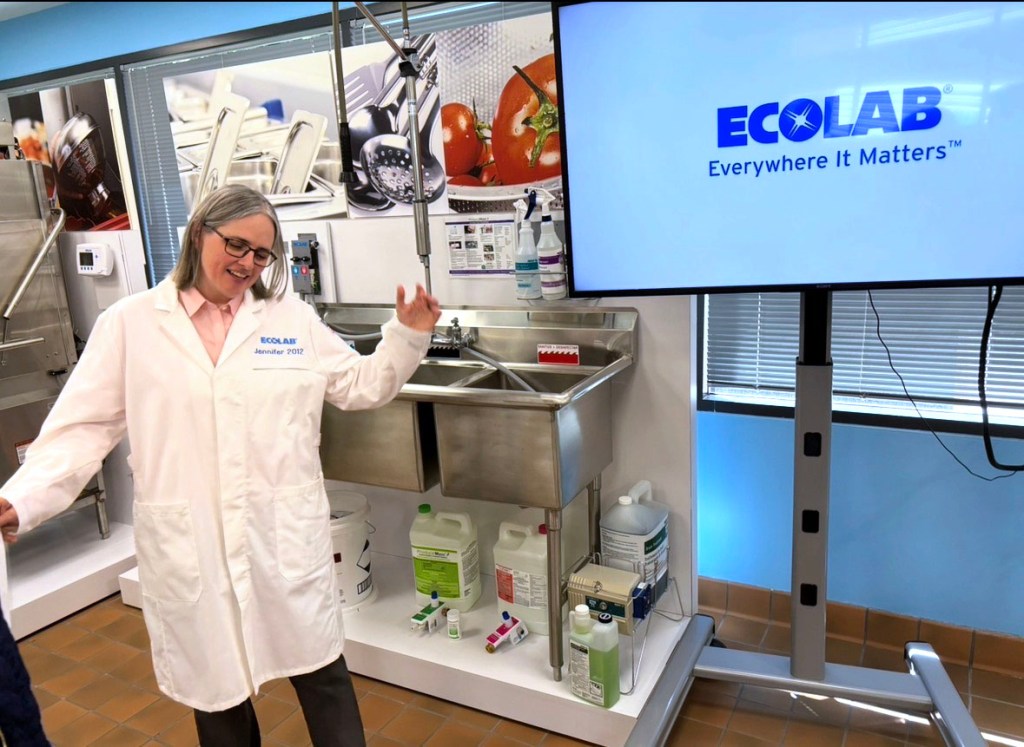
“Our goal is to double our economic growth,” said Doug Loon, presenting findings from the foundation report to a roomful of executives during a business forum held at Ecolab’s Eagan facilities this month.
“Minnesota has long led in innovation … productivity and prosperity, but our economy is no longer keeping pace with the nation,” said Loon, who will retire at the end of the year as the longstanding president and chief executive officer of the Minnesota Chamber of Commerce. “We want Minnesota to succeed, and we want Minnesota businesses to thrive and grow, and do that right here in Minnesota.”
Investment and innovation
Sean O’Neil, the foundation’s senior director of economic development and research, noted Minnesota ranks 45th in the growth of non-residential construction spending and 47th in startup job creation. It does well in the area of total research and development, thanks to the presence of companies like Ecolab and 3M, but it ranks 47th for growth in that area, meaning “Minnesota isn’t expanding on its strong foundation.”
In the healthcare sector in particular, “we have more companies that are headquartered here investing elsewhere,” said O’Neil, compared to “what we’re attracting into the state from companies that are headquartered outside of Minnesota. From kind of a deal-flow, capital investment perspective, we’re losing more than we’re gaining.”
“Overall investment, overall innovation levels have not been growing very much in recent years,” he added. “We’re going to need more companies that are investing in their operations here, that are building facilities, that are expanding, companies that are deploying new technologies, that are investing in productivity.”
O’Neil said focus groups and surveys reveal a general sentiment among business leaders that the state lacks a clear, consistent plan for economic growth so businesses know what to expect when they consider investing in Minnesota. The foundation report suggests streamlining state processes around environmental permitting and reviews, incentive programs, shovel-ready site readiness and workforce training.
Air permits, for instance, take 1 1/2 to 6 times longer to advance in Minnesota than in peer states, O’Neil said, though there’s been some “early signs of progress.”
The report also suggests updating the state’s tax structure; intentionally focusing on industries where Minnesota has a competitive edge for “a more coordinated, sector-driven approach;” and enhancing access to capital, technical assistance and growth-oriented resources for startups and startup expansions.
Skill development for Minnesota’s talent pool
On top of some concerns regarding sagging test scores at the K-12 level, the foundation report calls for a “shift to an employer-centered workforce system focused on talent development.”
Partnerships could expand applied learning opportunities between businesses and schools at both the K-12 and higher education levels, creating new avenues for internships, apprenticeships and other opportunities for on-the-job training. Georgia and Virginia, O’Neil noted, have created training centers to prepare workers for specific roles needed by new employers.
“We can’t just think about perpetually only increasing education levels,” O’Neil said. “At a certain point, we have to think about the quality and alignment of our education to the jobs that are being created in the economy, and to having the kind of workforce systems that allow people to access highly productive jobs.”
O’Neil said many workforce systems are focused on job placement, rather than skill development for existing workers. “We need more transparency around the programs that exist,” O’Neil said. “What really works? What are the programs that deliver a high return on investment? Shift some of the focus from job placement to upskilling and reskilling activities that directly involve employers.”
Talent retention and attraction
Nearly three out of four Minnesotans have some level of post-secondary education, making the state one of the best educated in the nation. That talent, however, doesn’t necessarily stick around. From 2020 to 2025, net domestic migration was negative, for a loss of 37,202 working-age adults, a number barely offset by natural population growth.
As a result, Minnesota ranked 33rd in the nation around the same time for workforce growth and 41st in the nation for domestic migration.
“Our largest net losses, in terms of domestic migration, is among high school grads,” O’Neil said. “That’s our future workforce. … We’ve had more people leaving than moving into Minnesota. … Our retention rate is not too bad. The problem is we’re toward the bottom of attracting people from other states.”
Those numbers have deep impacts on everything from city population growth to real estate. “We’re 48th, in the first half of this decade, in building new housing,” O’Neil noted. “The size of our workforce has been plateauing.”
To draw workers, O’Neil said the state needs to move beyond statewide marketing campaigns. The report recommends expanding housing supply to support both population growth and affordability, further study of whether tax policy impacts migration, leveraging higher education to attract and retain young talent through clearer paths into local careers, and strengthening “legal immigration pathways and integration efforts,” such as improving transitions from education to employment for international students.
While it’s not entirely clear how much taxes influence migration, “the bottom 15 states that are losing more people than they’re gaining are the bottom 15 states in terms of tax competitiveness,” O’Neil said. “Minnesota is unfortunately in both lists.”