
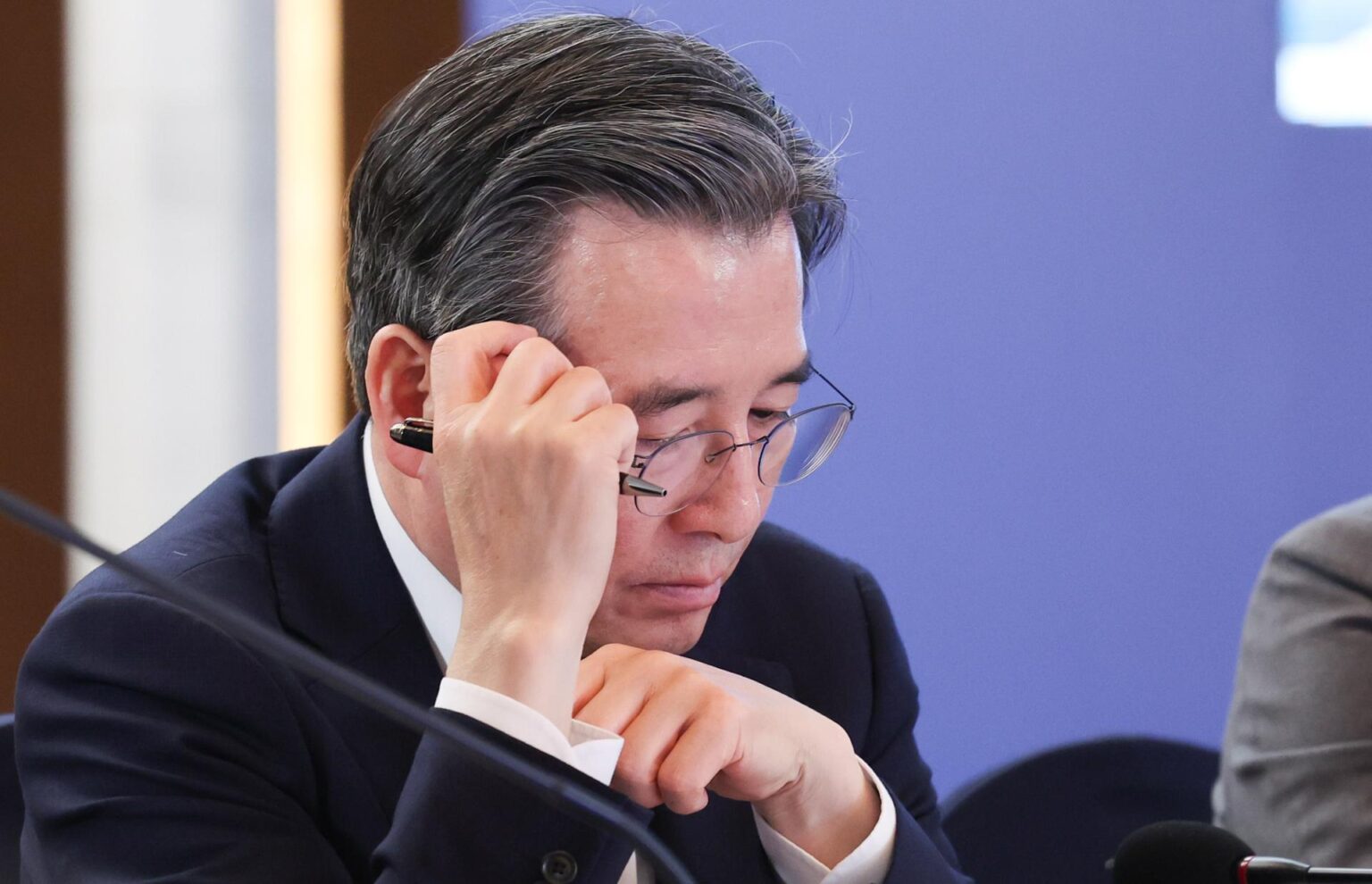
Kim Yong-beom, presidential chief of staff for policy, attends a meeting on visions for the shipbuilding industry chaired by President Lee Jae Myung at a hotel in Ulsan, May 13. Yonhap
The presidential policy adviser assessed that the Korean economy is taking a leap forward, brushing aside concerns over a triple burden of costly borrowing rates, high prices and a weak Korean won, calling them instead the “cost of success.”
In a Facebook post titled “The cost of success,” Saturday, Kim Yong-beom, presidential chief of staff for policy, said these three factors are not “a precursor to crisis, but friction emerging as the Korean economy enters a new phase.”
“While corporate performance is at an all-time high, interest rates and the exchange rate are rising, and housing prices are starting to heat up again, with markets and the media raising concerns about a crisis,” he said.
“The problem lies not in the economy itself, but in the framework through which it is perceived,” he added.
Kim’s post came as the lower bound of fixed mortgage rates at major commercial banks bounced back above 5 percent, while the benchmark interest rate remains unchanged at 2.5 percent since May last year.
The Korean won is weakening against the U.S. dollar, with the exchange rate breaching the worrisome 1,500 won level per dollar repeatedly this month.
Consumer prices also rose 4.6 percent in April from a year earlier, rising at the steepest pace in 21 months due to global oil risk.
Meanwhile, Korea’s current account surplus reached $37.33 billion in March, marking back-to-back record highs after a $23.19 billion surplus in February and extending its surplus streak to 35 consecutive months.
Kim said the country’s nominal economic growth is approaching 10 percent, highlighting that a virtuous cycle is emerging, driven by strong exports led by the semiconductor and artificial intelligence industries as well as improving corporate earnings, with corporate profits, wages and asset prices all rising together.
The policy chief went on to explain that adverse economic factors are “not a sign of weakness in the Korean economy, but a paradoxical outcome of its success.”
Kim, nevertheless, acknowledged that rising interest and exchange rates require careful management, stressing the need to ensure financial conditions do not outpace economic fundamentals or disproportionately harm vulnerable groups.
He called for comprehensive policy measures to address inflation and housing market risks, including supply expansion and stronger demand management.