The current worsening situation in the Sahel necessitates the search for a new security strategy. Terrorism, organized crime, separatism, and political instability require special attention in the face of these threats and challenges that hinder its socio-economic and political development. The intervention of external actors in recent years has worsened the situation by creating new problems.
The withdrawal of support from France, the European Union, the U.S., and the UN peacekeeping forces creates a vacuum that is now impossible to fill through the conjunction of the FDS and the Russian militiamen of the Africa Corps, successors of the Wagner Group. Despite the constant increase in the purchase of offensive equipment, especially surveillance and bombing drones, the elite units of the AES are unable to capitalize on their theoretical superiority in armament.
Combination of powers
All of this makes a new strategy for the Sahel necessary, and that is where an external actor has burst onto the scene with great force: Turkey has spent years consolidating its position as one of the regional powers with the strongest presence, capitalizing on the vacuum left by France while discreetly competing with China and Russia.
Turkey uses an approach that combines “soft power,” such as humanitarian aid or religious ties, with “hard power,” such as military cooperation or arms sales. In the case of the Sahel, Turkish contributions in defense have remained at the same level as before, training elite units, as well as ensuring the logistical support and necessary training for the operation of drones. SADAT—one of Turkey’s largest private military companies—could become a competitor to Russian security interests in Africa.
Through its economic, religious, diplomatic, educational, industrial, and military power instruments, Turkey is closing a series of commercial agreements that, although kept discreet, prepare the ground for achieving much larger objectives, competing with Russia, and collaterally with China.
Bayraktar diplomacy
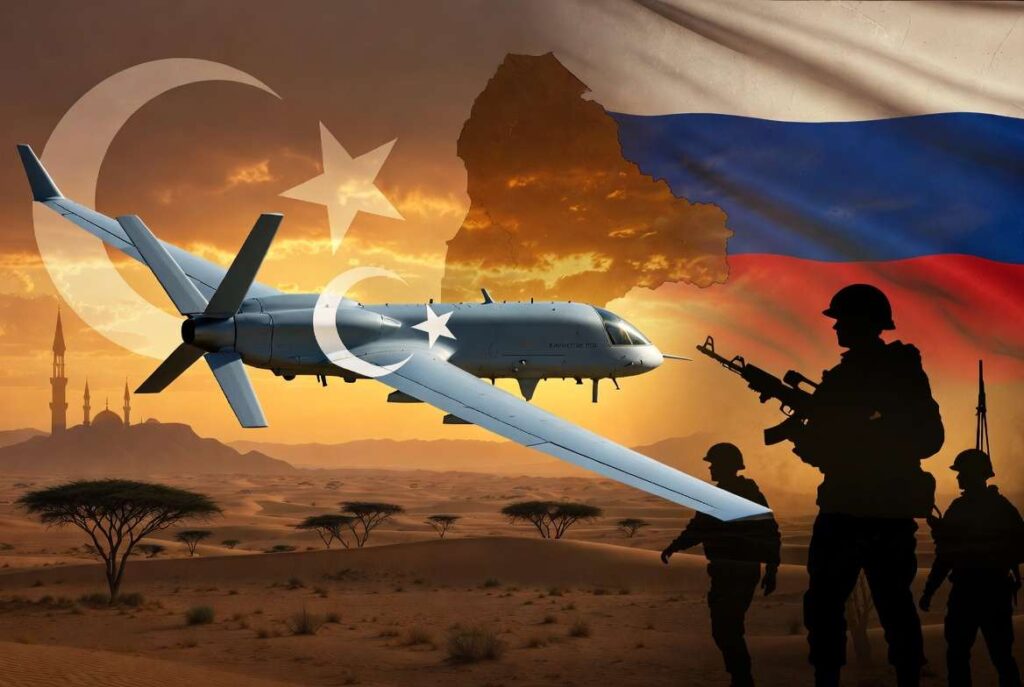
The so-called Bayraktar diplomacy and the central role of Turkish drones should be highlighted. Initially focused on providing cutting-edge weapons and other security assistance, Bayraktar diplomacy boosted Turkey’s considerable influence in the region. The Bayraktar-TB2 unmanned aerial vehicles and, more recently, the Bayraktar Akinci drones, remain a cornerstone of Turkey’s bilateral relations with the central Sahel states.
Known for their relative ease of use and relatively low cost, the Bayraktar-TB2 drones have become ubiquitous throughout Africa. The introduction of these UAVs into the Sahelian theater, where junta forces have particularly favored them, broadly coincided with the withdrawal of Western armies and their air power.
Turkey’s increasingly central role in the Sahelian security landscape is underscored by the numerous occasions it has been targeted in JNIM propaganda this year. The Al Qaeda branch has publicly accused Turkey and its defense companies of complicity in civilian deaths due to their supply of drones and munitions.
Will Turkey take advantage to expand its role in security?
The cooperation between Turkey and the region’s juntas goes beyond arms deals. Turkish personnel and private military companies have been instructing security forces in the region for some time, with recent reports suggesting that training programs are likely to expand in the coming years.
The devastating failure of the Russian Wagner Group mercenaries and then the Africa Corps has raised significant doubts about the future of Russian military support across the continent. Turkey is aware of this circumstance and could take advantage of this power vacuum in the central Sahel. Greater involvement would lead to Turkish private military companies beginning to provide more assistance, especially as the security situation continues to deteriorate in much of the region.
Throughout the year, there have been numerous reports suggesting that SADAT has been involved in the discreet deployment of Syrian mercenaries in the central Sahel. The BBC even reported that some of these men were found fighting against jihadist extremists under Russian command in the tri-border area between Burkina Faso, Mali, and Niger.
There is no definitive evidence to confirm these reports, most of which suggest that mercenaries are protecting Turkey-funded economic projects in Niger and possibly Burkina Faso. However, Russia-affiliated Telegram channels have recently mentioned losses suffered by mercenaries linked to Turkey in Niger. And perhaps more revealing, JNIM has explicitly referenced the presence of SADAT in the region.
Diplomatic platform
Turkish involvement in the regional security landscape has served as a diplomatic launching platform, also allowing Ankara to forge deeper economic ties. In just the past few months, bilateral agreements have been completed that will allow Turkish mining and hydrocarbon companies to expand their work in Niger. In Mali and Burkina Faso, it also holds economic interests in mining, oil, and agricultural projects.
Regarding Turkey’s strategy in the Sahel, while it will help contain Russian and Chinese influence in West Africa and the Sahel, it would be advisable for Washington to engage in a strategic dialogue with Ankara about their common interests in Africa.
Turkey does not seek to completely replace Russia in the Sahel but to position itself as a complementary strategic alternative, offering military juntas an advanced security option without the international isolation or absolute dependency that aligning solely with Moscow implies. And unlike Moscow, allying with Ankara does not irreversibly break bridges with Western financial channels, which is highly attractive to AES leaders.
Coexistence scenario
The Turkish government prefers to avoid its own casualties and uses private companies to train commandos. It does not assume the front line of combat against insurgents as Russia does. Furthermore, Turkey maintains a complex relationship with Russia in theaters like Libya, Syria, and the Black Sea. Ankara avoids direct confrontations that destabilize its energy or diplomatic agreements with the Kremlin.
The trend in the Sahel points to a scenario of coexistence and diversification. The Sahel countries will not replace one monopoly with another. Instead, they use Russia for the immediate survival of their political regimes, China for the financial support of infrastructures, and Turkey as their main technological-military and alternative diplomatic pillar.
Thus, while Europe withdraws from the Sahel, other powers quickly burst in. It is not a war, but a fierce battle for influence. The Ankara method is based on security above all, drones, military equipment, and rapid presence.
If there is any lesson, it is the need to consider all the actors involved in the Sahel, the protection and perception of the civilian population, and the local realities, aspects that so far do not seem to have been taken into account.
The current worsening situation in the Sahel necessitates the search for a new security strategy. Terrorism, organized crime, separatism, and political instability require special attention in the face of these threats and challenges that hinder its socio-economic and political development. The intervention of external actors in recent years has worsened the situation by creating new problems.
The withdrawal of support from France, the European Union, the U.S., and the UN peacekeeping forces creates a vacuum that is now impossible to fill through the conjunction of the FDS and the Russian militiamen of the Africa Corps, successors of the Wagner Group. Despite the constant increase in the purchase of offensive equipment, especially surveillance and bombing drones, the elite units of the AES are unable to capitalize on their theoretical superiority in armament.
Combination of powers
All of this makes a new strategy for the Sahel necessary, and that is where an external actor has burst onto the scene with great force: Turkey has spent years consolidating its position as one of the regional powers with the strongest presence, capitalizing on the vacuum left by France while discreetly competing with China and Russia.
Turkey uses an approach that combines “soft power,” such as humanitarian aid or religious ties, with “hard power,” such as military cooperation or arms sales. In the case of the Sahel, Turkish contributions in defense have remained at the same level as before, training elite units, as well as ensuring the logistical support and necessary training for the operation of drones. SADAT—one of Turkey’s largest private military companies—could become a competitor to Russian security interests in Africa.
Through its economic, religious, diplomatic, educational, industrial, and military power instruments, Turkey is closing a series of commercial agreements that, although kept discreet, prepare the ground for achieving much larger objectives, competing with Russia, and collaterally with China.
Bayraktar diplomacy
The so-called Bayraktar diplomacy and the central role of Turkish drones should be highlighted. Initially focused on providing cutting-edge weapons and other security assistance, Bayraktar diplomacy boosted Turkey’s considerable influence in the region. The Bayraktar-TB2 unmanned aerial vehicles and, more recently, the Bayraktar Akinci drones, remain a cornerstone of Turkey’s bilateral relations with the central Sahel states.
Known for their relative ease of use and relatively low cost, the Bayraktar-TB2 drones have become ubiquitous throughout Africa. The introduction of these UAVs into the Sahelian theater, where junta forces have particularly favored them, broadly coincided with the withdrawal of Western armies and their air power.
Turkey’s increasingly central role in the Sahelian security landscape is underscored by the numerous occasions it has been targeted in JNIM propaganda this year. The Al Qaeda branch has publicly accused Turkey and its defense companies of complicity in civilian deaths due to their supply of drones and munitions.
Will Turkey take advantage to expand its role in security?
The cooperation between Turkey and the region’s juntas goes beyond arms deals. Turkish personnel and private military companies have been instructing security forces in the region for some time, with recent reports suggesting that training programs are likely to expand in the coming years.
The devastating failure of the Russian Wagner Group mercenaries and then the Africa Corps has raised significant doubts about the future of Russian military support across the continent. Turkey is aware of this circumstance and could take advantage of this power vacuum in the central Sahel. Greater involvement would lead to Turkish private military companies beginning to provide more assistance, especially as the security situation continues to deteriorate in much of the region.
Throughout the year, there have been numerous reports suggesting that SADAT has been involved in the discreet deployment of Syrian mercenaries in the central Sahel. The BBC even reported that some of these men were found fighting against jihadist extremists under Russian command in the tri-border area between Burkina Faso, Mali, and Niger.
There is no definitive evidence to confirm these reports, most of which suggest that mercenaries are protecting Turkey-funded economic projects in Niger and possibly Burkina Faso. However, Russia-affiliated Telegram channels have recently mentioned losses suffered by mercenaries linked to Turkey in Niger. And perhaps more revealing, JNIM has explicitly referenced the presence of SADAT in the region.
Diplomatic platform
Turkish involvement in the regional security landscape has served as a diplomatic launching platform, also allowing Ankara to forge deeper economic ties. In just the past few months, bilateral agreements have been completed that will allow Turkish mining and hydrocarbon companies to expand their work in Niger. In Mali and Burkina Faso, it also holds economic interests in mining, oil, and agricultural projects.
Regarding Turkey’s strategy in the Sahel, while it will help contain Russian and Chinese influence in West Africa and the Sahel, it would be advisable for Washington to engage in a strategic dialogue with Ankara about their common interests in Africa.
Turkey does not seek to completely replace Russia in the Sahel but to position itself as a complementary strategic alternative, offering military juntas an advanced security option without the international isolation or absolute dependency that aligning solely with Moscow implies. And unlike Moscow, allying with Ankara does not irreversibly break bridges with Western financial channels, which is highly attractive to AES leaders.
Coexistence scenario
The Turkish government prefers to avoid its own casualties and uses private companies to train commandos. It does not assume the front line of combat against insurgents as Russia does. Furthermore, Turkey maintains a complex relationship with Russia in theaters like Libya, Syria, and the Black Sea. Ankara avoids direct confrontations that destabilize its energy or diplomatic agreements with the Kremlin.
The trend in the Sahel points to a scenario of coexistence and diversification. The Sahel countries will not replace one monopoly with another. Instead, they use Russia for the immediate survival of their political regimes, China for the financial support of infrastructures, and Turkey as their main technological-military and alternative diplomatic pillar.
Thus, while Europe withdraws from the Sahel, other powers quickly burst in. It is not a war, but a fierce battle for influence. The Ankara method is based on security above all, drones, military equipment, and rapid presence.
If there is any lesson, it is the need to consider all the actors involved in the Sahel, the protection and perception of the civilian population, and the local realities, aspects that so far do not seem to have been taken into account.
Become a premium member for free!