
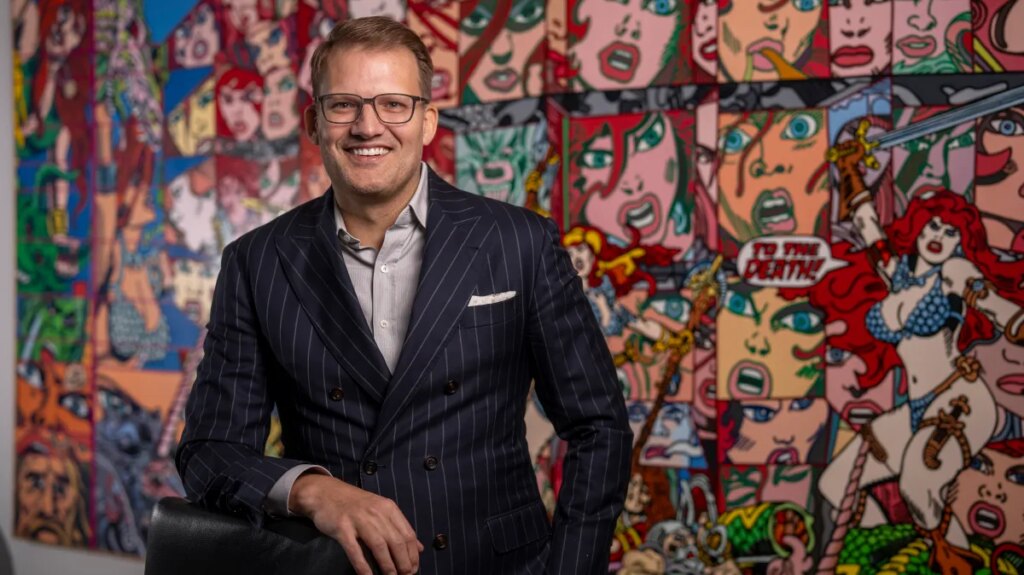
A London-based Icelandic “Viking” medicines-to-wines billionaire is considering quitting the UK over the government’s “anti-wealth” tax policies.
Robert Wessman, the founder and chief executive of Alvotech, a Nasdaq-listed biosimilar pharma company, said the “whole package” of inheritance and capital gains tax and political instability deterred him from staying and investing in the UK.
Wessman, in an interview in London’s Pall Mall, said: “It’s just the whole scheme has changed so much, which makes it very difficult for not only foreigners to come here, but for wealthy people, who live here, are born here, and have always been here, to basically stay here.”
Wessman, 56, who does not see the UK as “pro-business”, said: “At the same time the stability is not really [there]. You had Brexit, it was a big issue for the industry, for the country, for the business, and then all the tax legislation now.”
He added: “We see this in many countries, that this can be the flavour of the day for politicians. But in the end, countries [are] built on employment, on jobs, high paying jobs, preferably, value creation. And hopefully you can then benefit from having the business in the country.”
Wessman, who was speaking before Labour leadership challenger Wes Streeting said he would impose a “wealth tax that works”, moved to London from Iceland with his family in 2019, and opened a head office for Aztiq, his investment holding company, in Hammersmith two years later.
He made — and lost — his first fortune transforming Delta, a small Icelandic company, into one of the world’s largest generic drugs companies, renamed Actavis, competing with multinationals Teva and Sandoz, before losing an estimated €250 million during the Icelandic banking crisis of 2008.
The crash culminated in a long and bitter legal fight with another Icelandic entrepreneur, Bjorgolfur Thor Bjorgolfsson, over a highly-leveraged buyout of Thor’s investment firm shortly before the crisis.
Wessman, who has founded seven companies over the past three decades, is now seeking to build Alvotech into a global challenger in the biosimilar market via, unconventionally, a manufacturing and R&D base in Iceland.
He has invested $2 billion since 2013, into Alvotech, which employs 1,500 people, the majority in Reykjavik, as part of a drive to create a “fourth leg” for Iceland after fishing, tourism and manufacturing.
Biosimilars are highly similar to complex biological medicines whose patents have expired. Unlike conventional generic drugs, they are complex and expensive to develop, and often trigger lengthy patent disputes with the originator, such as AbbVie’s litigation with Alvotech over the blockbuster autoimmunue drug Humira. Wessman said biosimilars were essential if healthcare systems were to avoid being “sunk” by the rising cost of modern biologic drugs.
 The musician Norah Jones is a partner in Wessman’s wine venture, which is to produce two million bottles a yearGetty Images
Alvotech, which has five approved biosimilars, is listed in the US, Iceland and Sweden and valued at $1 billion in New York. It generated revenues of $593 million last year and is forecasting $650 million to $700 million in 2026.
Wessman holds a 35 per cent stake via the Luxembourg-domiciled Aztiq, plus a further 30 per cent via a partnership with Temasek, the Singapore sovereign wealth fund, and CVC Capital Partners, the private equity firm.
Wessman has diversified his fortune into the wine industry, which initially was a hobby.
Since acquiring the 12th-century Château de Saint-Cernin near Bergerac in 2004 and releasing an inaugural vintage in 2016, he is building a wine venture, Maison Wessman, forecast to produce about two million bottles this year.
Customers include Intermarché, the French retail chain, and partners include the musician Norah Jones, a co-investor. They were introduced by a contact of Wessman’s after Enrique Iglesias played at his wedding.
Wessman, who is not a non-dom, moved to London “against the stream when Brexit was happening”, because of the capital’s practical location for travel to his businesses in Asia, the US and central and eastern Europe.
His Russia-born wife and their six children are settled in London’s “world-class” schools.
“London is the most amazing city to live in. It has amazing education. It has everything to offer. It has amazing history,” he said.
But he believes Brexit was a mistake for the UK, “a very proud nation”, from a “business sense …because the UK is so integrated into Europe and it was a lot of disruption, hassle, uncertainty”.
“Since Brexit many of the big banks don’t ever bring up [the] UK as an alternative, as a listing venue anymore.”
Coupled with tax changes, he said: “There has been too much turbulence. And it’s sad to see all these people leaving because in the end these are income which is not only for [the] benefit of the government, it’s a benefit for the school system, road system, healthcare system, for everything.”
The Sunday Times Rich List this month showed that one in six people on the list two years ago did not appear in 2026. Almost a third of the UK citizens who appear in the main list of 350 individuals no longer live on the British mainland.
Wessman, who recently sought to view properties in Milan, said he did not regret paying high taxes in the UK “but it has to be within certain certainties and scope”.
He added: “I’m sitting with my tax adviser getting [an] update two to three times a year of what might be coming next, and it’s all over the place and this is not encouraging anyone to live here.”
“I really love to live here. But overall I think where you have mobile capital, which can be based anywhere, it will push more people out.
“We are leaving with a lot of capital. We are leaving with a lot of jobs. We are leaving without even thinking that [the] UK would be a good idea to build any manufacturing or R&D or anything. So that’s the sad part of it.”