
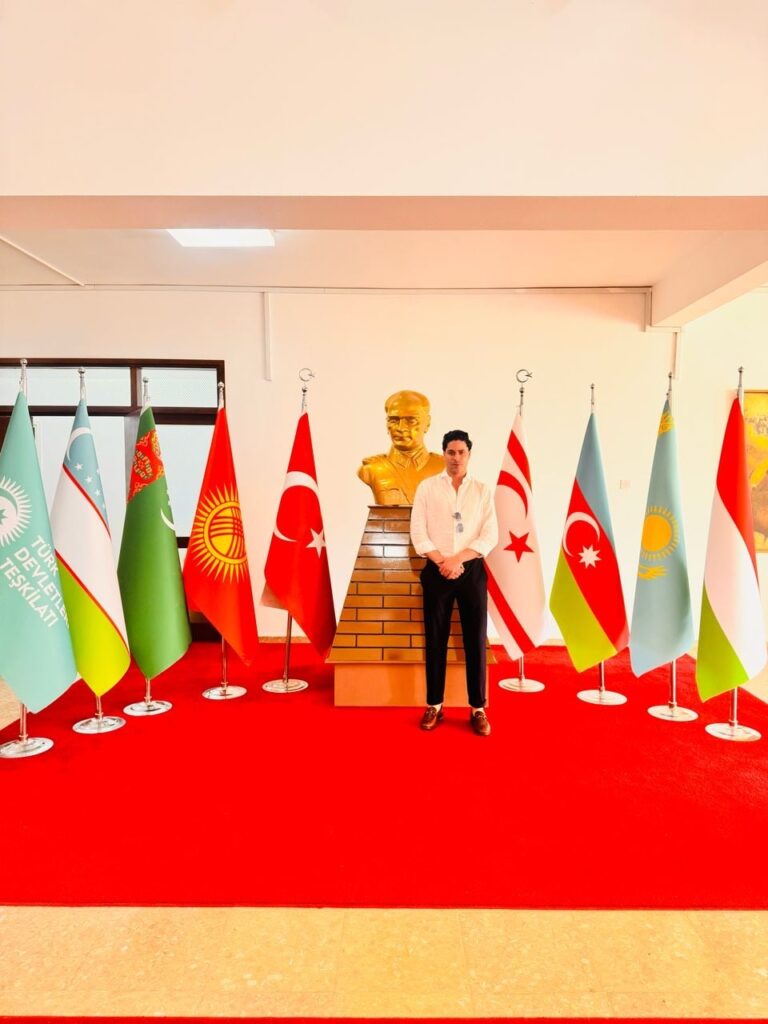
The Illusion of Normalcy
In late April 2025, I had the opportunity to travel on a field mission to Northern Cyprus, a place often overlooked in broader Middle Eastern conflict discourse, despite representing one of the region’s longest-running unresolved disputes.
With a background in conflict studies, I had long been interested in the Cyprus context and had engaged with it both academically and professionally. It was therefore difficult not to draw comparisons between the situation in Cyprus and the conflict that has shaped my own regional experience in Israel–Palestine.
Arriving in Lefkoşa felt unexpectedly disorienting. I had prepared myself to enter what I understood to be a conflict environment within a deeply polarised regional context. Instead, I was met with a striking image: a large billboard advertising a performance by Linet, an Israeli-Turkish singer, prominently displayed at the airport.
The juxtaposition was difficult to ignore. An Israeli artist, associated in many contexts with a state widely viewed as an occupying power in Palestine, being advertised in a territory itself considered by much of the international community to be occupied, immediately unsettled my assumptions. The moment was less about the artist herself and more about what the image revealed: a form of everyday normalcy coexisting with unresolved political realities.

Billboard of Turkish-Israeli singer Linet at Ercan International Airport in Northern Cyprus.
Exiting the airport, I was immediately struck by the warmth of the Mediterranean climate, and the ease with which the surroundings seemed to invite a sense of normalcy. Bars and restaurants lined the streets, and there was a slow-paced, almost understated sense of comfort that felt more akin to an island retreat than a conflict environment. Northern Cyprus carried a distinct character of its own, less polished than other Mediterranean destinations, yet with its own unique unassuming rhythm.
What stood out just as much was how international it felt. University campuses brought together students from regions often absent in more Eurocentric Mediterranean cities; Yemen, North and West Africa, and across the broader Middle East, giving the territory a different kind of global presence. It was not the typical internationalism of tourism or European integration, but something more complex, shaped by political realities and alternative networks of connection.
Yet beneath this initial sense of charm and openness was a far more rigid and visible reality. Turkish military installations and bases were impossible to ignore. Their presence served as a persistent reminder that this was not simply another Mediterranean setting, but a space shaped by unresolved political tension and external influence. There was no immediate sense of danger or active instability in the conventional sense, yet it became increasingly clear that the conflict itself had not disappeared; it had instead settled into a form that was less visible, more controlled, and more enduring.
The contemporary political landscape of Cyprus remains defined by a long standing territorial and political division. The Republic of Cyprus, situated in the south, is internationally recognized as the sovereign state of Cyprus and is a member of the European Union. The Turkish Republic of Northern Cyprus emerged in the aftermath of the events of 1974, including a Greek backed coup on the island and the subsequent Turkish military intervention, which ultimately resulted in a de facto territorial division between the north and south. The violence surrounding these events led to thousands of deaths and injuries and displaced approximately 200,000 people, fundamentally reshaping the island and its demographic landscape. Today, Northern Cyprus remains recognized only by Türkiye and continues operating under conditions of political and diplomatic isolation. The island itself remains physically divided by the United Nations Buffer Zone, commonly referred to as the Green Line, while broader questions surrounding sovereignty, recognition, and long term political settlement remain unresolved.
FROM VISIBLE STABILITY TO INVISIBLE CONFLICT
If conflict had not disappeared, then where exactly had it gone?
This question increasingly followed me throughout the mission. On the surface, Northern Cyprus appeared remarkably stable. Unlike many environments associated with active conflict, there was no visible atmosphere of fear or anticipation of violence. Coming from an Israeli context, and particularly from Jerusalem where security consciousness and underlying tension can often become embedded into ordinary life, the contrast felt significant. There was no sense that violence might suddenly emerge into public space. The immediate threat itself seemed absent.
Yet over time, another reality began to emerge.
While military installations and political symbols remained visible throughout the landscape, the deeper dimensions of the conflict increasingly revealed themselves through conversations with political leaders, diplomats, academics, and local stakeholders. Meetings with His Excellency Mustafa Akıncı, former President of the Turkish Republic of Northern Cyprus, and His Excellency Tahsin Ertuğruloğlu, Minister of Foreign Affairs of the Turkish Republic of Northern Cyprus, proved particularly significant in shaping these reflections.
Our discussions were direct and, at times, deliberately challenging. As members of the delegation coming from diverse backgrounds and not approaching the issue from predetermined political positions, we often asked questions openly and without diplomatic caution. Rather than simply discussing historical events or political positions, the conversations repeatedly returned to themes of exclusion, recognition, political stagnation, and long term uncertainty.
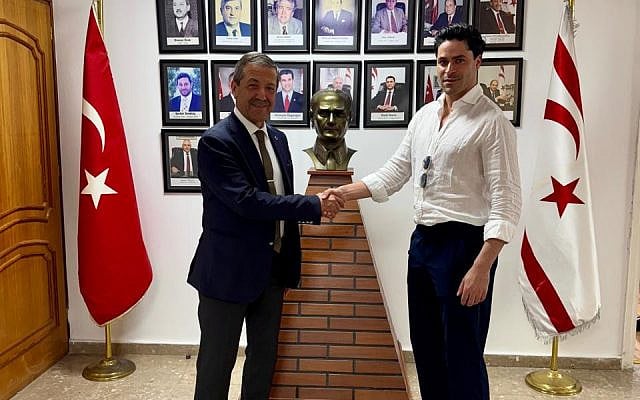
Gabriel Bell together with H.E. Tahsin Ertuğruloğlu, Minister of Foreign Affairs of the Turkish Republic of Northern Cyprus (TRNC).
More striking than the content itself was the tone.
There appeared to be a fatigue that often accompanies prolonged political suspension. Not necessarily resignation, but the exhaustion that emerges after decades in which meaningful political movement becomes increasingly difficult to envision. There remained a sense of determination and conviction regarding their positions, yet there also appeared to be an underlying recognition of the immense difficulty of shifting realities that have remained largely unchanged for decades. It seemed less a conflict driven by immediate violence than one increasingly shaped by isolation, marginalisation, and the experience of existing in a prolonged state of waiting.
What appeared particularly interesting was that some unresolved dimensions of the conflict seemed, in certain respects, to extend beyond immediate tensions between communities themselves. There was a recurring sense that isolation and limited international engagement had become central aspects of the broader experience. It raised an important question: when a conflict becomes frozen, does the conflict itself gradually transform? Does it evolve from one centred primarily on violence and territorial disputes into one increasingly defined by political exclusion and uncertainty?
This raises an important distinction between peace and stability.
The absence of violence does not automatically resolve questions surrounding sovereignty, collective memory, identity, legitimacy, or historical grievance. Frozen conflicts, by their nature, often preserve many of these underlying dynamics beneath the surface. Violence may decrease while unresolved realities continue to shape institutions, politics, and perceptions.
Yet the experience in Northern Cyprus also forces another question: compared to what? When compared to environments where violence remains active and populations continue living under recurring cycles of insecurity and humanitarian devastation, the distinction becomes more complicated. Relative stability may not constitute sustainable peace, but for populations accustomed to immediate threat, the reduction of violence itself can fundamentally reshape everyday life.
One evening near the United Nations Buffer Zone unexpectedly captured this tension. Following days of intensive meetings, policy discussions, and official engagements, our delegation sat at a venue overlooking the Green Line itself. Directly in front of us stood United Nations observation posts and barbed wire. A DJ played music while people moved through the evening, laughing and talking as the sun disappeared over the city.
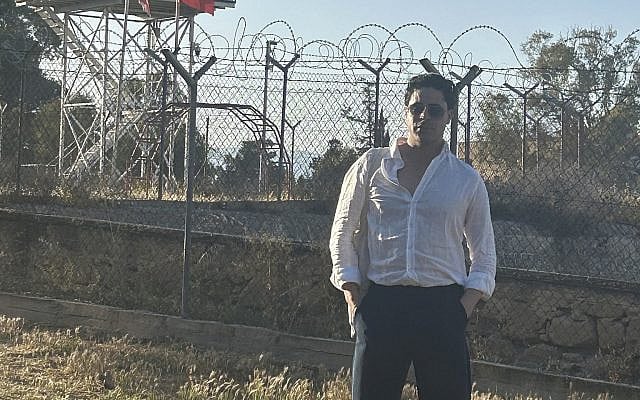
Gabriel Bell at the UN Buffer Zone during a field mission to Northern Cyprus.
I remember sitting there drinking prosecco and smoking a lemon flavoured cigarette I had only found in Northern Cyprus.
The irony was difficult to ignore.
We were positioned at the physical centre of separation, yet there was no fear of rockets, mortars, or snipers. That reality simply did not exist.
It was during that moment that a different question emerged. Not whether Northern Cyprus represented perfect peace, because it clearly does not. Rather: if populations can reach a point where they no longer live under immediate threat of violence, how significant is that achievement in itself?
For Israel and Palestine, where violence repeatedly produces devastating humanitarian consequences and where generations continue growing up within cycles of fear, insecurity, trauma, and loss, such a reality would not represent failure. It would represent profound relief.
This is where Northern Cyprus becomes relevant. Not because it offers a final political blueprint, and certainly not because unresolved conflict should be romanticised, but because it raises an important possibility: that reducing violence itself may represent a meaningful humanitarian achievement.
Frozen conflict should not be mistaken for sustainable peace, nor should indefinite political paralysis become the objective. Yet for civilians living under prolonged violence, the immediate removal of violence as the dominant force shaping everyday life may itself create the conditions through which deeper political questions can eventually be approached.
And only once people no longer fear for their immediate survival can those questions move from crisis management into the realm of genuine peace-building.
HUMANITARIAN NEEDS BEFORE POLITICAL PROCESSES
If the reduction of violence itself can represent an important humanitarian achievement, then a different question follows: have we been focusing on the wrong objective altogether?
Traditional frameworks frequently focus heavily on political arrangements such as sovereignty, borders, governance structures, recognition, and final status negotiations. These discussions remain essential. However, in highly volatile environments, immediate attempts to resolve conflict may become disconnected from realities experienced by affected populations on the ground. Therefore, the immediate objective should not necessarily be resolution itself, but the creation of conditions in which populations are no longer living primarily within violence and survival.
Within the context of Israel and Palestine, populations living through recurring violence and humanitarian crisis may not primarily be asking constitutional or diplomatic questions. Concerns surrounding food, shelter, healthcare, physical safety, and the ability to navigate ordinary life may become more immediate than broader political formulations.
People cannot meaningfully build peace while remaining uncertain about how they will feed their families, where they will sleep, or whether violence may return tomorrow. Efforts aimed at resolving conflict risk becoming disconnected from lived realities when they prioritise broader political frameworks while populations remain preoccupied with immediate humanitarian needs and survival.
Within conflict resolution literature, some scholars and practitioners have argued that conflicts become most “ripe” for negotiation during periods of heightened volatility, when the costs of continued confrontation become increasingly unsustainable. The underlying logic suggests that once violence becomes sufficiently painful and costly, parties become more willing to compromise.
However, Israel and Palestine may represent a context that challenges aspects of this assumption.
Historically, repeated cycles of escalation have often produced temporary pauses in violence rather than sustained political movement. In contexts where civilians remain deeply embedded within violence itself, prolonged escalation may reinforce trauma, deepen fear, strengthen identity divisions, and intensify perceptions of existential threat.
Meaningful political movement may become more likely not when societies are experiencing the highest levels of violence, but once violence itself no longer dominates everyday life.
Humanitarian needs should therefore not simply be viewed as outcomes of peace processes. They must become their starting point.
BEYOND FROZEN CONFLICT: LESSONS FOR ISRAEL AND PALESTINE
Before drawing broader lessons, an important distinction should be made. The comparison presented here is not intended to suggest that Northern Cyprus and Israel-Palestine share identical historical origins, political realities, or power dynamics. They clearly do not. Rather, the comparison being explored concerns conflict dynamics and mechanisms of stabilisation: how violence decreases, how populations experience security, and what conditions may create space for longer term political processes.
For Israel and Palestine, this raises a difficult but necessary question: how do populations move from active violence toward a reality in which violence no longer dominates everyday life? The experience of Northern Cyprus and Southern Cyprus may offer a useful lens through which to examine this question. Not because it provides a direct political blueprint, and certainly not because frozen conflicts should be romanticised, but because it raises an important possibility: if relative nonviolence emerged within Cyprus through particular mechanisms of stabilisation, could aspects of those mechanisms help inform approaches aimed at creating a similar reduction of violence within the Israel–Palestine context?
At present, security realities remain largely defined through a direct and deeply asymmetrical dynamic in which both populations continue existing within recurring cycles of fear, retaliation, trauma, and insecurity. Temporary pauses in violence repeatedly emerge only to collapse back into renewed escalation.
If reducing violence itself becomes the objective, then the question is no longer simply how to negotiate peace, but how to alter the security environment in a way that changes expectations surrounding violence itself.
The experience of Northern Cyprus suggests that relative stability did not emerge spontaneously. This shift was influenced by the emergence of external actors, deterrence structures, territorial separation, and Türkiye’s continued role as a political and security guarantor, all of which fundamentally altered expectations surrounding violence itself. Populations no longer perceived themselves as existing entirely alone or facing immediate existential threat because they no longer believed they would be left entirely responsible for their own security.
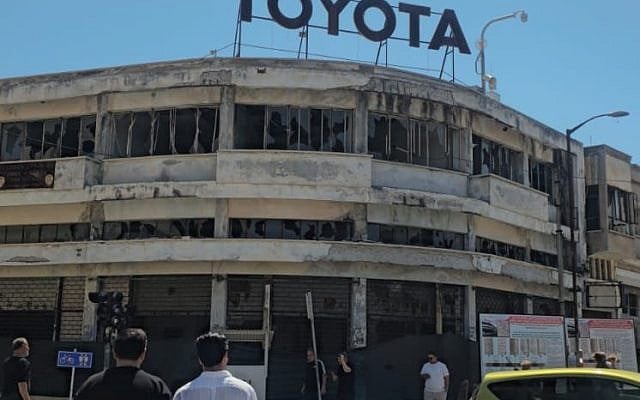
Gabriel Bell near the former Toyota building along the United Nations Buffer Zone in Lefkoşa, Northern Cyprus. Once associated with the violence surrounding the island’s division, the structure remains a visible reminder that conflict can persist physically long after large scale violence itself has diminished.
Whether one agrees with the political realities that emerged afterward is ultimately a separate discussion. The important observation concerns the mechanism itself: violence significantly diminished only once a fundamentally different security environment emerged.
Temporary ceasefires alone may prove insufficient if populations continue anticipating renewed escalation and remain unconvinced that violence itself has genuinely receded.
Based on the mechanisms observed in Cyprus, such an approach may require third party actors physically present on the ground with meaningful operational authority rather than purely symbolic roles, alongside security guarantees tailored differently to the realities experienced by both populations.
For Israel, this could include continued security guarantees and strategic assurances from longstanding allies such as the United States.
For Palestinians, a different framework of support may be required involving credible regional actors capable of providing political legitimacy, reconstruction support, and long term institutional engagement. In the same way that Türkiye functioned as a political, security, and economic guarantor for Northern Cyprus, neighboring actors may play a similar stabilising role within a broader framework for Gaza. Egypt’s geographic and political position could become particularly significant in this regard, while actors such as Saudi Arabia could potentially contribute through sustained economic and institutional support aimed at rebuilding conditions on the ground and gradually transitioning populations away from environments defined primarily by conflict.
Political questions would not disappear within such a framework. However, they should not immediately dominate it either. If the objective is creating a durable reduction in violence, then formal political processes may become more feasible only once violence itself genuinely recedes and a different reality becomes established. Such a process could take years rather than months and would likely require agreed review periods, monitoring mechanisms, and measurable indicators capable of evaluating whether progress toward stability is actually occurring.
This approach does not create a Palestinian state. It does not end occupation, nor does it resolve sovereignty questions, historical grievances, or deeper political realities. These aspirations remain important and for many nonnegotiable.
However, after years of extraordinary destruction and suffering, we also need to ask whether populations pushed to the edge of human endurance can realistically be expected to simultaneously carry the burden of survival while also resolving one of the world’s most difficult political conflicts.
I think back to that evening near the United Nations Buffer Zone in Northern Cyprus, with a glass of prosecco in front of me and a lemon flavored cigarette in my hand. The conflict had not disappeared and the political questions remained unresolved. Yet violence no longer dictated every moment of ordinary life.
This is where Cyprus offers its most important lesson. Peace is not simply about formulas, immediate political arrangements, or idealised end states. It concerns people and the realities of human experience. The lesson from Cyprus is not that unresolved conflict should become the destination, but that removing violence as the dominant force shaping everyday life may sometimes be the first step that allows societies to recover, rebuild, and eventually approach formal political processes from a place of relative stability and strength rather than catastrophe.