
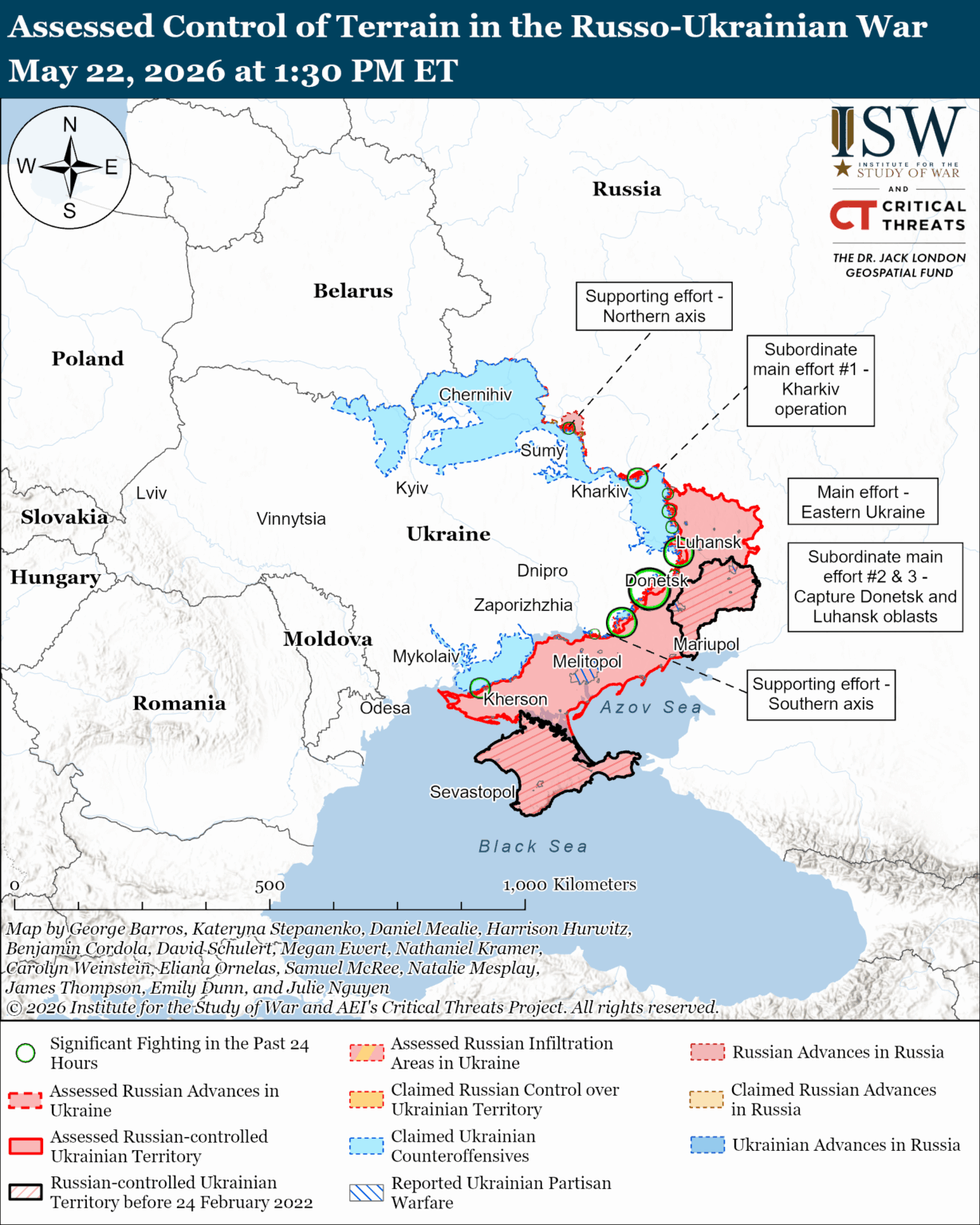
Assessment as of: 6:20 PM ET
Data Cutoff: 1:45 PM ET
Click here to see ISW’s interactive map of the Russian invasion of Ukraine. This map is updated daily alongside the static maps present in this report.
Click here to see ISW’s 3D control of terrain topographic map of Ukraine. Use of a computer (not a mobile device) is strongly recommended for using this data-heavy tool.
Click here to access ISW’s archive of interactive time-lapse maps of the Russian invasion of Ukraine. These maps complement the static control-of-terrain map that ISW produces daily by showing a dynamic frontline. ISW will update this time-lapse map archive monthly.
For more information on ISW’s map methodology, please view our statement here.
Western officials are increasingly reporting that Ukraine is hindering Russia’s advances in Ukraine, in line with ISW’s consistent assessments, but that the Kremlin likely remains committed to its original war aims despite some recognition within the Russian elite that the war is not going well. The US Defense Intelligence Agency (DIA) published an assessment on May 18, noting Ukraine’s recent territorial gains following Russian forces’ loss of access to Starlink in early February 2026.[1] NATO Secretary General Mark Rutte stated on May 21 that Ukraine’s strong defenses are stabilizing the frontline and also noted Ukraine’s territorial gains.[2] Ukraine’s intensifying long-range and mid-range strike campaigns have also imposed increasing economic, military, and manpower costs on Russian forces’ efforts to sustain the war effort for disproportionately limited gains, at least 59,000 seriously wounded, and over 800 captured prisoners of war (POWs). Zelensky’s statement indicates that Russian forces have suffered an average of 1,021 personnel killed, injured, and captured per day thus far in 2026. Bloomberg reported on May 22 that some senior Kremlin officials believe that the war in Ukraine has reached a “dead end” with no clear resolution, but that Russian President Vladimir Putin still wants to resolve the war on his terms, including fully seizing Donetsk and Luhansk oblasts by the end of 2026.[3] Bloomberg’s report is consistent with ISW’s longstanding assessment that Putin remains unwilling to compromise his field in recent months.[4]
Ukraine’s mid-range strike campaign is disrupting Russian transport arteries in occupied Ukraine and will likely complicate Russian logistics. Kherson Oblast occupation head Vladimir Saldo signed a decree on May 21 restricting the movement of freight vehicles on a section of the “R-280 Novorossiya highway,” the occupation name for the M-14 Mariupol-Berdyansk-Melitopol-Henichesk highway in occupied Kherson Oblast, as of midnight local time on May 21.[5] The R-280/M-14 is a primary land route connecting Russia and occupied Crimea. Saldo noted that the decree includes exceptions for military transport vehicles and other essential goods. Footage published on May 21 shows the aftermath of a series of recent Ukrainian strikes on Russian military cargo along the M-14 highway, and geolocated footage published on May 22 shows Ukrainian forces striking Russian trucks along the H-20 Mariupol-Donetsk City highway – another highway that Ukrainian forces have been significantly interdicting in recent weeks.[6] A Kremlin-affiliated milblogger criticized Saldo’s decree, however, claiming that it will make it easier for Ukrainian drone operators to strike Russian military vehicles along the highway, as every large transport vehicle will carry important cargo.[7] Ukrainian forces have significantly intensified their mid-range strikes and battlefield air interdiction (BAI) campaign against Russian ground lines of communication (GLOC) in occupied Ukraine over the last several months, which has been generating cascading effects on the battlefield and inhibiting Russian advances.[8] Saldo’s decision to restrict movement along the M-14 highway indicates that Ukrainian strikes have made transport along this route much more dangerous and will likely affect Russian logistics along this route within occupied Ukraine.
Ukrainian forces struck occupied Starobilsk, Luhansk Oblast, overnight on May 21 to 22. The Ukrainian General Staff reported on May 22 that Ukrainian forces struck a headquarters of the Russian Rubikon Center for Advanced Unmanned Technologies near occupied Starobilsk, Luhansk Oblast, overnight.[9] Russian officials claimed that Ukrainian forces deliberately struck a dormitory of the Starobilsk Pedagogical College in three waves of drone strikes and that the site did not serve as a military or special services facility.[10] The Russian officials claimed that the strikes killed at least six and injured at least 39 students. The Ukrainian General Staff refuted Russian officials’ allegations that Ukrainian forces struck a civilian object rather than an object that Russia has used for military purposes.[11] ISW is unable to verify these reports. Russian officials, including President Vladimir Putin, used the Starobilsk strike to advance a number of longstanding Russian information operations, including a cognitive war effort falsely portraying Ukrainian forces as suffering significant setbacks across the theater.[12]
Key Takeaways:
- Western officials are increasingly reporting that Ukraine is hindering Russia’s advances in Ukraine, in line with ISW’s consistent assessments, but that the Kremlin likely remains committed to its original war aims despite some recognition within the Russian elite that the war is not going well.
- Ukraine’s mid-range strike campaign is disrupting Russian transport arteries in occupied Ukraine and will likely complicate Russian logistics.
- Ukrainian forces struck occupied Starobilsk, Luhansk Oblast, overnight on May 21 to 22.
- Ukrainian forces advanced in Sumy Oblast and in the Borova, Slovyansk, and Pokrovsk directions and in western Zaporizhia Oblast.
- Russian forces launched 124 drones toward Ukraine overnight.
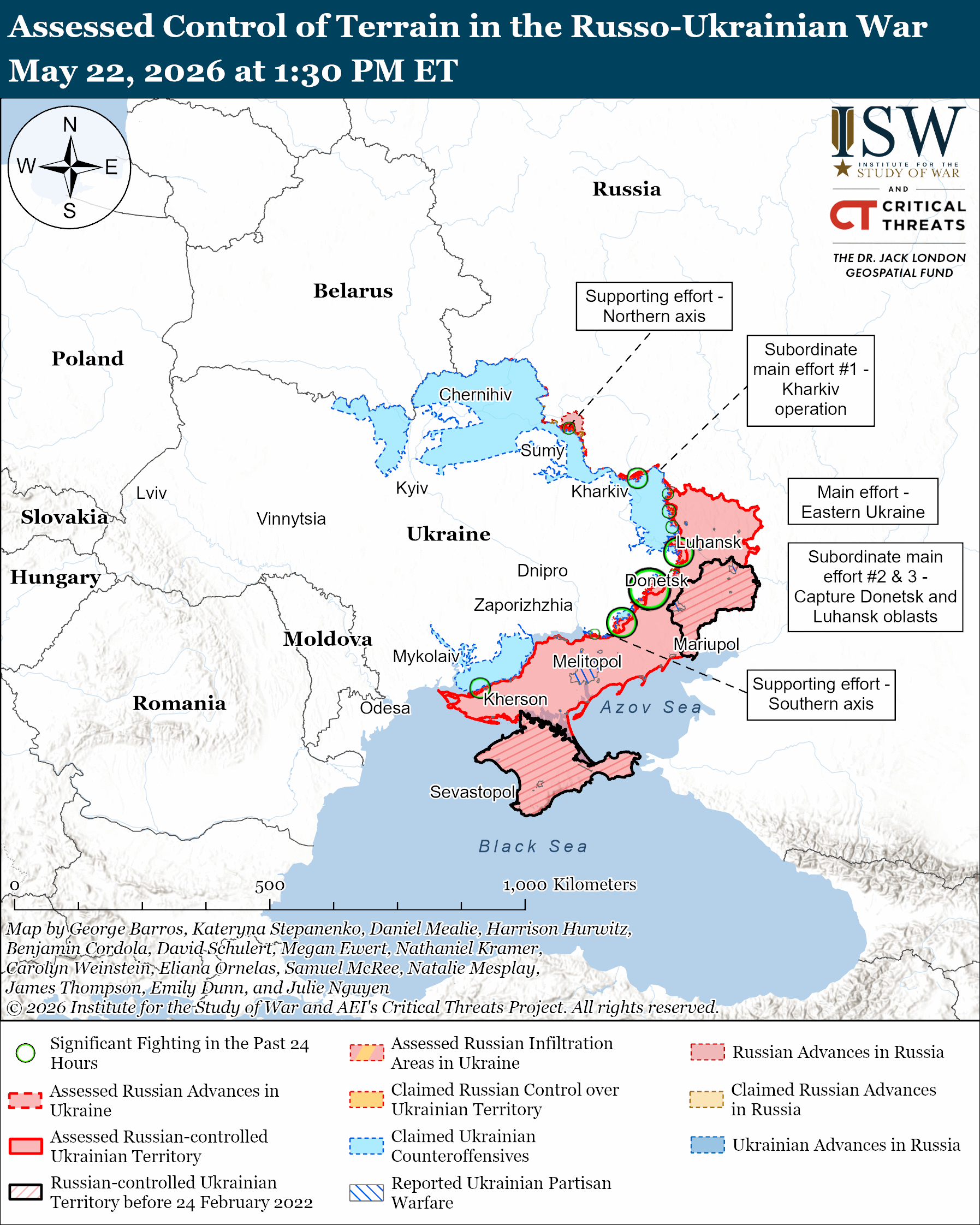
We do not report in detail on Russian war crimes because these activities are well-covered in Western media and do not directly affect the military operations we are assessing and forecasting. We will continue to evaluate and report on the effects of these criminal activities on the Ukrainian military and the Ukrainian population and specifically on combat in Ukrainian urban areas. We utterly condemn Russian violations of the laws of armed conflict and the Geneva Conventions and crimes against humanity even though we do not describe them in these reports.
- Ukrainian Operations in the Russian Federation
- Russian Supporting Effort – Northern Axis
- Russian Main Effort – Eastern Ukraine (comprised of three subordinate main efforts)
- Russian Subordinate Main Effort #1 – Push Ukrainian forces back from the international border with Belgorod Oblast and approach to within tube artillery range of Kharkiv City
- Russian Subordinate Main Effort #2 – Capture the remainder of Luhansk Oblast and push westward into eastern Kharkiv Oblast and encircle northern Donetsk Oblast
- Russian Subordinate Main Effort #3 – Capture the entirety of Donetsk Oblast, the claimed territory of Russia’s proxies in Donbas, and possibly advance into Dnipropetrovsk Oblast
- Russian Supporting Effort – Southern Axis
- Russian Air, Missile, and Drone Campaign
- Significant Activity in Belarus
Ukrainian Operations in the Russian Federation
Ukrainian forces continued their long-range strike campaign against Russian oil infrastructure on the night of May 21 to 22. Russian opposition source Meduza reported on May 22 that Ukrainian drones struck Yaroslavl City, Yaroslavl Oblast, overnight.[13] Ukrainian President Volodymyr Zelensky confirmed that Ukrainian drones were operating in Yaroslavl Oblast and continued to target Russian oil infrastructure.[14] Russian opposition outlet Astra reported that the Ukrainian drones’ likely target was the Slavneft-YANOS refinery, which processes an average of 15 million tons of oil per year and is the main refining asset of the PJSC NK Slavneft company.[15] Yaroslavl Oblast Governor Mikhail Evrayev acknowledged that Ukrainian drones struck the oblast and temporarily shut down traffic from Yaroslavl City to Moscow City.[16]
Ukrainian strikes continue to inhibit Russian oil production in the short-term. Reuters reported on May 21, citing two industry sources, that Ukrainian May 20 strikes forced the Lukoil-Nizhegorodnefteorgsintez Oil Refinery in Kstovo, Nizhny Novgorod Oblast, to partially halt operations.[17] An industry source told Reuters that the Ukrainian strikes forced the refinery to close the AVT-6 primary oil refining unit, which will lead to a sharp decline in the plant’s production of petroleum products.
Russian Supporting Effort – Northern Axis (Russian objective: Create defensible buffer zones in Sumy Oblast along the international border)
Ukrainian forces recently advanced northeast of Sumy City as Russian forces continued ground operations north, northeast, and southeast of Sumy City on May 22.[18] Geolocated footage published on May 22 indicates that Ukrainian forces recently advanced southeast of Varachyne (northeast of Sumy City).[19] The footage indicates that Ukrainian forces also maintain positions southeast of Varachyne in areas where Russian sources previously claimed that Russian forces maintained positions. A Russian milblogger claimed that Russian forces advanced east of Yunakivka (east of Varachyne).[20]
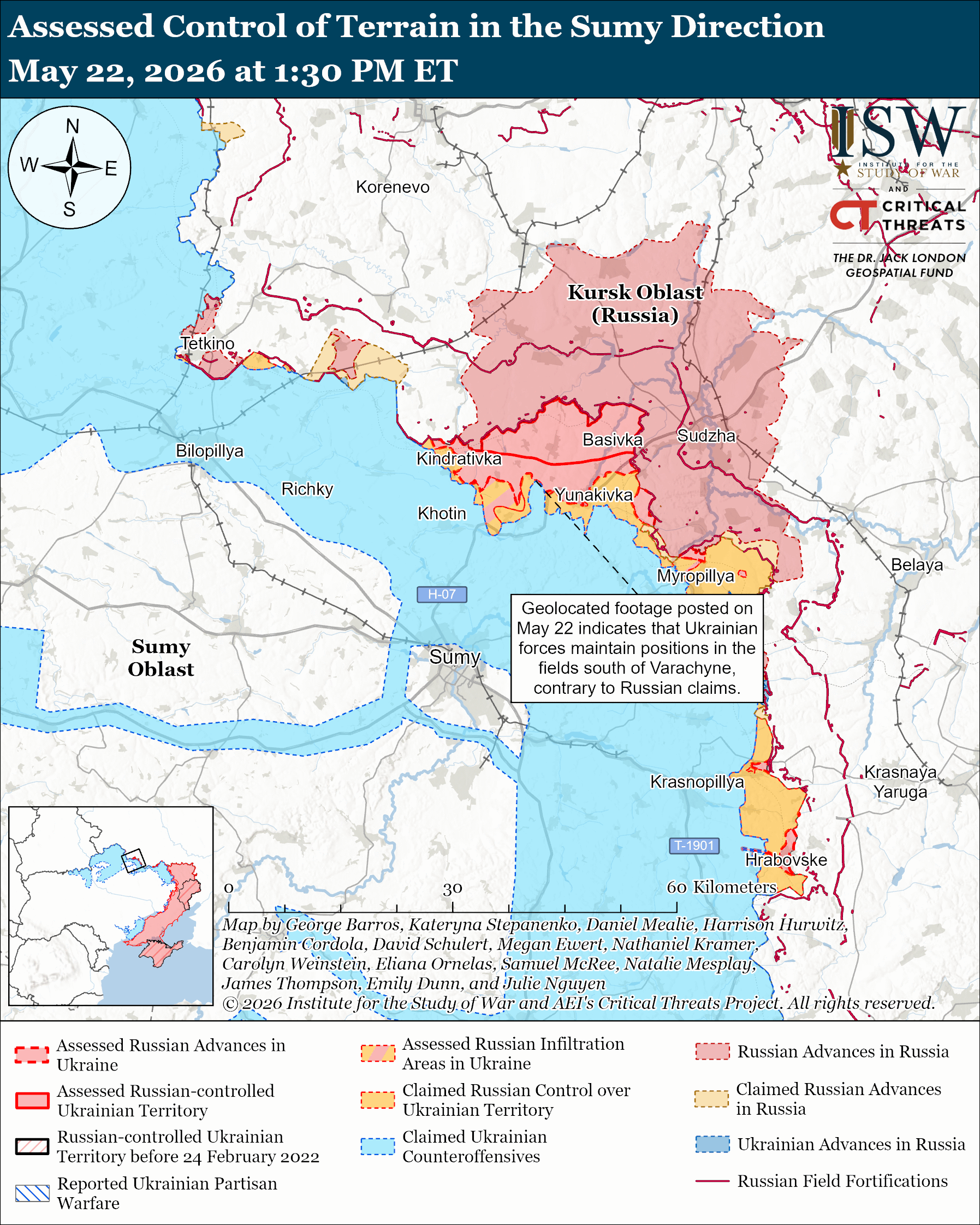
Ukrainian 14th Army Corps Spokesperson Colonel Vitaliy Sarantsev stated on May 22 that the Ryasne area (southeast of Sumy City) is the most active in the Sumy direction.[21]
Ukrainian forces continued frontline strikes against Russian military assets in the Sumy direction on the night of May 21 to 22. The Ukrainian General Staff reported on May 22 that Ukrainian forces struck a Russian command and observation post in Tetkino, Kursk Oblast, and Russian personnel concentrations in Troyebortne, Bryansk Oblast, overnight.[22]
Russian Main Effort – Eastern Ukraine
Russian Subordinate Main Effort #1 – Kharkiv Oblast (Russian objective: Push Ukrainian forces back from the international border to create a defensible buffer zone with Belgorod Oblast and approach to within tube artillery range of Kharkiv City)
Russian forces continued ground attacks northeast of Kharkiv City in and near Vovchansk on May 22 as Ukrainian forces counterattacked in the area.[23] A Russian milblogger claimed that Russian forces advanced west of Shesterivka (northeast of Kharkiv City) and into northern Losivka (southwest of Shesterivka).[24] Ukrainian 14th Army Corps Spokesperson Colonel Vitaliy Sarantsev stated on May 22 that the Kozacha Lopan (north of Kharkiv City) area is the most active in the Kharkiv direction.[25]
Neither Russian nor Ukrainian sources reported ground activity in the Velykyi Burluk direction on May 22.
Russian Subordinate Main Effort #2 – Oskil River (Russian objective: Cross the Oskil River in Kharkiv Oblast and push westward into eastern Kharkiv Oblast and northern Donetsk Oblast)
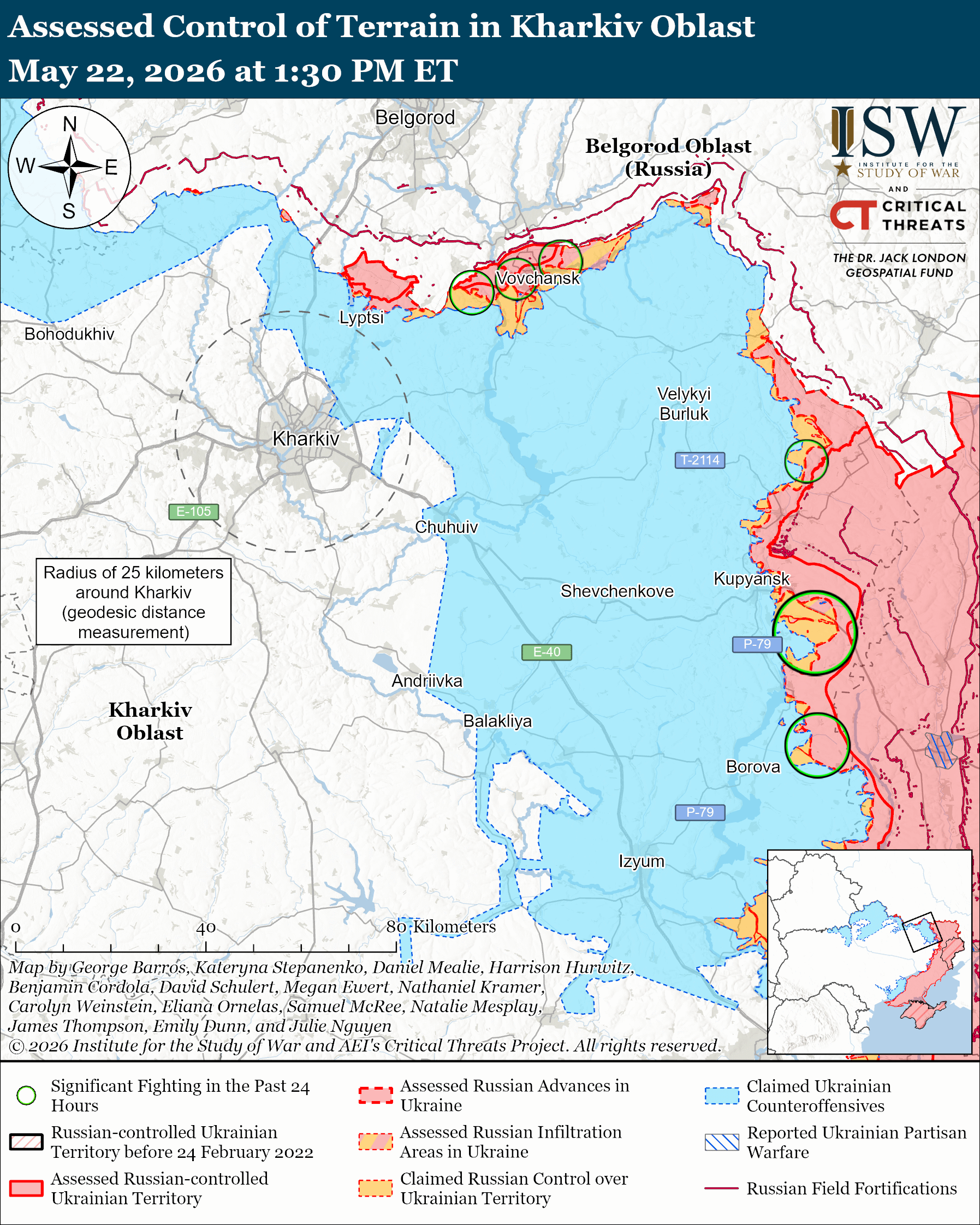
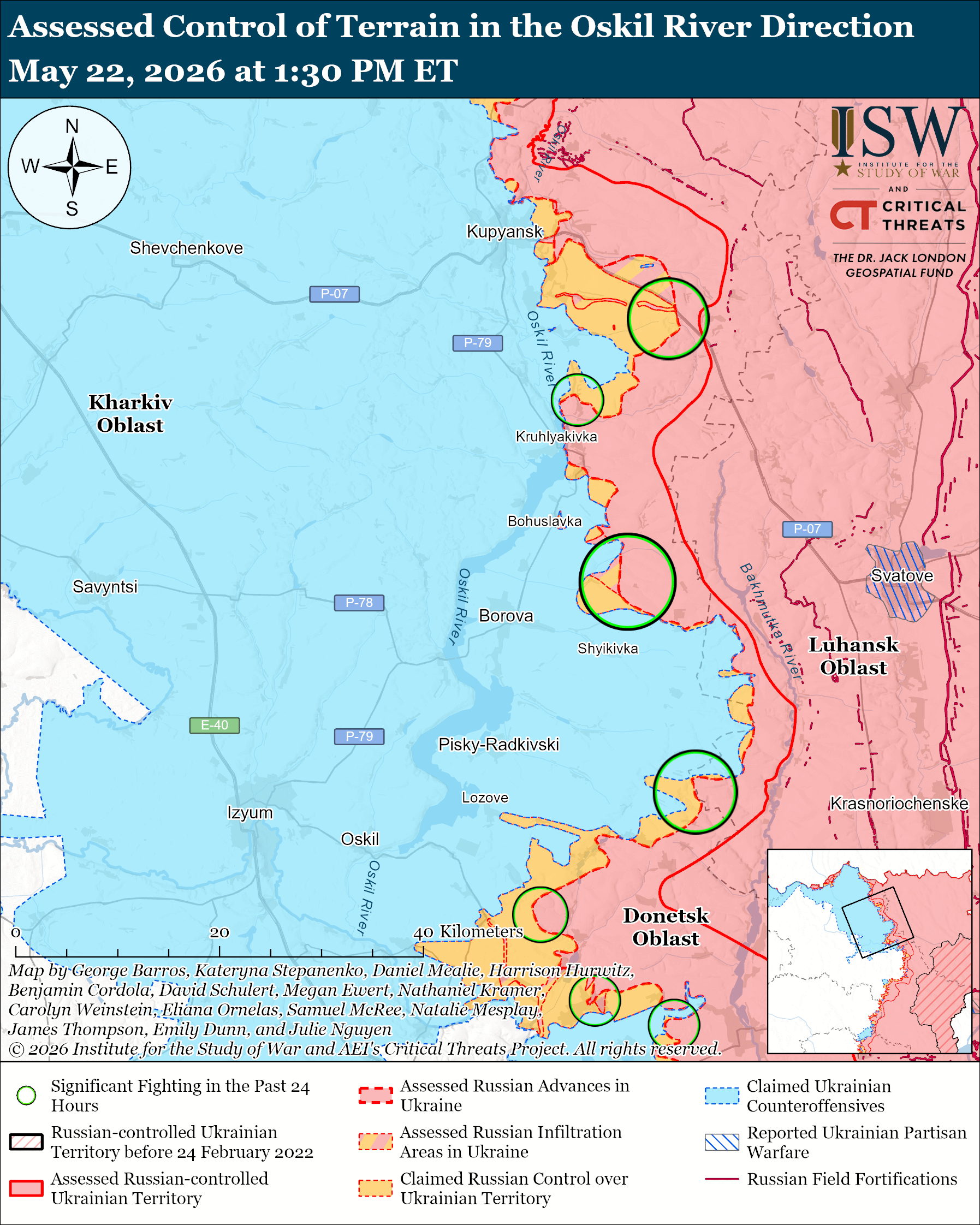
Russian forces continued limited ground attacks southeast of Kupyansk on May 22 but did not advance.[26]
The Ukrainian General Staff reported that Ukrainian forces struck a Russian crossing over the Oskil River near Holubivka (immediately north of Kupyansk) overnight on May 21 to 22.[27]
Ukrainian forces recently advanced in the Borova direction as Russian forces conducted limited ground operations north of Borova near Novoplatonivka.[28] Geolocated footage published on May 21 indicates that Ukrainian forces recently advanced in western Ridkodub (southeast of Borova).[29] The geolocated footage indicates that Russian forces likely do not maintain positions in Hlushchenkove (northwest of Ridkodub), contrary to Russian claims.
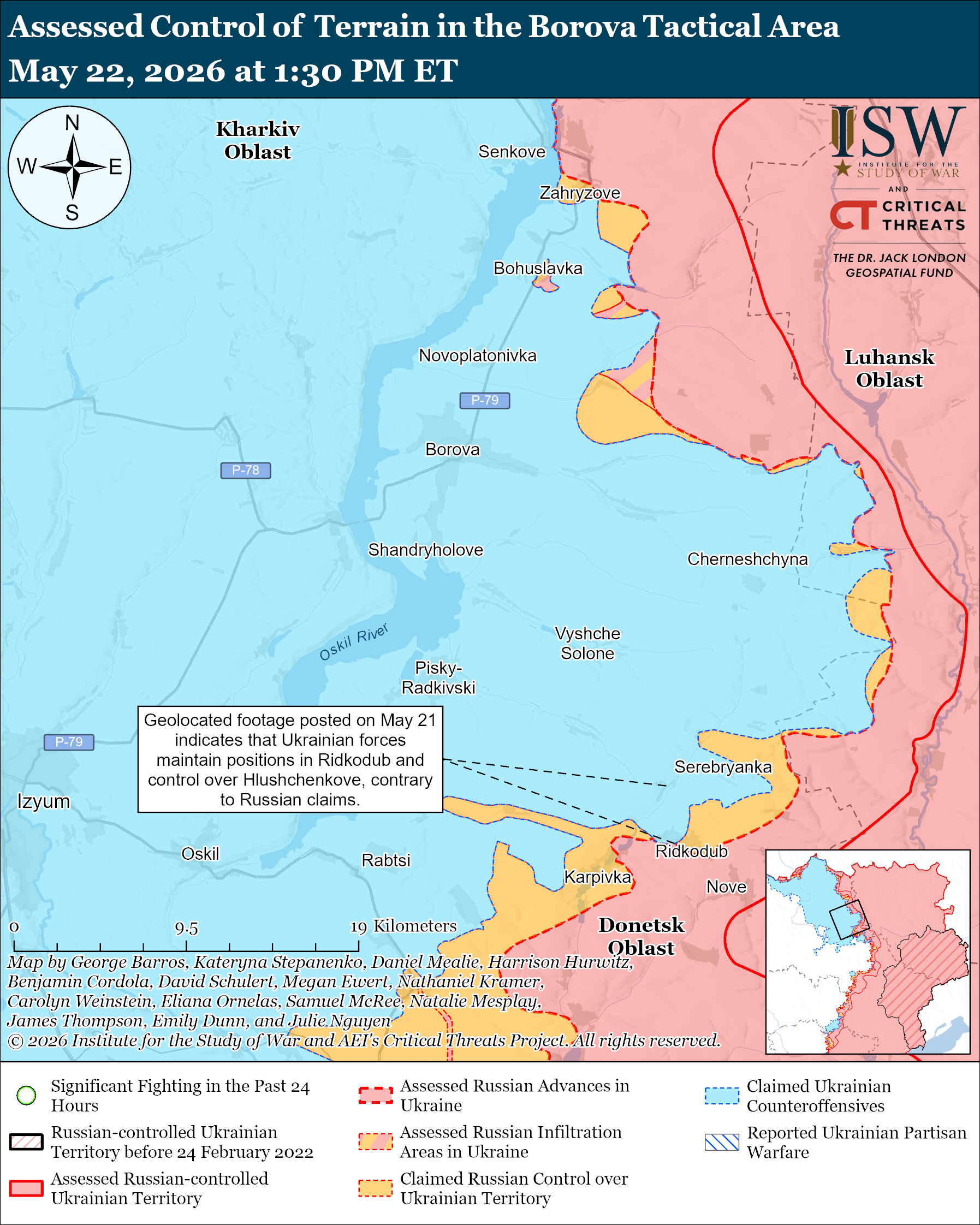
Ukrainian forces continued their mid-range strike campaign against Russian military assets in occupied Luhansk Oblast overnight on May 21 to 22. The Ukrainian General Staff reported that Ukrainian forces struck a Russian materiel and technical warehouse in occupied Rovenky (about 130 kilometers from the frontline).[30]
Russian Subordinate Main Effort #3 – Donetsk Oblast (Russian objective: Capture the entirety of Donetsk Oblast, the claimed territory of Russia’s proxies in Donbas, and advance into Dnipropetrovsk Oblast)
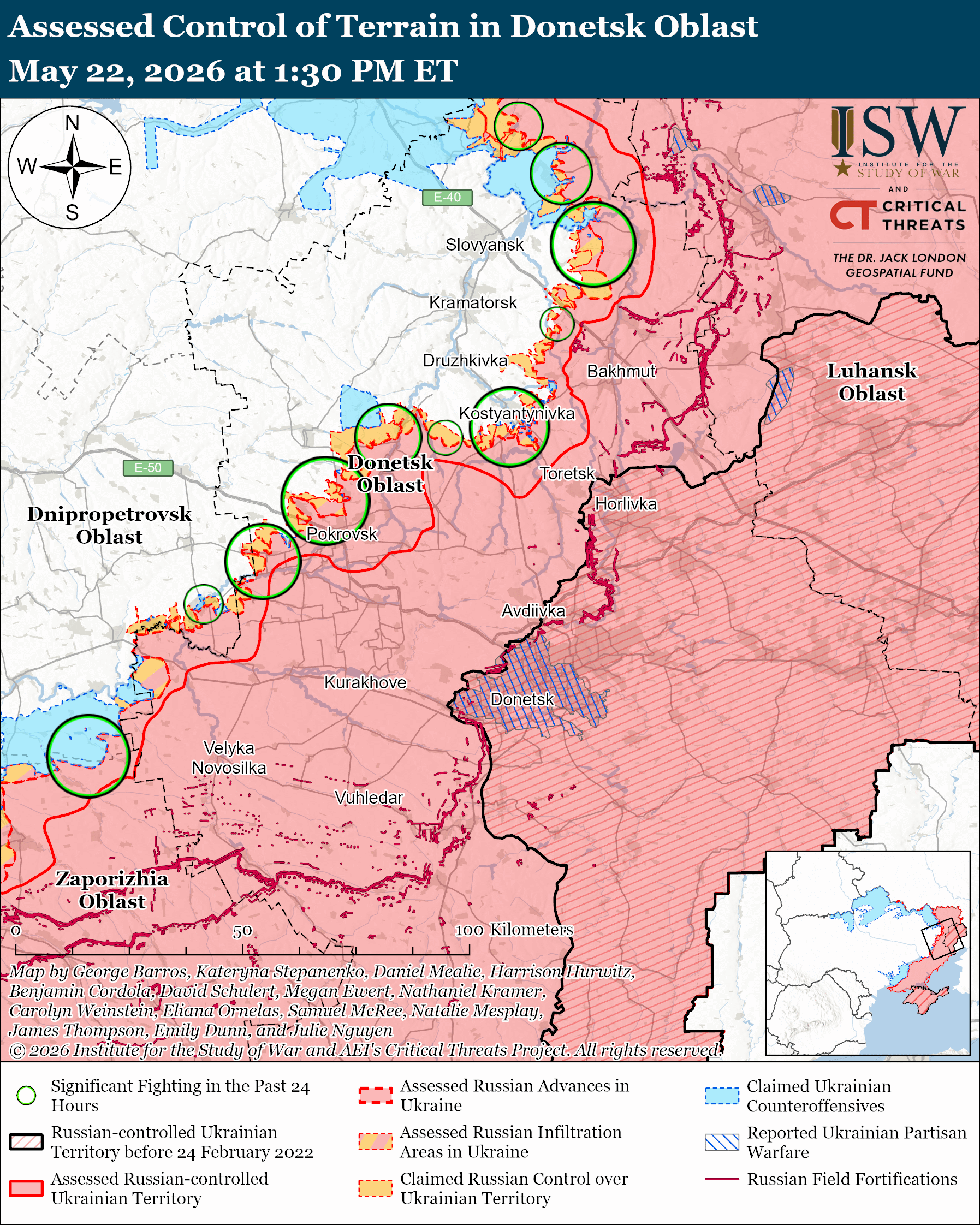
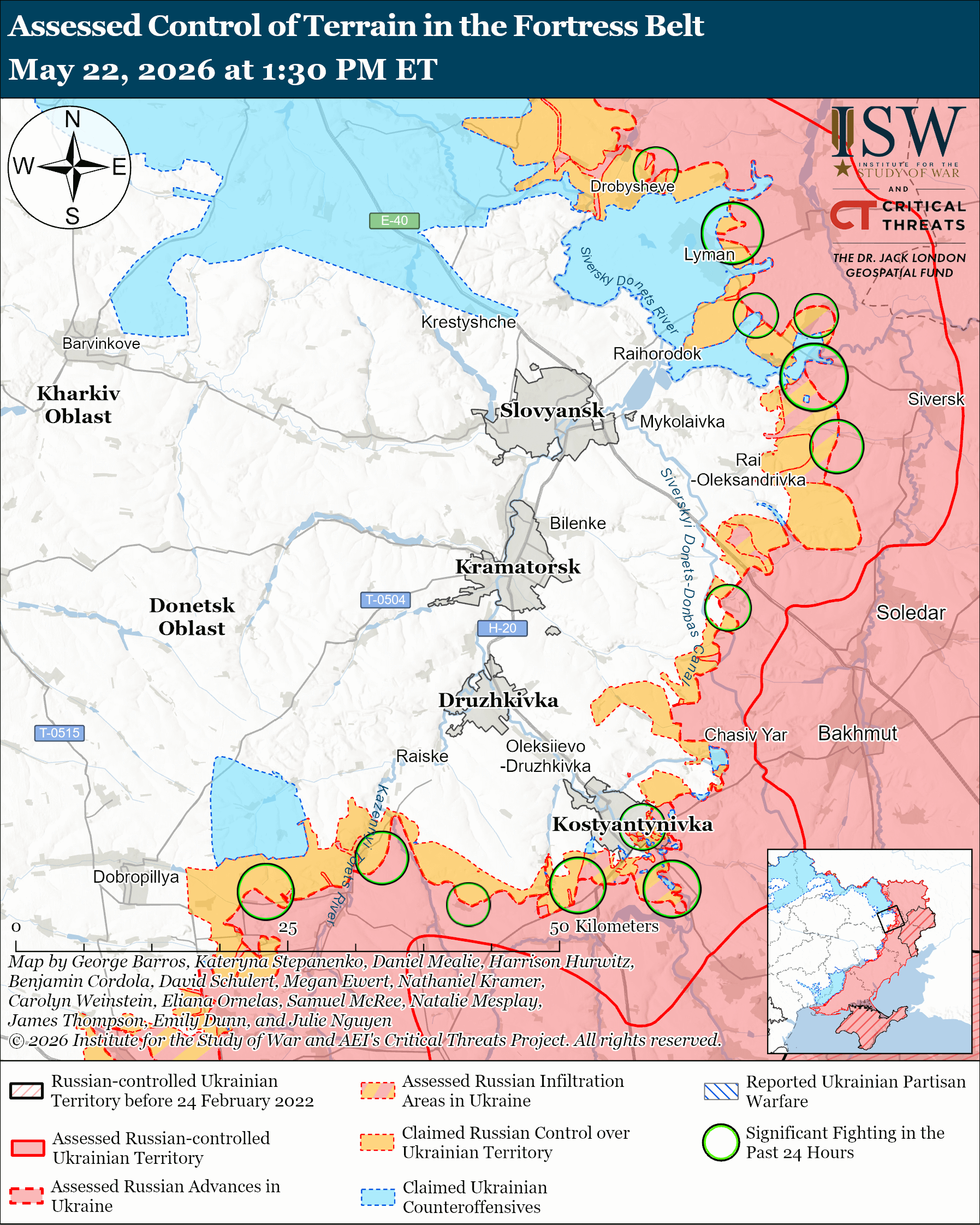
Ukrainian forces recently advanced in the Slovyansk direction as Russian forces conducted infiltration missions in the area. Geolocated footage published on May 21 indicates that Ukrainian forces recently advanced southeast of Kryva Luka (east of Slovyansk).[31] The presence of Ukrainian forces southeast of Kryva Luka indicates that Russian forces likely infiltrated around existing Ukrainian positions east of Kryva Luka. Additional geolocated footage published on May 20 shows Ukrainian forces striking a Russian position in eastern Lyman after what ISW assesses was a Russian infiltration mission.[32]
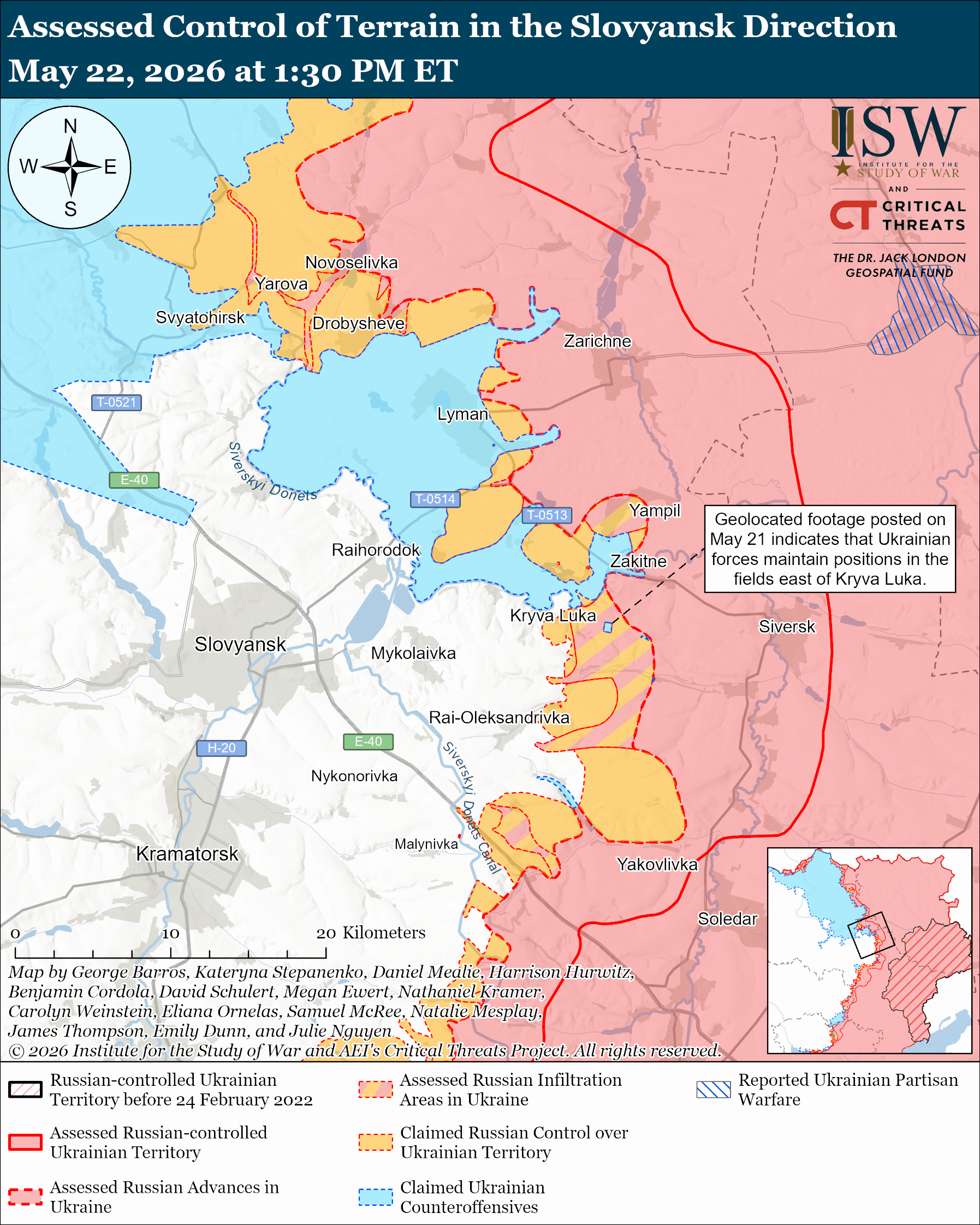
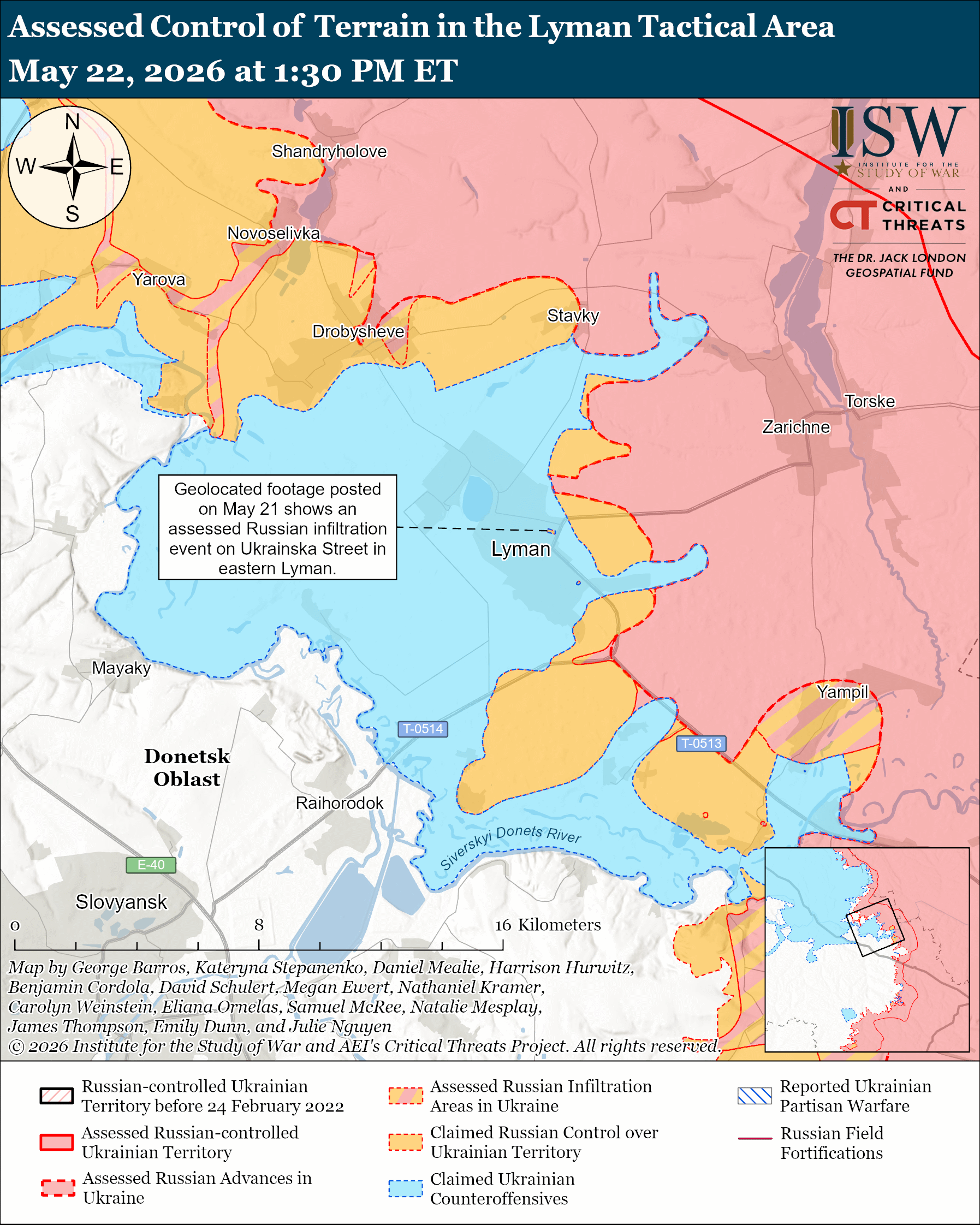
Russian forces continue to commit war crimes in the Slovyansk direction. The commander of a Ukrainian brigade operating in the Slovyansk direction reported on May 22 that Russian forces are conducting infiltration missions disguised as civilians – an act of perfidy and a war crime under the Geneva Convention.[33]
Russian forces continued offensive operations in the Kostyantynivka direction on May 22 but did not advance.[34]
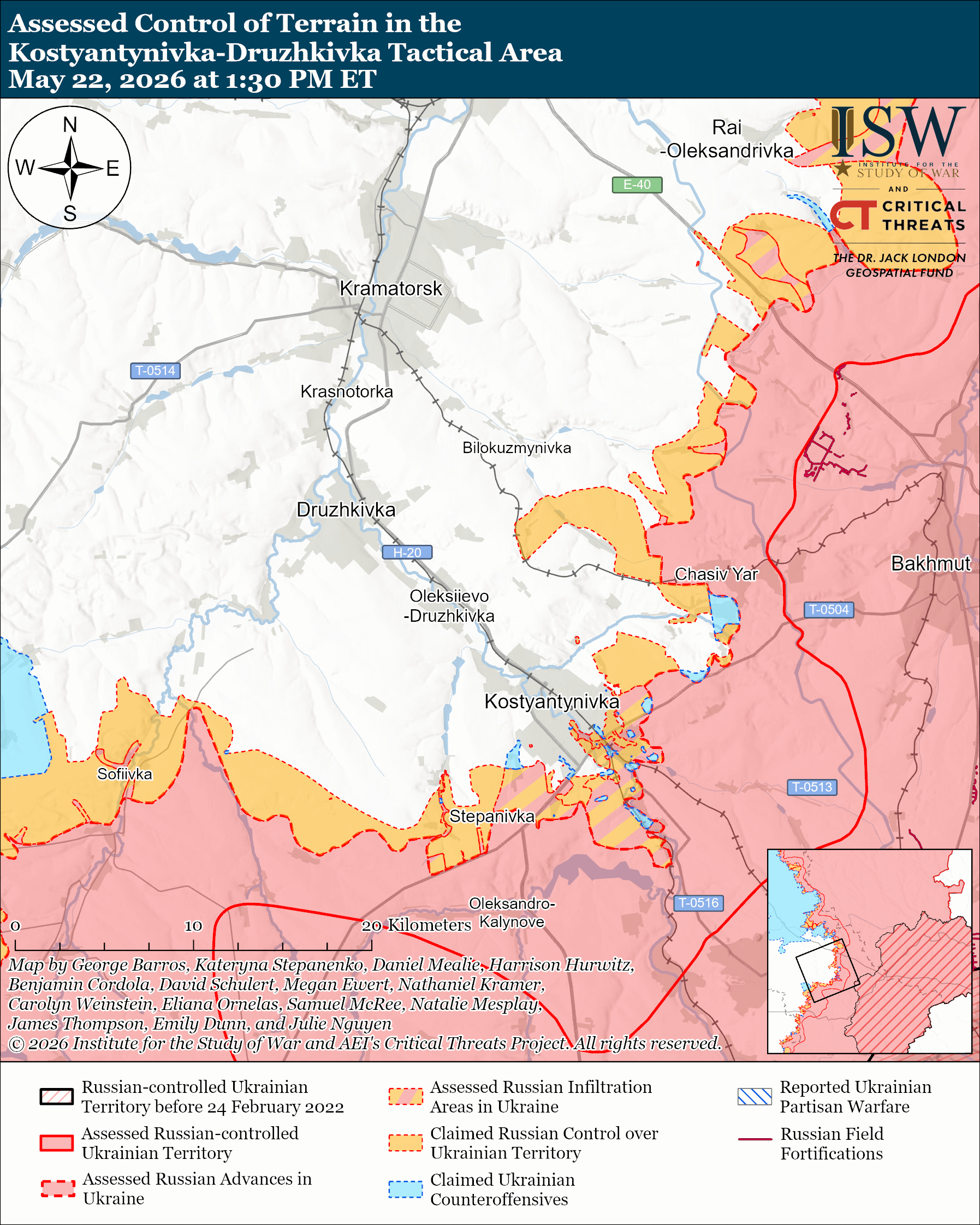
Russian forces conducted limited ground attacks in the Dobropillya tactical area on May 22 but did not advance.[35]
Ukrainian forces recently advanced in the Pokrovsk direction. Geolocated footage posted on May 21 indicated that Ukrainian forces recently advanced northwest of Kotlyne (southwest of Pokrovsk).[36]
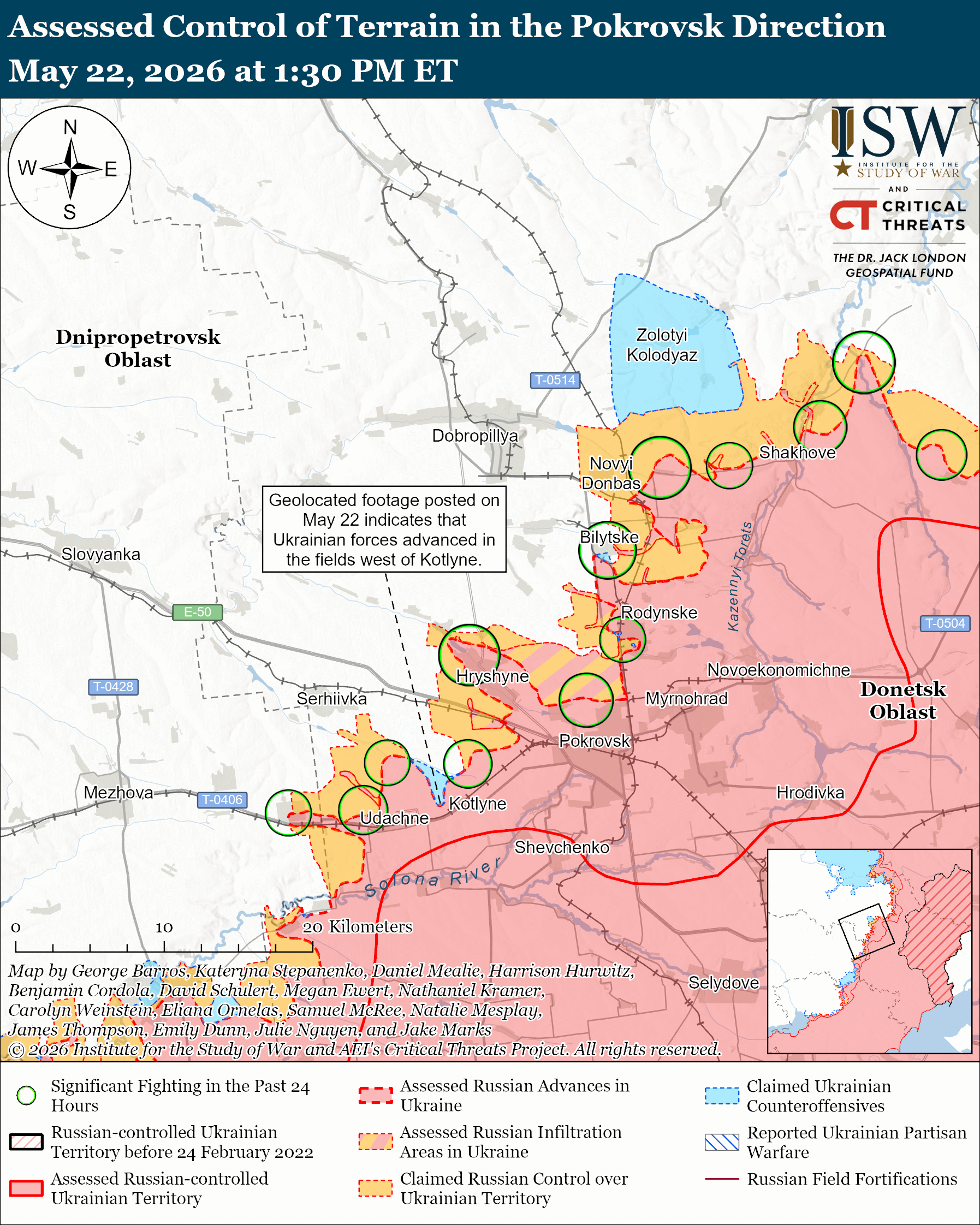
Ukrainian forces continued their short-range strike campaign against the Russian near rear in the Pokrovsk direction on the night of May 21 to 22. The Ukrainian General Staff reported on May 22 that Ukrainian forces struck Russian personnel concentrations in Selydove (roughly 21 kilometers from the frontline), Ukrainka (roughly 17 kilometers from the frontline), and Pokrovsk overnight.[37]
Russian forces continued offensive operations in the Novopavlivka and Oleksandrivka direction on May 22 but did not advance.[38]
Ukrainian forces continued their short- to mid-range strike campaign against Russian military assets in occupied Donetsk Oblast on the night of May 21 to 22. The Ukrainian General Staff reported that Ukrainian forces struck a Russian Osa air defense system and a material and technical warehouse in occupied Donetsk City; a command and observation post in occupied Novopetrykivka (roughly 40 kilometers from the frontline); Russian drone command posts in occupied Selydove, Malynivka, and Vesele (roughly 22, 16, and 18 kilometers from the frontline, respectively); and an ammunition depot in occupied Velyka Novosilka (roughly 20 kilometers from the frontline).[39]
Russian Supporting Effort – Southern Axis (Russian objective: Maintain frontline positions, secure rear areas against Ukrainian strikes, and advance within tube artillery range of Zaporizhzhia City)
Russian forces recently conducted infiltration missions in the Hulyaipole direction. Geolocated footage published on May 21 shows Ukrainian forces striking a Russian position in Hulyaipilske (southwest of Hulyaipole) after what ISW assesses was a Russian infiltration mission.[40] Additional geolocated footage published on May 22 shows elements of the Russian 155th Naval Infantry Regiment (55th Naval Infantry Division (Pacific Fleet) (newly formed from the 155th Naval Infantry Brigade) and of the 394th Motorized Rifle Regiment (127th Motorized Rifle Division, 5th Combined Arms Army [CAA], Eastern Military District [EMD]) raising flags in Verkhnya Tersa (northwest of Hulyaipole) during what ISW assesses was a Russian infiltration mission.[41] The Russian Ministry of Defense (MoD) subsequently claimed that Russian forces had seized the settlement.[42] ISW continues to assess that these flag raisings are part of the Kremlin‘s cognitive warfare effort aimed at aggrandizing Russian advances to falsely portray the Ukrainian line as collapsing across the theater, contrary to all available evidence.[43]
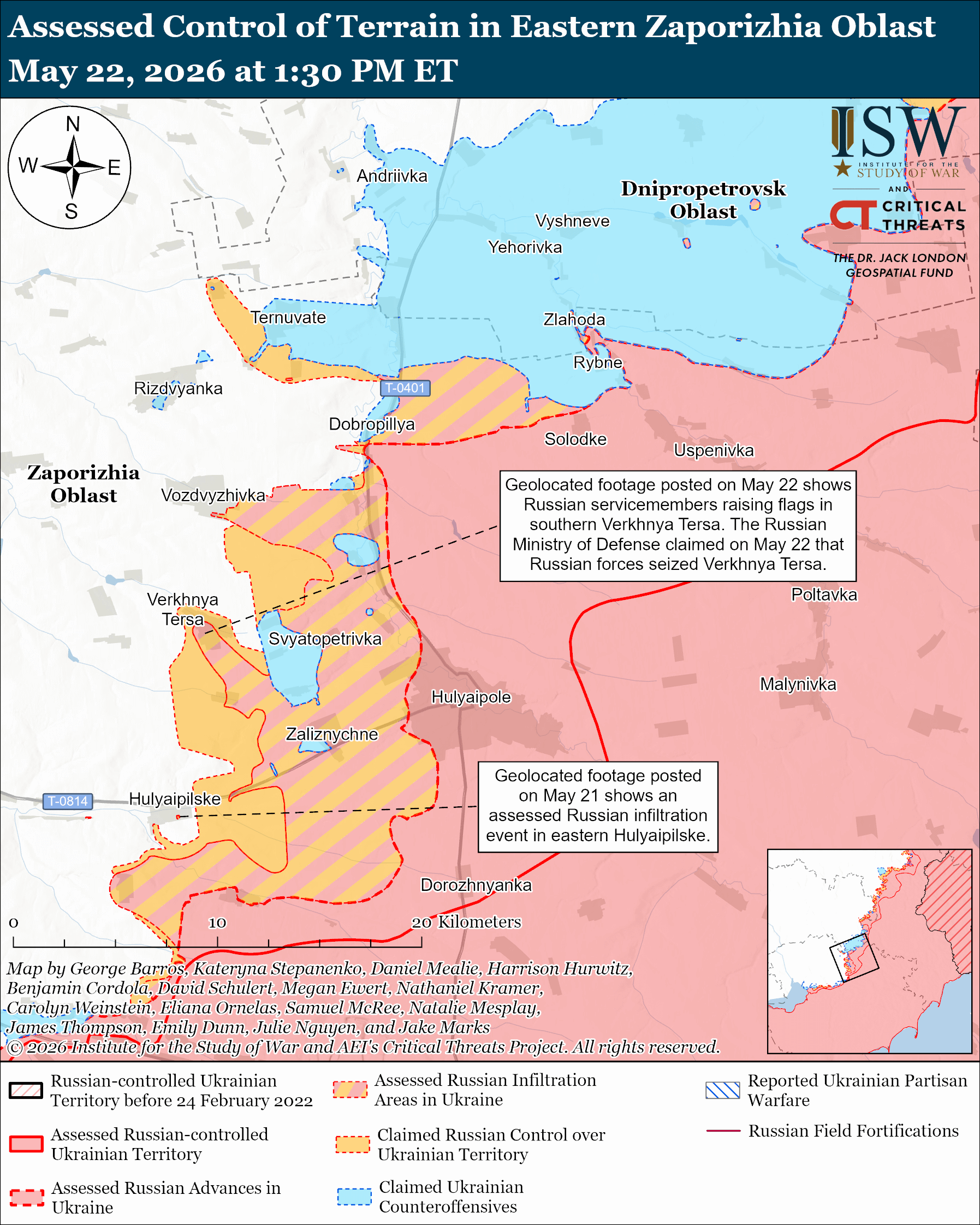
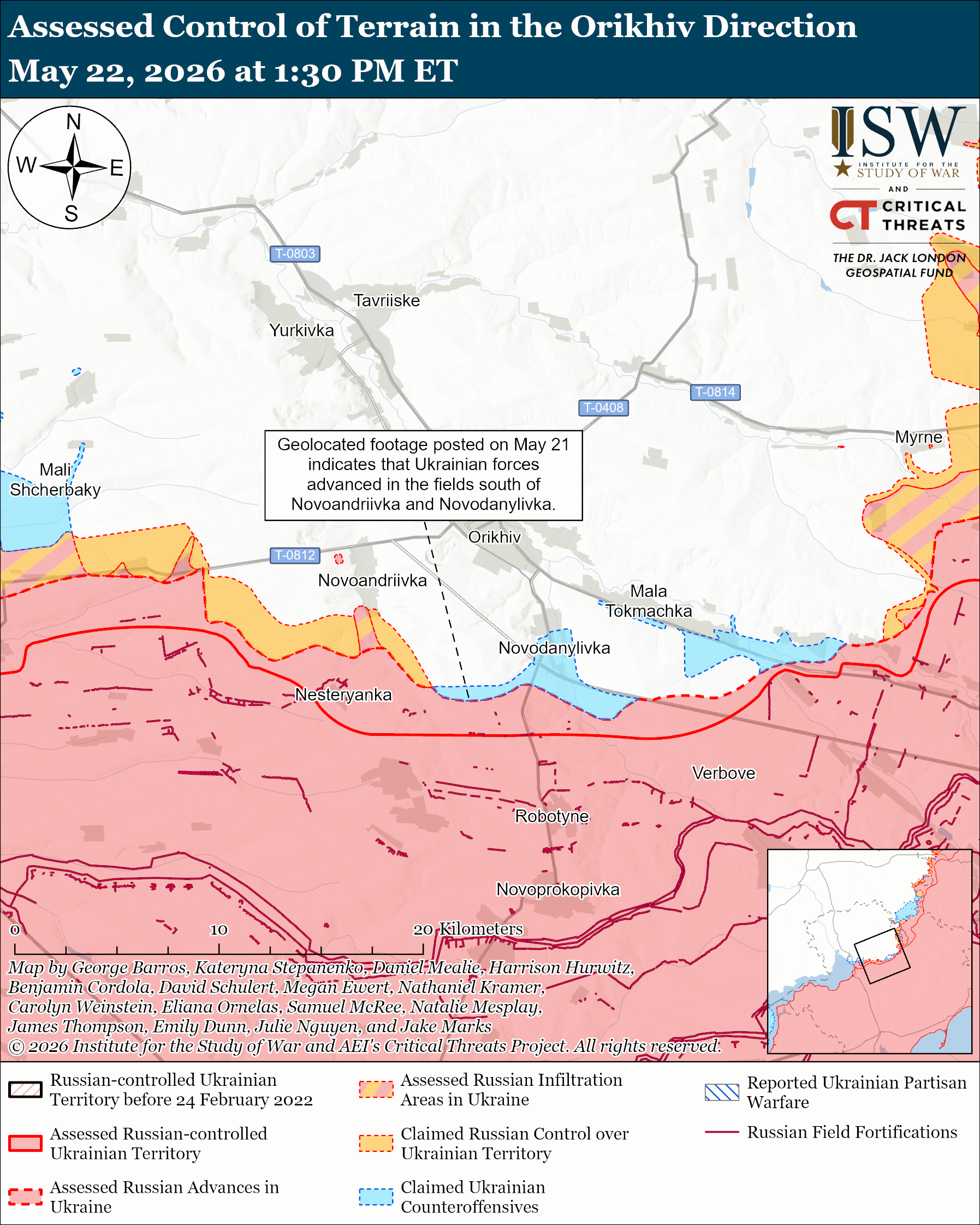
Ukrainian forces recently advanced in western Zaporizhia Oblast as Russian forces continued limited ground attacks in the area.[44] Geolocated footage published on May 21 indicates that Ukrainian forces recently advanced southwest of Novodanylivka (southwest of Orikhiv).[45] A Kremlin-affiliated Russian milblogger acknowledged that Ukrainian forces largely control Mala Tokmachka (southeast of Orikhiv) after recent Ukrainian counterattacks in the area.[46]
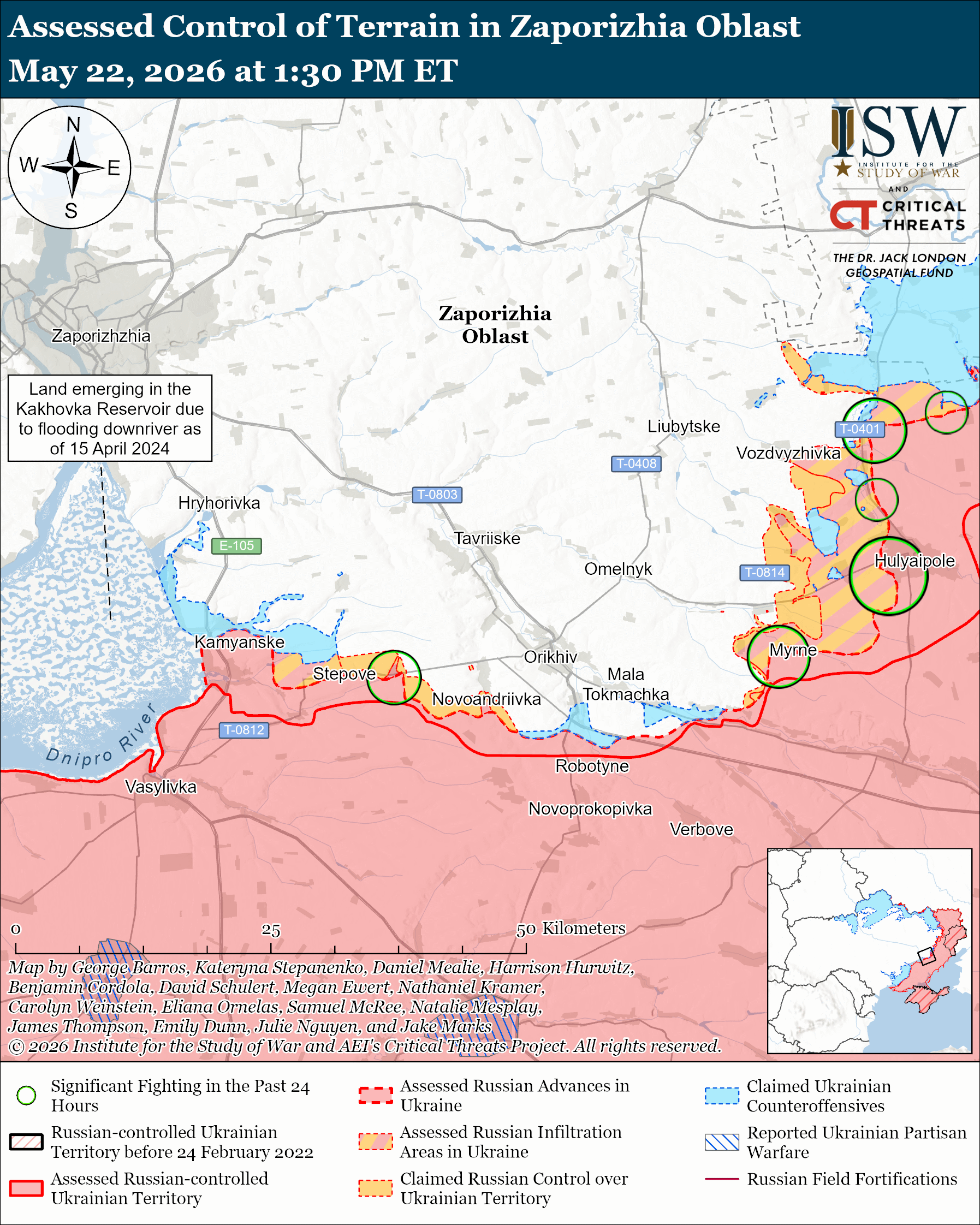
Ukrainian forces continued their mid-range strike campaign against Russian military assets in occupied Zaporizhia Oblast on the night of May 21 to 22. The Ukrainian General Staff reported that Ukrainian forces struck a Russian communications node in occupied Verkhnii Tokmak Druhyi (roughly 40 kilometers from the frontline) and a Russian manpower concentration in occupied Malynivka (roughly 18 kilometers from the frontline) overnight.[47]
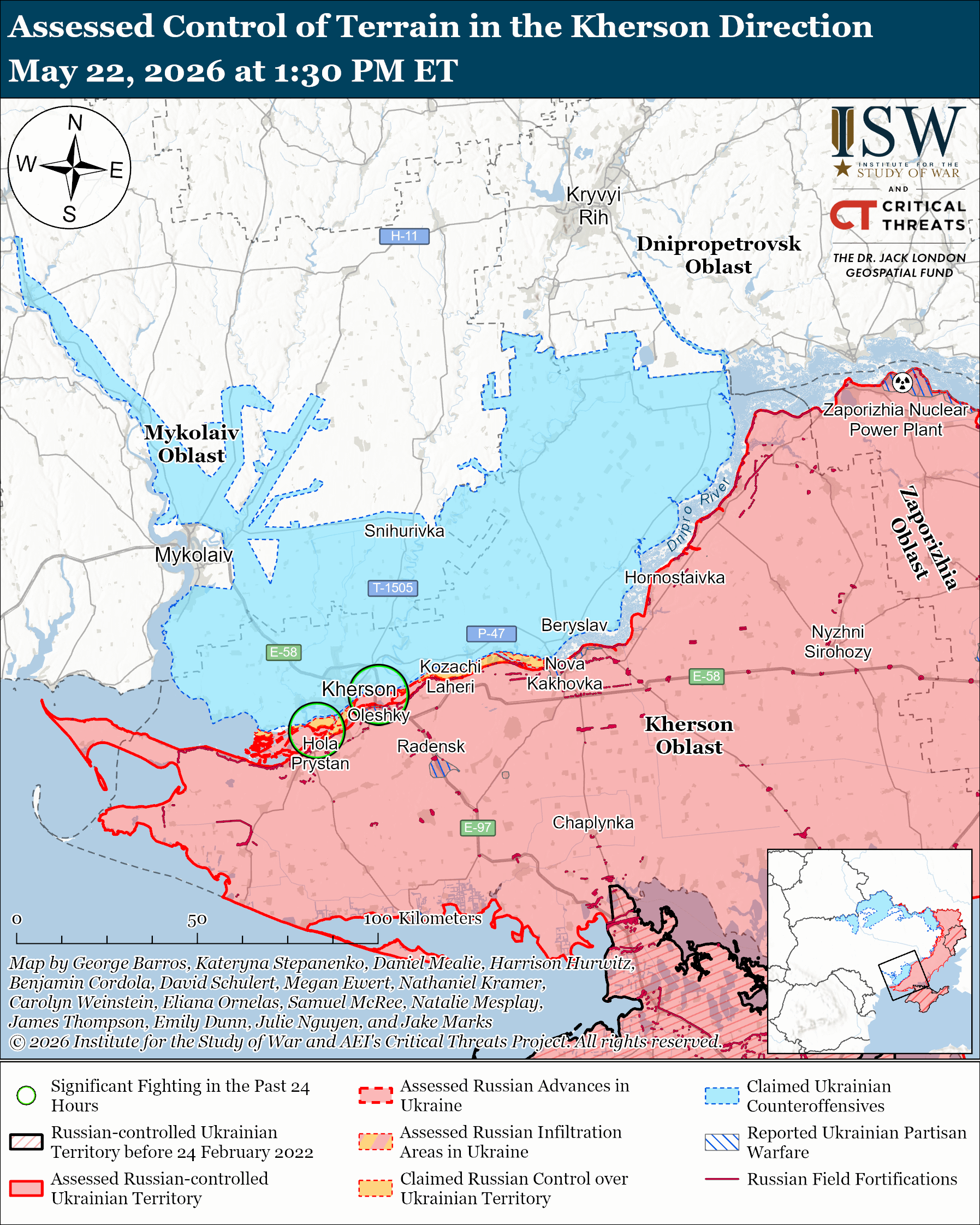
Russian forces continued limited ground attacks in the Kherson direction on May 22 but did not advance.[48]
Russian Air, Missile, and Drone Campaign (Russian Objective: Target Ukrainian military and civilian infrastructure in the rear and on the frontline)
Russian forces conducted a series of long-range drone and missile strikes against Ukraine from May 21 to May 22. The Ukrainian Air Force reported that Russian forces launched 124 Shahed-type, Gerbera-type, Italmas-type, and Parodiya decoy drones from the directions of Kursk, Oryol, and Bryansk cities; Millerovo, Rostov Oblast; Shatalovo, Smolensk Oblast; Primorsko-Akhtarsk, Krasnodar Krai; and occupied Hvardiiske, Crimea.[49] The Ukrainian Air Force reported that Ukrainian forces downed 115 drones, that seven drones struck five locations, and that debris fell on five locations. Ukrainian officials reported that Russian forces struck civilian and administrative infrastructure in Dnipropetrovsk and Mykolaiv oblasts.[50] Ukrainian state energy operator Ukrenergo reported that Russian strikes on energy infrastructure caused power outages in Sumy, Kharkiv, Dnipropetrovsk, Zaporizhia, and Kherson oblasts.[51]
Russian forces struck a major humanitarian aid depot in Ukraine’s rear. The United Nations High Commissioner for Refugees (UNHCR) reported on May 22 that a Russian strike on May 20 on a UNHCR warehouse in Dnipro City killed at least two, injured an unspecified number of others, and caused at least $1 million in damages to basic aid supplies and shelter materials destined for frontline regions.[52]
Significant activity in Belarus (Russian efforts to increase its military presence in Belarus and further integrate Belarus into Russian-favorable frameworks)
Belarus continues to gradually expand its military infrastructure. Satellite imagery captured on May 14 and 17 suggests that Belarus is currently building a new military facility on the site of the former Military Camp No. 25 “Pavlivka” (roughly 185 kilometers from the Ukrainian border), consisting of fortifications, hangars, and foundations for further construction.[53]
Belarus continues to balance its military buildup with both saber-rattling and diplomatic reassurances to the West. Belarusian President Aleksandr Lukashenko stated on May 22, following joint Russian and Belarusian military exercises on May 19 to May 21, that Belarus has no intention of attacking its Western neighbors, and in turn accused Ukrainian and Western actors of conducting an information operation against Belarus.[54] Lukashenko reiterated that Belarus is ready to respond with “every weapon at its disposal” if infringed upon by external powers, however.
Note: ISW does not receive any classified material from any source, uses only publicly available information, and draws extensively on Russian, Ukrainian, and Western reporting and social media, as well as commercially available satellite imagery and other geospatial data as the basis for these reports. References to all sources used are provided in the endnotes of each update.

View Citations