
By Catherine Pepinster
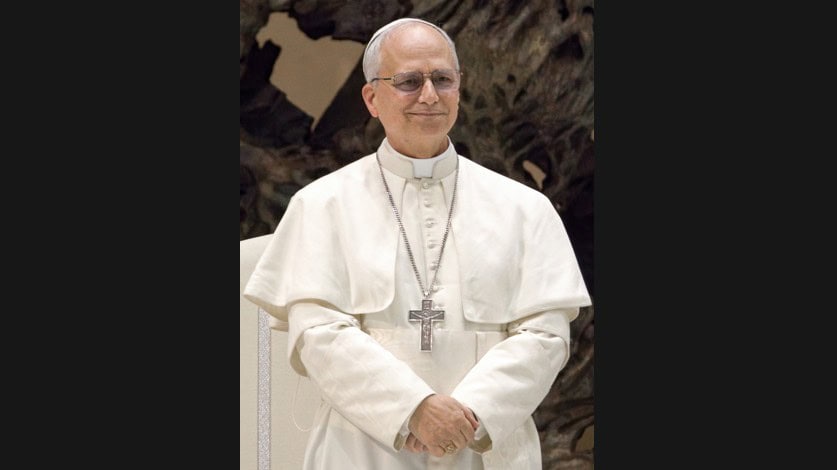
Pope Leo XIV has warned of the dangers facing human civilisation in the face of the growing power and influence of artificial intelligence in his most authoritative document yet.
The Pope, who said when he was elected last year that responding to AI would be a priority of his pontificate, has set out his views in his encyclical, or teaching document:
“Technology is never neutral, because it takes on the characteristics of those who devise, finance, regulate and use it,” and that those involved in developing AI, “bear a particular ethical and spiritual responsibility, for every design choice reflects a vision of humanity.”
AI must be “disarmed,” he said, in order to free it from the mentality of military, economic, and cognitive competition. “To disarm means discrediting the assumption that technical power automatically confers the right to govern. To disarm does not mean rejecting technology, but preventing it from dominating humanity”.
The encyclical “Magnifica Humanitas” (Magnificent Humanity), not only focuses on AI but other pressing issues of our time, including war, modern slavery, wealth inequality, threats to democracy and to human endeavours.
But it is AI that is Pope Leo’s chief concern and the ethical dilemmas surrounding it – a decline in human solidarity and the need to maintain focus on the differences between people and machines. Technology, he writes, “merely imitates certain functions of human intelligence” and cannot replace that intelligence.
“So-called artificial intelligences do not undergo experiences, do not possess a body, do not feel joy or pain, do not mature through relationships and do not know from within what love, work, friendship or responsibility mean,” he says.
One of Leo’s particular concerns is the way in which AI could be used in warfare, which he says must be subject to the “most rigorous ethical constraints”.
Pope Leo acknowledges that the development of AI is fast-moving which means that commentary on it is at risk of quickly being out-dated. But given that AI is more cultivated than built, with developers creating a framework through which the intelligence grows, there needs to be specific attention given to it: “on the one hand, a deepening of scientific research; on the other, the exercise of moral and spiritual discernment.”
The danger, he comments, is that AI systems can surpass human intelligence but they have no moral conscience:
“They do not judge good and evil, grasp the ultimate meaning of situations, or bear responsibility for consequences. They may imitate language, behaviour and analytical skills, or even simulate empathy and understanding, but they do not understand what they produce, for they lack the affective, relational and spiritual perspective through which human beings grow in wisdom”.
Pope Leo acknowledges the valuable tool which AI can be, but at a personal level it can be dangerous, creating an illusion of a personal friendship, while its use by public bodies means that “important and sensitive decisions — concerning employment, credit, access to public services or even a person’s reputation — risk being fully delegated to automated systems that do not know compassion, mercy, forgiveness, and above all, the hope that people are able to change”.
He also expresses concern about the environmental impact of AI, given that systems require huge amounts of energy and water.
Leo rejects the idea that questioning the ethical issues surrounding AI means opposing progress. Rather, calling for prudence and rigorous evaluation, he writes, means recognising the importance of “responsible care for the human family” and the need for discussion of ethical frameworks.
If that doesn’t happen, “those who control AI will impose their own moral vision, which will become the invisible infrastructure of these systems. A more moral AI is not enough if that morality is determined by a few”.
Encyclicals have traditionally been documents sent by the Pope to his bishops and the laity, but in recent times, starting with Pope Francis, they have been issued as letters to all people of goodwill. Pope Leo is the first pontiff to publicly launch his encyclical himself at the Vatican, rather than delegate it to a cardinal.
While he sets his work in the context of Catholic social teaching and particularly cites the work of his nineteenth century predecessor Leo XIII on industrialisation and its impact on humanity, there is a surprising aspect to what he writes, with his critique of one of the most celebrated social doctrines of the Church: on just war.
He says that this theory is now “outdated”. The theory, which owes much to the medieval Dominican theologian Thomas Aquinas, outlines that war is only acceptable if there are conditions under which is it justified (jus ad bellum) and that it is conducted in an ethical manner (jus in bello). But in the world today, writes Leo, military force can only be used for “self-defence in the strictest sense”.
“Humanity possesses far more effective and capable tools for promoting human life and resolving conflicts, such as dialogue, diplomacy and forgiveness”, he writes. “The use of force, violence and weapons reflects a relational poverty that always has disastrous consequences for civilian populations”.
The Trump administration may well be monitoring closely what the Pope says in this document both about AI and war.
Vice-president J D Vance, a Catholic convert, has previously told the Pope to be careful when he talks about theology after Leo criticized American and Israeli strikes on Iran, while President Donald Trump has also attacked the Pope as “weak on crime and terrible on foreign policy”.
The Trump White House may also perceive as provocative the appearance of Chris Olah, co-founder of the AI company Anthropic, sitting alongside the Pope as he launched his encyclical. Anthropic is involved in a legal dispute with the US Department of Defense over its use of Anthropic’s technology in defence operations.