
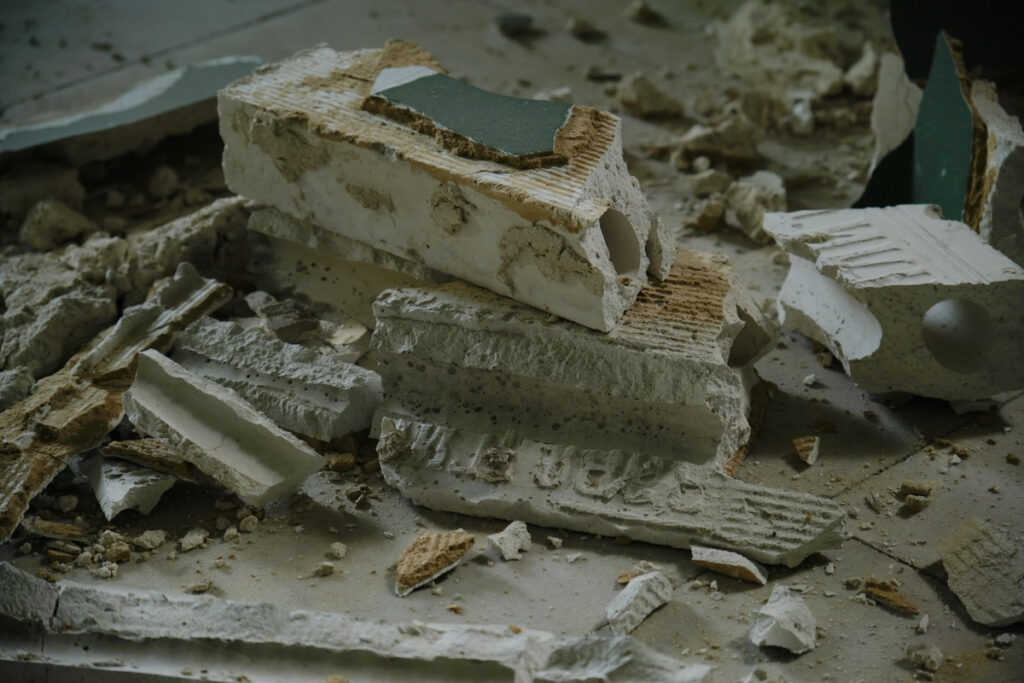
More than 4,300 documented cases. A medieval icon collection that has been evacuated three times. And now a blast wave through the windows of the National Art Museum of Ukraine. Russia’s latest strike on Kyiv hit not just buildings, but centuries of cultural memory.
During the night of May 24, Russia launched a massive, combined attack on Kyiv and other Ukrainian cities. Among the dozens of damaged sites were several major cultural institutions.
Follow our coverage of the war on the @Kyivpost_official.
At the National Chornobyl Museum, about 40% of the exhibition’s artifacts were reportedly lost beyond recovery. The collections displayed at NAMU were successfully saved, though the museum’s historic building sustained damage from the blast wave.
The damaged structure is a national landmark of architecture, history, and monumental art, designed by architect Vladislav Gorodetsky near Kyiv’s government quarter. In recent years, the building had undergone large-scale restoration while continuing to serve as one of the capital’s key cultural strongholds during wartime.
Museum officials said neither staff nor collections were harmed. The NAMU team is currently working with emergency and heritage specialists to document the consequences of the attack and assess the scale of the damage.
“We are currently dealing with the immediate aftermath of the destruction,” said Yuliya Lytvynets. “The next stage will involve developing a new restoration plan based on a detailed analysis of the building’s structures and surviving elements that may still be preserved and reused. Only after that will it be possible to move on to the actual restoration of the building.”
Other Topics of Interest
Over 900 Housing Compensation Claims Made in Kyiv After Russia’s Weekend Missile Barrage
Ukraine’s recovery minister said nearly 1,000 housing compensation claims were submitted in Kyiv alone within 24 hours of the attack, with another 147 filed across the wider region. The compensation is provided through Ukraine’s eRecovery program, launched in May 2023, under which the government helps people repair or replace homes destroyed in Russian attacks.
NAMU is one of Ukraine’s oldest museums and houses tens of thousands of works of Ukrainian art – from medieval icon painting to contemporary works.
Since Ukraine gained independence, the museum has had to urgently evacuate and hide parts of its collection three times: during the Orange Revolution, the Revolution of Dignity, and in the first days of Russia’s full-scale invasion.
Lytvynets recalls that in 2022, the museum became almost a shelter and second home for part of the staff.
“In the first weeks of the full-scale war, some members of our team practically lived inside the museum,” she said. “Despite everything happening outside, there was a sense of calm inside. We were protecting the museum, but in a way, the museum was also protecting us.”
NAMU reopened to the wider public only in the summer of 2023. Before that, it mainly hosted foreign delegations interested in seeing how a cultural institution functions during wartime.
The museum’s main entrance had already been closed for restoration works before the attack.
Despite the war, NAMU continued renovating parts of its interior spaces. One storage facility was fully restored and reequipped thanks to support from British publisher Thames & Hudson and the ALIPH Foundation, which supports cultural heritage preservation in conflict zones.
Part of the museum’s collection is currently traveling internationally as part of Ukraine’s cultural diplomacy efforts.
Two days before the attack, on May 21, curator, gallerist, artist, and co-founder of the Raphael Lemkin Society Hanka Tretiak opened the exhibition-performance “Disco Art: In the Rhythm of Light” at NAMU – a project exploring art as experience, rhythm, and a form of art therapy during war.
“It was a performance-exhibition by two artists – Holyi / Kostiantyn Mishukov and Oleh Tistol – who continue to work in Ukraine during the war, reflecting on this experience and creating their own artistic language,” Tretiak said.
“The project combined painting, video art, sculpture, light, and music into a space designed to shift people’s emotional state and give them at least a brief escape from the daily stress of war. We saw how deeply art is capable of supporting people in times like these.”
After the overnight strike and damage to the museum on May 24, the exhibition had to be dismantled.
“It is especially symbolic and painful that this happened just days after International Museum Day,” Tretiak added. “Monitoring databases of war crimes have already documented more than 4,357 cases of damage to or destruction of cultural heritage sites – and after this latest attack, that number has risen again. Russians are destroying cultural heritage that belongs not only to Ukraine, but to all of Europe and the world.”