
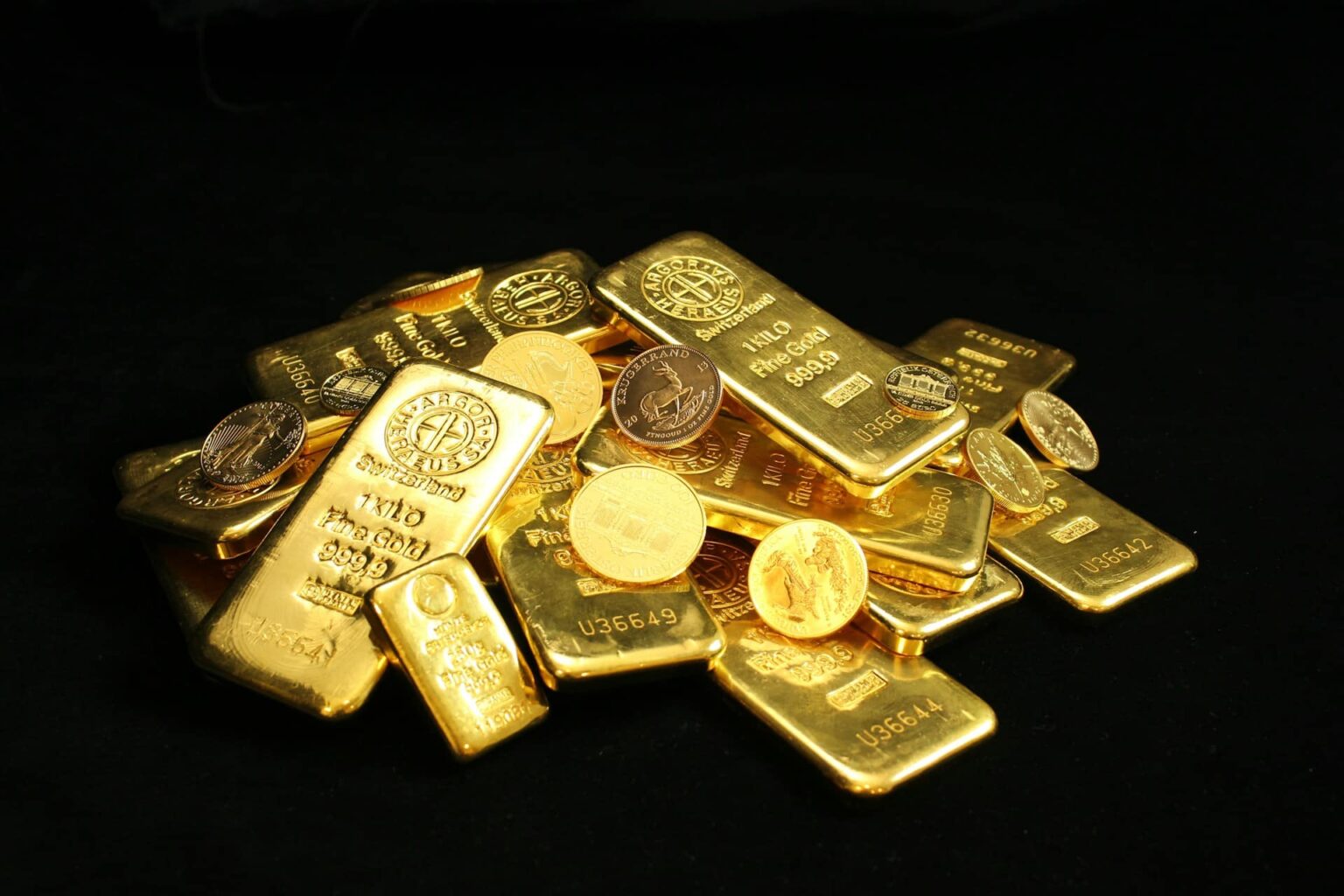
 Credit: Unsplash.
Gold has survived in tombs, shipwrecks and museum cases with a stubborn glitter that other metals cannot match. While iron reddens, copper turns green, and silver darkens, gold seems to persist unadulterated by the environment.
A new study suggests that gold’s imperviousness to rust is not simply a matter of gold being chemically aloof. At its surface, gold atoms can subtly rearrange themselves into patterns that make oxygen reactions dramatically harder.
The finding helps explain why gold objects can stay pristine for thousands of years, while also pointing to a way to make gold more useful in catalysts for industry, pollution control and clean-energy chemistry.
A Hidden Defense on the Surface
Gold has long been known as a “noble” metal, meaning it does not react easily with oxygen, water or many other substances. This quality explains why it has been prized for jewelry, coins and sacred objects for thousands of years.
Oxygen drives rust and tarnish on many metals by first splitting into individual oxygen atoms, which can then bind to the metal surface. Gold is not vulnerable to rust. Yet tiny particles of gold, especially nanoparticles, can sometimes act as surprisingly good catalysts for oxygen-driven reactions.
 A coffin of solid gold held King Tut’s mummified remains. Credit: Net Geo.
Researchers at Tulane University set out to examine this paradox at the atomic level. In their new study, computational chemists Santu Biswas and Matthew M. Montemore used quantum mechanical simulations to test how oxygen molecules behave on two common gold surfaces.
“People have generally thought gold doesn’t tarnish simply because it doesn’t interact strongly with oxygen,” said Matthew Montemore, an associate professor of chemical engineering at Tulane University.
“What we show is that for two of the most common gold surface types, the surface atoms actually rearrange themselves in a way that makes the gold much more resistant to oxidation.”
When a fresh gold surface appears — after cutting, scratching or forming a new crystal face — its outer atoms do not necessarily stay in the same positions they had inside the solid metal. They can shift into a new arrangement, a process called reconstruction.
In the simulations, the difference was striking. Unreconstructed gold surfaces had looser, square-like patterns. Those surfaces gave oxygen enough room to split apart. Reconstructed surfaces packed the atoms into tighter hexagonal patterns. On those, oxygen molecules struggled to break.
Why Tiny Shifts Matter
The effect was far larger than the researchers expected. On reconstructed gold, oxygen dissociation slowed by a factor of a billion to a trillion compared with unreconstructed surfaces.
“Just how much more reticent the reconstructed gold was to oxidize was ‘definitely a surprise,’” Montemore told Science News. “It’s something like a billion to a trillion times slower oxidation once you rearrange.”
That helps explain why bulk gold — the kind in rings, coins, wires and artifacts — can keep its shine for so long. The surface settles into a low-energy arrangement that also happens to make oxidation extremely difficult.
The protection is not perfect in an absolute sense. Gold oxide is unstable and even if the more reactive square arrangement could be maintained, gold would probably form only a thin oxide layer. But the study changes the emphasis. Gold does not merely sit there refusing oxygen. Its surface geometry can help decide how strongly it resists.
The finding also connects to a major turn in chemistry that began in the 1980s, when scientists discovered that gold nanoparticles could catalyze reactions that bulk gold performs poorly. That was surprising because catalysts often need to grab and activate molecules, while gold seemed too inert for the job.
The new work suggests one reason nanoparticles behave differently. Small particles may expose more unreconstructed, square-like regions or prevent gold from fully settling into its tightly packed surface pattern. Those less orderly patches may give oxygen the space it needs to split.
From Jewelry to Catalysts
Oxygen activation through catalysis is central to many useful reactions. Catalysts that split oxygen can help turn carbon monoxide into carbon dioxide, make industrial chemicals and drive oxidation reactions used in manufacturing.
Gold already plays a role in some catalytic systems. Gold-palladium catalysts help produce vinyl acetate, a building block for plastics and other materials. Researchers are also studying gold-based catalysts for cleaning carbon monoxide from exhaust and producing propylene oxide, an important industrial chemical.
Gold has an appealing balance for this work. More reactive metals may activate oxygen easily, but they can also corrode, bind oxygen too tightly or produce unwanted byproducts. Gold’s resistance to surface oxidation can be an advantage — provided chemists can persuade it to activate oxygen when needed.
“If you can trick gold into dissociating oxygen, it can actually become a very effective catalyst for certain reactions,” Montemore said. “Our work suggests a new strategy for potentially doing that by preventing or reversing these surface rearrangements.”
Until now, researchers have often tried to improve gold catalysts by mixing gold with other metals or placing tiny gold particles on oxide supports. The new study suggests another route: control the surface shape itself. Stabilizing square or rectangular surface patterns could make gold more chemically active without abandoning the qualities that make it valuable.
The same atomic arrangement that helps a gold ring survive generations may also limit gold’s industrial usefulness. Change that arrangement, and one of the least reactive metals may become a sharper chemical tool.
The findings appeared in the journal Physical Review Letters.