
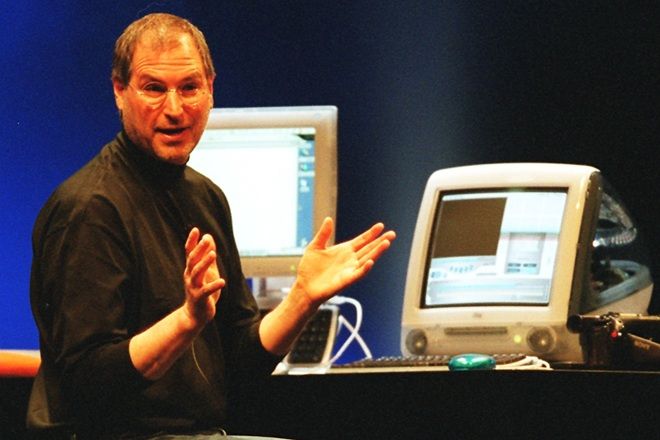
SAN FRANCISCO—A global tech behemoth appears to be at the start of a new era, which is not necessarily a good thing.
Although Apple Inc. turned 50 in April and is getting a new CEO in fall, comparing its current “rut” to its prior world-changing innovations has only deepened the murk of whether its prospects can continue building on past triumphs.
Tech analyst Horace Dediu attributes Japanese consumer electronics companies as nurturing the U.S. tech giant.
“Japan could … teach the world during the ’90s and onward about how to do better manufacturing,” he said. “And they taught Apple.”
These positions eventually flipped, with no new firms coming out of Japan to take the world by storm; where they stumbled, Apple found success.
Apple now has 2.5 billion active devices worldwide, including its largest cash cow—iPhones and Macs.
By making computers accessible beyond professional settings to consumers, it arguably helped democratization of information and became the first U.S. company worth $1 trillion (158 trillion yen) in 2018.
But what caused this reversal? And why is it relevant again?
Apple was inspired by Japanese companies being committed to high-quality products from a component level, their highly efficient manufacturing operations and their technology, which allowed them to make smaller and higher performance products.
“Steve Jobs was in awe of Japan,” Dediu said of Apple’s co-founder and later CEO. “They (Apple executives) were absolutely paralyzed with fear that Sony (Corp.) would beat them at this game.”
Jobs also held a great respect for the country and learned from its companies. He was fascinated by the Walkman and that its portability created a new lifestyle that made it possible to listen to music outside the home.
At the time, many Japanese companies made strenuous efforts to ascertain customer needs by conducting thorough market research.
However, the intense commitment to quality and other details eventually backfired.
“I think the Japanese were for many decades thinking that if you build good things, particularly if they were better than what was on the market, then customers would buy them by simply focusing on quality,” the analyst continued.
This led to an issue of diminishing returns where their customers were unable to recognize a difference in quality despite them concentrating resources toward improvements such as graphics. Another issue that emerged was adding special features only used by some users.
On the other hand, according to Dediu, Apple shied away from questionnaire-based market surveys.
“They have talks among themselves. They talk to each other,” he said.
Rather than overly relying on consumer voices, the company pursued what it saw as the true needs of customers.
When developing the iPhone, the company zeroed in on the question of what users would want to do with the product.
This meant doing the opposite of Japanese and European companies that continued adding buttons to their mobile devices; Apple pared them down to achieve a simple design that was easy to use.
Apple created potential demand among those less technologically savvy with computers and others who wanted to use the internet while traveling.
“The most important distinction is that Apple created the world’s most successful consumer product ever,” said David Yoffie, a Harvard Business School professor specializing in competitive strategy, who has observed Apple for more than 40 years. “The iPhone is off the charts. … (Apple) built its ecosystem around that closed product to try to lock in their customers.”
This “ecosystem” involves Apple’s strict control over what apps and features are usable on its devices through its own operating systems.
Doing so meant it provided security and guaranteed user-friendliness while also succeeding at retaining customers.
The first iPhone was released 19 years ago.
Although Apple continues to improve its smartphone, including making it thinner and enhancing its camera performance, it appears the company is struggling creatively.
It also seems that Apple has become trapped in the “innovator’s dilemma” just as Japanese companies were in the past.
Digital devices other than smartphones are also beginning to gain in popularity, such as smartglasses created by Meta Platforms Inc. and an artificial intelligence device currently being developed by OpenAI.
Tim Cook, who took over for Jobs 15 years ago, will be succeeded as CEO by hardware chief John Ternus on Sept. 1.
Dediu said Apple’s starting point is key for the company’s continuous growth, and that its next 50 years hinge on whether it can still ask, and correctly answer, what it is that customers truly want.