
 Paquita – Lithuanian National Ballet, opening night cast 21-05-2026
Paquita is a surprising survivor. 180 years have elapsed since Joseph Masilier’s choreography was first performed at the Paris Opera, but despite this longevity, it lacks the kudos and worldwide popularity of other classical ballets from the nineteenth century.
Marius Petipa gave Paquita a facelift in 1881, adding the Grand Pas Classique as a spectacular finale, which became a stand-alone favourite throughout the twentieth century, with the pas de deux often used as ubiquitous gala fare. One reason for its detachment from the full-length ballet was the latter’s slimline story, a scanty tale even by ballet standards.
The twenty-first century opened with Pierre Lacotte’s full-scale rehabilitation of the 1846 ballet at its original home of the Paris Opera Ballet, and now, Manuel Legris, a Parisian Étoile for a quarter of a century, has built upon his familiarity with Lacotte’s ballet to create his own vision of Paquita. It retains the romance of Spain with an abandoned young girl being rescued and brought up by Andalusian gypsies; her love for an aristocratic Spanish Colonel seemingly doomed by their social divide, until her true identity is revealed.


Legris has kept that skeleton structure in place but, with support from his dramaturg, Jean-François Vazelle, he has provided a new historical context by setting the events around the opening of the Puente de Isabel II (the Triana Bridge) in Seville on 23 February 1852, an inauguration surrounded by intrigue between the loyal supporters of Queen Isabella and the misogynistic Carlists, who believed that the rightful king was her uncle, the infante Don Carlos de Borbón (known as Charles V). To be historically accurate, since he had renounced his claim to the throne and was incapacitated by a stroke in 1849, the Carlist claimant at the time of the Triana Bridge’s opening would have been his son, Carlos Luis de Borbón (Charles VI).
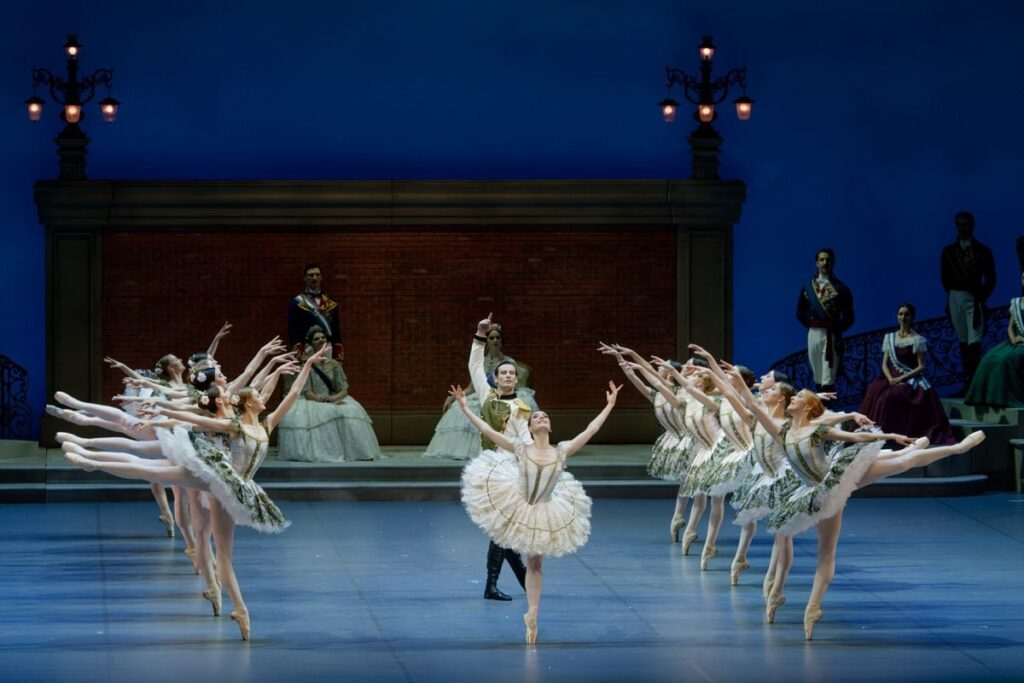
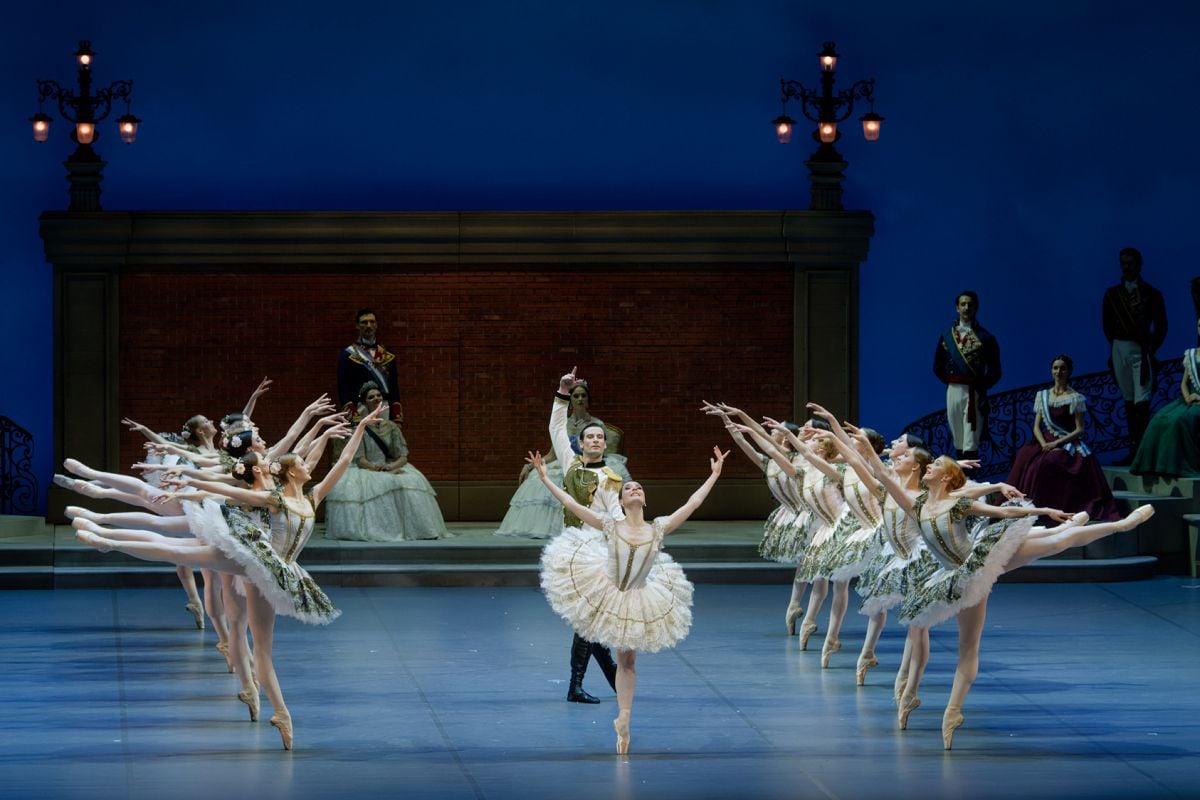
The narrative in this new production of Paquita is done and dusted through just a brief prologue and three scenes, concluding within a few minutes of the second act, to be followed by the celebrations of the Grand Pas Classique. As a supreme classicist himself, Legris has left this lengthy divertissement largely untouched as a challenging performance test for the soloists and corps, and they acquitted themselves with alacrity and distinction over the two casts that I had the pleasure to see.
The story may be scant, but, like Don Quixote or The Sleeping Beauty, Paquita is a big ballet with a host of dancing and character roles, and I was impressed by the depth of talent in the Lithuanian company, which had no need to engage guest dancers from elsewhere. The two ballerinas I witnessed in the title role, Olesia Šaitanova and Kristina Gudžiūnaitė, gave excellent performances with consummate technical skills: Šaitanova’s pristine footwork was especially impressive, and she rattled off her 32 fouettés in the Grand Pas coda with a mix of doubles and even a triple turn; Gudžiūnaitė’s technique was to take the stamina-sapping journey of single whipped spins, the first 24 of which were completed hands-on-hip. Her strength of leg and balance was remarkable.
The two performances as Colonel Lucien d’Hervilly could not have been more different. Opposite Šaitanova, Jonas Laucius exuded an aristocratic and military bearing, haughty until melting through the ‘Romeo and Juliet’ moment of love at his first sight of Paquita. His virtuoso dancing was powerful, including a striking manège of barrel turns in the finale. Edvinas Jakonis was a more coltish d’Hervilly, but his chemistry with Gudžiūnaitė was palpable. Incidentally, Jakonis opted for a more traditional manège of coupé jeté en tournant, which had the audience applauding long before the circle was complete. Jakonis had an all-too-brief spell of 18 months at English National Ballet, and, on this evidence, it was a good decision to return to his homeland (where he was recently voted ballet soloist of the year).

Mime plays a huge part in the storytelling and was portrayed with great clarity by all. The historical relevance was emphasised by the presence of not only Queen Isabella (Barbara Gudavičiūtė in both casts) but also her friend, the French Empress Eugénie (Vilija Montrimaitė); and – in a touch of genius – the imagined performance of a Spanish Cachucha, a sensuous dance with castanets, by the celebrated ballerina, Fanny Elssler at a Reception to celebrate the bridge’s inauguration. A little artistic licence was necessary since Elssler was no longer performing by 1852! On the opening night, this vital solo was danced by Miryam Roca Cruz with superhuman back bends and, on the following evening, with great coordination of castanets and dancing, by Jekaterina Kučinskienė.
There is insufficient space to pay tribute to all the credited dancers on both nights, but a special commendation is due to the dancers of the first act pas de trois with impressive variations at both performances (Arata Yamamoto, Marija Kastorina and Saulė Jauniškytė followed by Reito Nashiki, Kastorina and Julia Alonso). Mantas Daraškevičius was suitably arrogant as the duplicitous Don López de Mendoza, the Governor of Seville, whose intentions to kill the Queen with the aid of Paquita’s stepbrother, Inigas (Ignas Armalis and Imanol Sastre), are thwarted by Paquita and d’Hervilly at the conclusion of the first act.
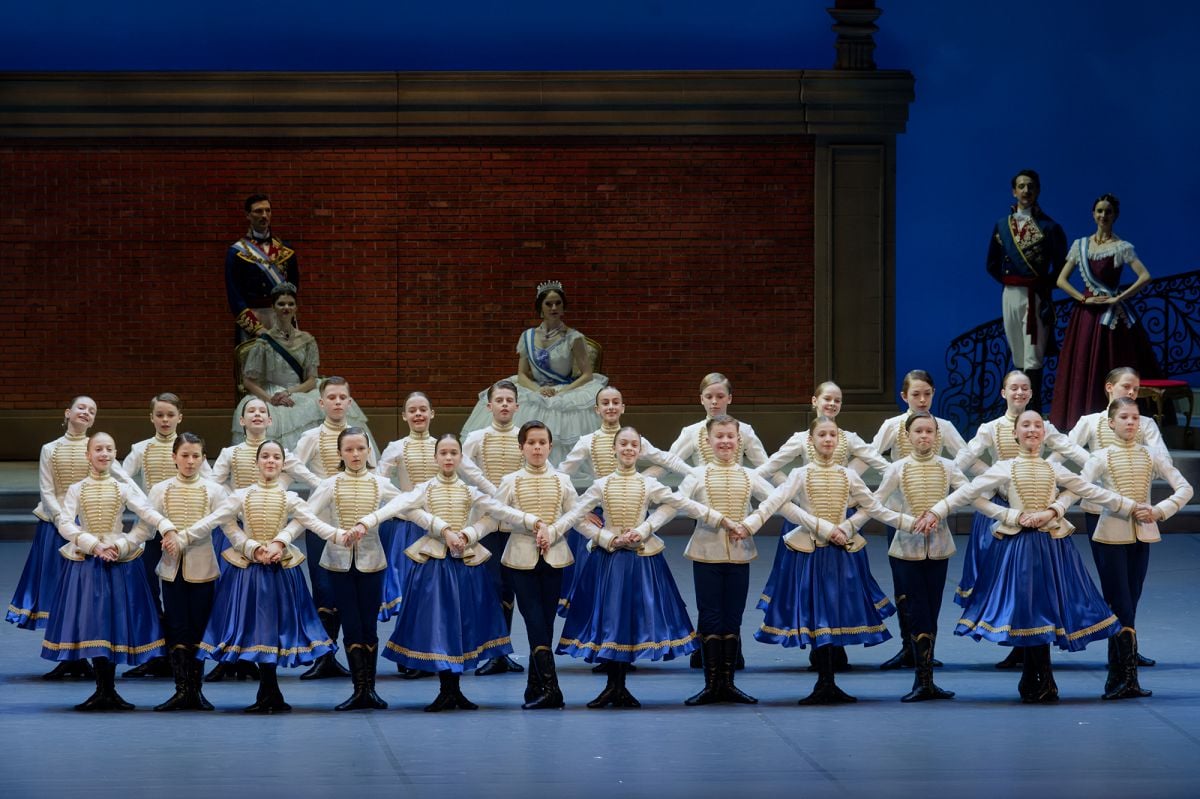
As a rule, I’m no great fan of children in ballet, but the Grand Pas included the charming interlude of 24 young dancers in a joyously structured formal dance, the performers graduated by height. The two separate casts performed with unity on both occasions.
 Paquita – Lithuanian National Ballet, opening night cast 21-05-2026
The excellence of this production was further assured through a superb score, arranged and conducted by Maria Seletskaja, and magnificent set and costume designs by Jean-Marc Puissant. Seletskaja’s reworking of the music began with a piano reduction in collaboration with pianist Maria Babanina, using the original score by Édouard Deldevez as an anchor and building onto it with ballet music of the time by Cesare Pugni, Ludwig Minkus, Adolphe Adam and Friedrich Burgmüller. The outcome is a great credit to Seletskaja and Babanina for coalescing these diverse elements into a rich and seamless score that is both “new” and respectful of the ballet’s musical history.
Puissant’s designs fit into this same mould. The costumes are spectacular and varied, from militaria and royalty to the gitanos of Sevilla and the long opening scene is dominated by a background image of the Triana Bridge, still a tourist attraction today and an Iron marvel of the modern world when it was built. The range and quality of the tutus worn in the Grand pas Classique was breathtakingly beautiful with outstanding costume craftsmanship.
All in all, both performances were hugely enjoyable and showed the range and diversity of the Lithuanian company to great effect, proving also that Legris is as much a master of classical ballet creation as he was one of the outstanding classical dancers of his generation. Having made Le Corsaire on the company in 2018, he is clearly building a rapport with Lithuanian National Ballet and the mutual inspiration between choreographer and dancers was obvious.
Second Night Cast 22 May 2026
Related

Graham Watts is a freelance writer and dance critic. He writes for The Spectator, Tanz, Shinshokan Dance Magazine (Japan), Ballet Magazine (Romania), BachTrack and the Hong Kong International Arts Festival and has previously written for the Sunday Express, Dancing Times, Dance Europe, DanceTabs, London Dance, the Edinburgh International Festival and Pointe magazine (USA). He has also written the biography of Daria Klimentová (The Agony and the Ecstasy) and contributed chapters about the work of Akram Khan to the Oxford Handbook of Contemporary Ballet and on Shobana Jeyasingh for the third edition of Routledge’s Fifty Contemporary Choreographers.
He is Chairman of the Dance Section of The Critics’ Circle and of the UK National Dance Awards and regularly lectures on dance writing and criticism at The Royal Academy of Dance, The Place and (until the war) for Balletristic in Kyiv. He was a nominee for the Dance Writing Award in the 2018 One Dance UK Awards and was appointed OBE in 2008.