
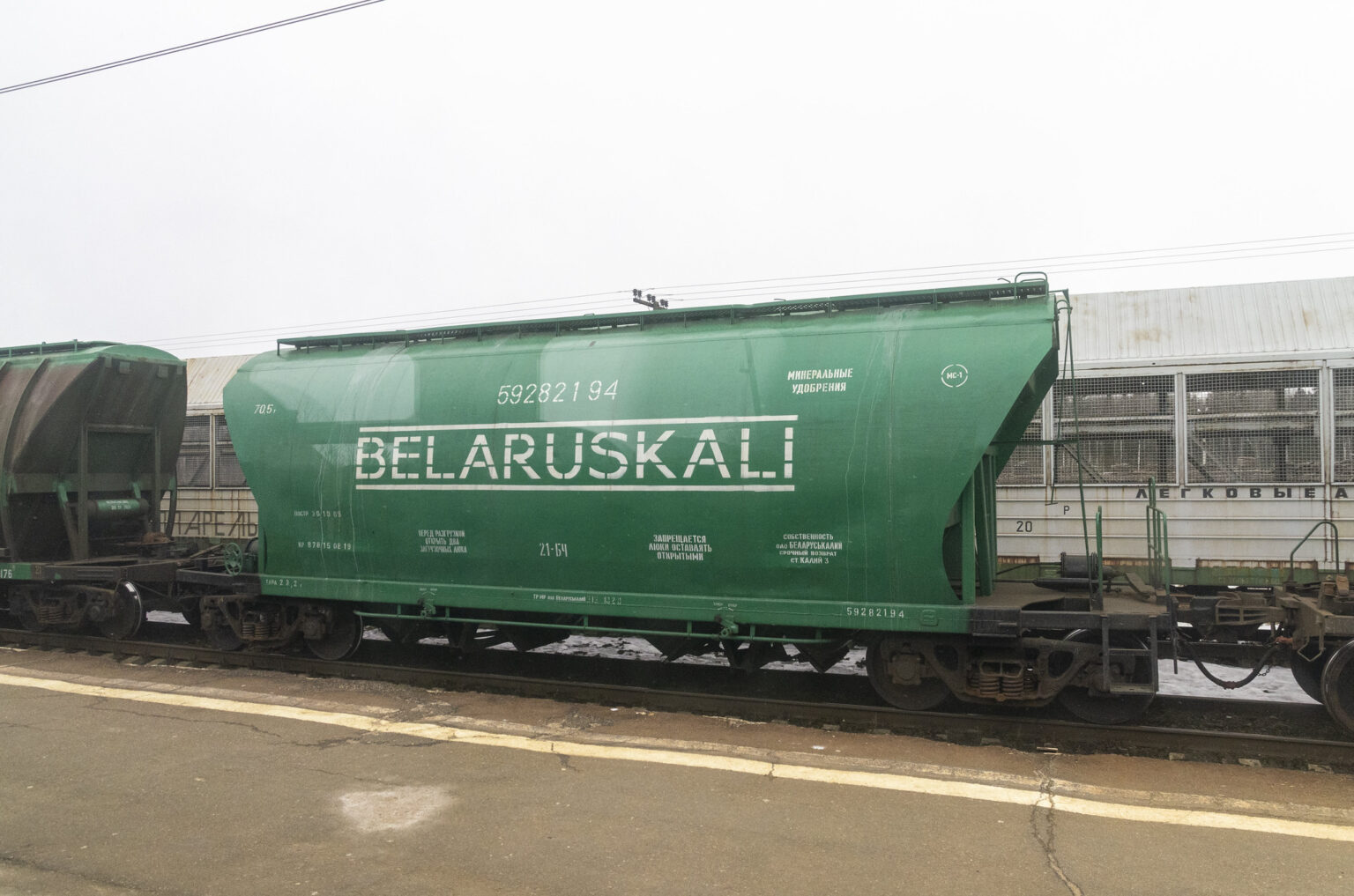
US officials have urged Lithuania, Poland and Ukraine to lift sanctions on Belarusian potash fertilizers and allow their transit through their territories.
Radio Free Europe/Radio Liberty (RFE/RL) has obtained an undated, one-page document sent to Lithuania, Poland and Ukraine. It refers to the decision by US President Donald Trump’s administration in March to lift sanctions on Belaruskali, a state-owned fertilizer producer. The document states that now that the US has lifted sanctions on Belaruskali, American companies are interested in purchasing and transporting Belarusian potash fertilizers. This requires permission to export the fertilizers through the territory of European Union countries or Ukraine to avoid transit through Russia.
It is also indicated that the US is interested in exploring potential transit routes through Lithuania, Poland or Ukraine to alleviate the crisis in the international fertilizer market, and hopes to wait for concrete decisions.
Belaruskali is one of the largest producers of potash fertilizers in the world, and as such is also a significant source of income for the government of self-proclaimed President Alexander Lukashenko.
A senior EU official, who wished to remain anonymous, indicated that the proposal, known in diplomatic circles as an informal or discussion document, was received by all three countries from the US State Department.
Ukraine’s Foreign Ministry confirmed receipt of the document but declined to comment further.
The Polish Foreign Ministry did not respond to RFE/RL’s request for comment, while the Lithuanian Foreign Ministry denied receiving such a request, although the Lithuanian foreign minister said last week that Washington was exerting pressure to resume transit of Belarusian fertilizers. Relations between Poland and Lithuania (both NATO and EU members) and Lukashenko are frosty, in part because the Belarusian politician maintains warm relations with the Kremlin.
Belarusian opposition leader Sviatlana Tsikhanouskaya told RFE/RL on the 22nd of May that now was not the time to ease sanctions against Lukashenko’s regime. She added that the US proposal to lift sanctions on Belarusian potash fertilizer exports is not an instruction, suggesting that Washington knows that each country can decide for itself whether to restore contacts with Lukashenko. Various interests are at stake, and a free and secure Belarus is also in the interests of its neighbors. At the Globsec security conference in Prague, Tsikhanouska said that neighboring countries are not naive and understand that as long as Lukashenko is in power, balloons will continue to fly over Lithuania, Belarusians will demonstrate nuclear weapons, and conduct military exercises, so lifting sanctions is not the right course of action.
The US and the EU imposed significant sanctions on Lukashenko and his government in 2020. At that time, after the presidential elections, in which Lukashenko declared himself the winner, widespread protests broke out, which were violently suppressed.
The Belarusian opposition and much of the West called the results rigged, and protests raged for weeks.
Since returning to the White House in January 2025, Trump has focused on restoring relations with Minsk. Trump’s top envoy for Belarus, John Coale, met with Lukashenko in Minsk and secured the release of a large number of political prisoners. In return, the Trump administration has eased sanctions on Belaruskali, the state airline Belavia, and other companies.
Meanwhile, the EU unanimously expanded sanctions against Belarus earlier this year. The sanctions include a ban on the import of potash fertilizers produced in Belarus, and specific sanctions on companies such as Belaruskali. Imports of nitrogen fertilizers from Belarus were previously banned. The resumption of transit would require the lifting of sanctions, or the countries whose territory would be used for transit would have to abandon them in an appropriate legal way. The document states that by allowing the purchase of Belarusian products, the EU would deny Russian fertilizer producers profits, and would also prevent the aggressor state from earning income from transit.
Before the introduction of EU sanctions, most Belarusian fertilizers were exported through the ports of the Baltic States, mainly through the port of Klaipeda. In recent years, cargoes have been redirected through Russian ports, mostly using the port of St. Petersburg. The American proposal also offers an unusual financial solution –
all profits that the EU would make from the transit of Belarusian fertilizers would be directed to the defense of Ukraine
against Russian aggression.
The US proposal came at a time when the war launched by the Americans and Israel against Iran and the resulting closure of the Strait of Horus caused a significant increase in the prices of fertilizers and other agricultural products. UN officials have warned that the price hike will also be reflected in food markets, including the US.
Previously, Belarusian mineral fertilizers accounted for about 15% of the total used worldwide.
Read the full article in English here: https://www.lrt.lt/en/news-in-english/19/2939366/us-asks-lithuania-poland-ukraine-to-allow-belarusian-fertiliser-exports