
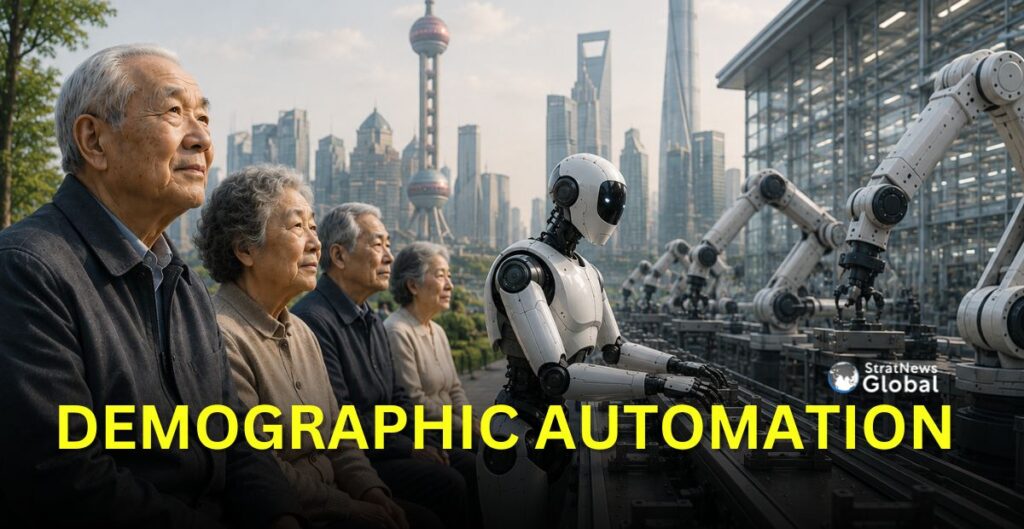

Recent reports published by the South China Morning Post (SCMP) show that China now has more people above the age of 65 than children under 14, for the first time in records dating back to 1949, marking a historic demographic shift for a country that once relied on a massive young workforce to power decades of rapid economic growth.
However, China’s demographic anxiety is no longer just about falling birth rates or an ageing population. It is increasingly trying to redesign itself for a future with fewer young people.
Despite falling marriage registrations and increasing non-marriage and childlessness trends, China is strategically responding to this shift. Rather than viewing ageing purely as a social burden, it is gradually attempting to transform it into a new economic model.
According to a United Nations estimate, China is expected to become a “super-aged” society by the early 2030s, with people aged 65 and older making up 20% of the country’s population. With this China’s ‘silver economy’ is gaining momentum.
According to reporting by SCMP, sales of smart wristbands and smartwatches equipped with elderly-friendly features rose by more than 200% and 350% year-on-year, respectively, during the first eight months of last year, according to data from Alibaba’s Taobao and Tmall platforms.
The report also noted that sales of AI companion robots, devices capable of voice conversations and remote video calling, increased by 200% compared with the previous year during the same period.
Beijing is also increasingly viewing its sizable “younger elderly” population — those between 60 and 64 years old — as an economic resource rather than a dependent group. SCMP reported Chinese authorities are pushing measures aimed at building a more “birth-friendly” society, including efforts to reduce the financial burden of childbirth, childcare and education as the government attempts to slow declining birth rates.
This silver economy is further being powered by artificial intelligence. As the labour force shrinks, China is also accelerating automation.
‘Dark factories’ are rising across the country, as factories are increasingly integrating AI-driven systems, robotics and automated logistics to reduce dependence on human labour.
Automation is becoming demographic policy.
This transformation is not limited to elderly care or consumer technology. China increasingly appears to be betting on AI-driven manufacturing which can compensate for a shrinking workforce while preserving its position as an industrial power.
The push toward robotics, smart manufacturing and industrial AI also aligns with Beijing’s broader strategic ambitions of reducing dependence on foreign technology and maintaining economic productivity despite demographic decline.