
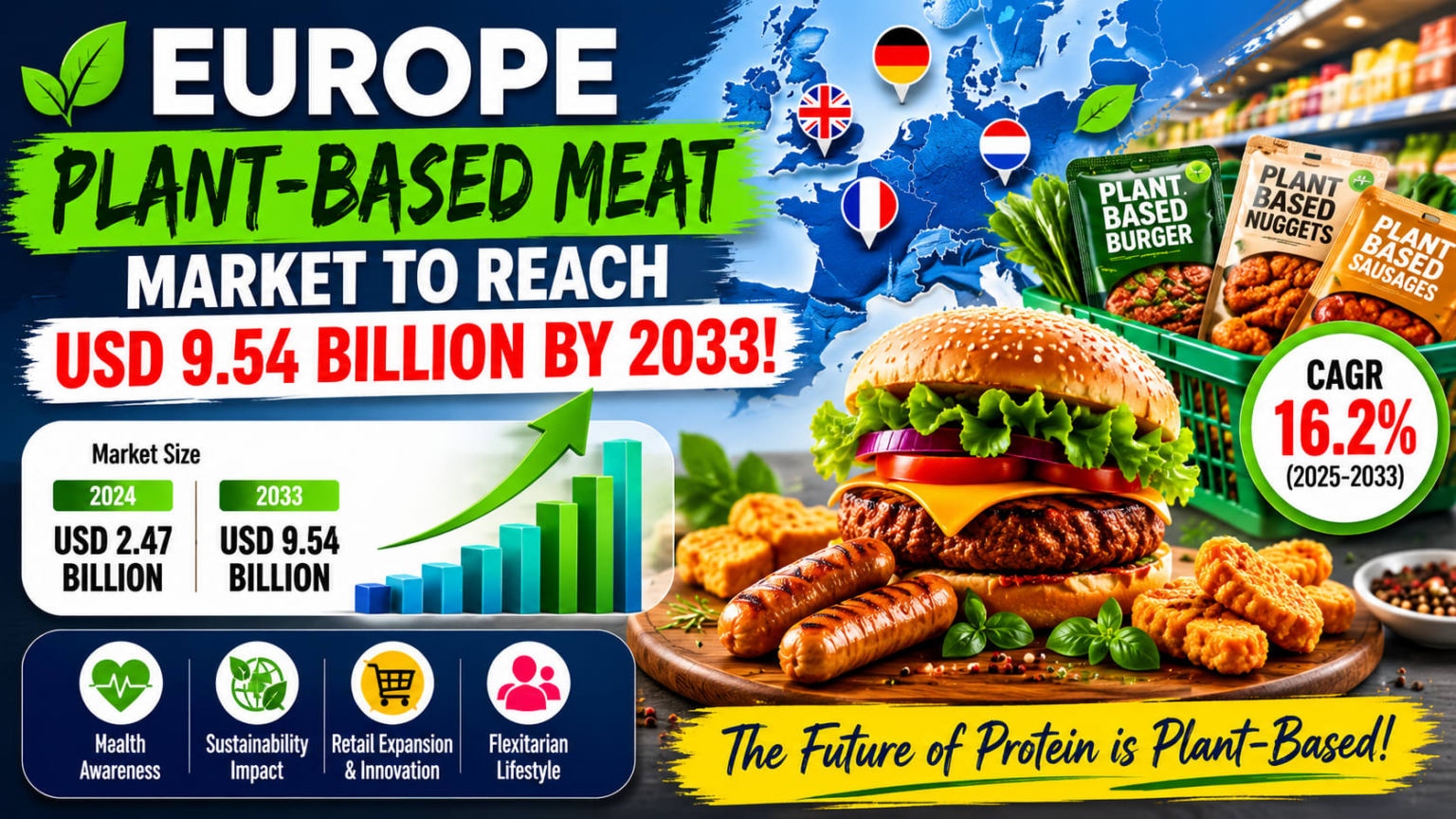
Europe’s food industry is undergoing one of its most significant transformations in decades as plant-based meat products move from niche vegan shelves into mainstream supermarkets, restaurant menus, and household kitchens. According to Renub Research, the Plant-Based Meat Market in Europe was valued at USD 2.47 billion in 2024 and is expected to surge to USD 9.54 billion by 2033, growing at an impressive CAGR of 16.2% between 2025 and 2033.
This remarkable expansion reflects more than just a dietary trend. Across Europe, consumers are increasingly adopting healthier eating habits, reducing meat consumption, and embracing environmentally sustainable food choices. Countries such as Germany, United Kingdom, France, and Netherlands are leading the transition toward alternative protein consumption.
The rise of plant-based meat is not only reshaping consumer behavior but also forcing traditional food manufacturers, retailers, and restaurant chains to rethink their long-term strategies.
Flexitarian Diets Become Europe’s New Normal
One of the strongest drivers behind Europe’s plant-based meat boom is the rapid adoption of flexitarian diets. Unlike strict veganism, flexitarianism encourages reducing meat consumption without eliminating it entirely. This lifestyle has become increasingly attractive to consumers seeking healthier food habits while maintaining dietary flexibility.
European consumers are becoming more aware of the relationship between diet and chronic health conditions such as obesity, cardiovascular disease, and digestive disorders. Plant-based meats are often perceived as lower in saturated fat and cholesterol, making them appealing alternatives to traditional animal protein.
A survey conducted by the Smart Protein Project revealed that flexitarians represent nearly 30% of Europe’s population. When vegetarians and pescatarians are included, the figure climbs to approximately 40%. Furthermore, more than half of surveyed consumers expressed a desire to reduce meat consumption over time.
This growing consumer shift is encouraging food companies to expand plant-based offerings across multiple categories, including burgers, sausages, nuggets, ground meat, and seafood alternatives.
Sustainability Concerns Push Consumers Toward Meat Alternatives
Environmental sustainability has become a defining factor in food purchasing decisions across Europe. Consumers are increasingly linking livestock farming with greenhouse gas emissions, water scarcity, deforestation, and biodiversity loss.
Plant-based meat products are being marketed as environmentally responsible alternatives that can significantly reduce carbon footprints compared to conventional meat production. Governments, environmental organizations, and food advocacy groups across Europe are also supporting the transition toward sustainable protein sources.
Projects such as the VALPRO Path initiative, funded by Horizon Europe and UK Research and Innovation, are helping develop sustainable plant protein supply chains for future food systems.
As climate awareness intensifies among younger generations, sustainability messaging is becoming one of the most powerful marketing tools for plant-based food brands.
Retailers and Foodservice Chains Expand Plant-Based Offerings
Retail expansion is another major growth catalyst for Europe’s plant-based meat market. Supermarket giants and discount retailers are aggressively increasing shelf space dedicated to meat alternatives.
Chains such as Tesco, Carrefour, Aldi, Lidl, and Sainsbury’s are launching private-label vegan products while collaborating with innovative startups to diversify product portfolios.
Improved product innovation is also making plant-based foods more attractive to mainstream consumers. Advances in texture engineering, flavor science, and ingredient technology now allow manufacturers to create products that closely resemble conventional meat in taste and appearance.
Consumers can now choose from a wide range of plant-based foods, including realistic burgers, sausages, meatballs, chicken strips, and seafood alternatives.
Fast-food chains and quick-service restaurants are also helping normalize plant-based eating. Vegan burgers, nuggets, and sandwiches have become increasingly common across restaurant menus in major European cities.
Price and Taste Remain Key Market Challenges
Despite impressive growth, the Europe plant-based meat industry still faces several obstacles.
One of the biggest challenges remains pricing. Plant-based meat products are often significantly more expensive than traditional meat due to high research costs, specialized ingredients, and complex manufacturing processes.
This price gap limits broader adoption, especially among middle-income consumers and price-sensitive markets in Central and Eastern Europe.
Taste and texture also continue to present difficulties for manufacturers. Although technology has improved substantially, many consumers still believe certain plant-based products fail to fully replicate the sensory experience of real meat.
This challenge is particularly important in countries with strong culinary traditions such as France and Italy, where consumer expectations regarding food quality remain exceptionally high.
Pea Protein Emerges as a Strong Alternative to Soy
Soy protein has long dominated the plant-based meat industry because of its affordability and high protein content. However, European consumers are increasingly exploring alternatives due to concerns about allergens and genetically modified ingredients.
As a result, pea protein is rapidly gaining popularity across Europe. Manufacturers favor pea protein because it is allergen-friendly, gluten-free, sustainable, and highly functional in meat analog formulations.
Pea protein is now widely used in burgers, sausages, and meatballs, especially in Northern and Western Europe where demand for clean-label products continues to grow.
Plant-Based Chicken and Seafood Gain Momentum
Among meat categories, plant-based chicken products are seeing particularly strong demand due to their familiarity and versatility. Consumers transitioning away from meat often prefer recognizable products such as nuggets, tenders, and fillets.
Fast-food chains and convenience-focused consumers are driving rapid adoption of these products across the UK, Germany, and Benelux countries.
Meanwhile, plant-based seafood is emerging as a high-potential niche segment. Concerns about overfishing, ocean pollution, and mercury contamination are encouraging consumers to experiment with fish-free seafood products.
Manufacturers are investing heavily in seaweed-based ingredients and advanced flavor technologies to replicate seafood textures and flavors more accurately.
Frozen Products and E-Commerce Strengthen Market Accessibility
Frozen plant-based meat products are becoming increasingly popular among busy urban consumers due to their convenience, affordability, and longer shelf life.
Frozen burgers, sausages, and nuggets dominate supermarket freezer sections across Europe, while foodservice operators also benefit from simplified storage and preparation.
At the same time, e-commerce is emerging as an important sales channel for plant-based brands. Online grocery shopping accelerated significantly after the COVID-19 pandemic, allowing consumers easier access to both mainstream and niche vegan products.
Subscription meal kits, direct-to-consumer brands, and specialty vegan retailers are gaining traction in countries such as Germany, the UK, and the Netherlands.
Germany Leads Europe’s Plant-Based Revolution
Germany remains Europe’s most influential plant-based meat market. The country’s strong vegan and flexitarian culture, combined with environmental awareness and innovation-friendly consumers, has created an ideal environment for alternative protein growth.
Berlin has become a major center for vegan food startups and product innovation. Retailers such as Lidl and Edeka continue expanding plant-based product lines, while local brands gain increasing shelf presence.
Germany’s leadership position is expected to strengthen further as investments in sustainable food manufacturing continue rising.
France and the UK Continue Expanding Plant-Based Consumption
In France, plant-based meat adoption is steadily increasing despite the nation’s deep-rooted culinary traditions centered around animal protein. French consumers are increasingly interested in premium, gourmet-style vegan products emphasizing organic ingredients and local sourcing.
Meanwhile, the United Kingdom continues to represent one of Europe’s most mature plant-based markets. Vegan campaigns such as Veganuary, combined with strong retail penetration and environmentally conscious younger consumers, continue fueling demand.
The UK market also benefits from strong visibility for established plant-based brands in supermarkets and food delivery platforms.
10 Recent Developments by Leading Companies
1. Beyond Meat Expanded UK Product Portfolio
In April 2023, the company introduced new chicken-style products in select Waitrose and Sainsbury’s stores across the UK, strengthening its European retail presence.
2. Planted Foods AG Announced New Germany Factory
In September 2024, Swiss meat analogue producer Planted announced plans to establish a large vegan meat production facility in Bavaria, Germany.
3. Aoste Better Balance Introduced Meat-Free Product Line
The French charcuterie company launched soy- and pea-based burgers, sausages, and cutlets in March 2024.
4. Project Eaden Secured Major Funding
The foodtech startup raised €15 million in January 2025 to accelerate development of ultra-realistic plant-based meats using fiber-spinning technology.
5. Danone Expanded Plant-Based Nutrition Focus
The company continues increasing investments in dairy-free and alternative protein innovation across European markets.
6. Hormel Foods Corporation Strengthened Alternative Protein Strategy
Hormel continues exploring diversified protein portfolios to align with changing global food consumption patterns.
7. Tyson Foods Increased Plant-Based Innovation Investments
Tyson Foods continues expanding research into hybrid and fully plant-based protein alternatives.
8. Archer Daniels Midland Company Expanded Plant Protein Supply Capabilities
ADM continues strengthening its global ingredient supply network for alternative protein manufacturers.
9. Taifun-Tofu GmbH Expanded Organic Tofu Offerings
The German manufacturer continues scaling organic tofu and meat-alternative production to meet rising regional demand.
10. Berief Food GmbH Accelerated Private-Label Partnerships
The company is expanding collaborations with European supermarkets for private-label plant-based products.
Final Thoughts
Europe’s plant-based meat market is no longer a temporary food trend—it is becoming a permanent transformation within the region’s food ecosystem. Consumer priorities are rapidly shifting toward health, sustainability, convenience, and ethical consumption, creating enormous opportunities for plant-based food manufacturers.
As innovation improves taste, texture, affordability, and nutritional value, plant-based products are expected to capture an even larger share of Europe’s protein market over the next decade.
With strong support from retailers, foodservice providers, startups, and sustainability initiatives, Europe is positioned to remain one of the world’s most influential hubs for plant-based food innovation.worldwide.