
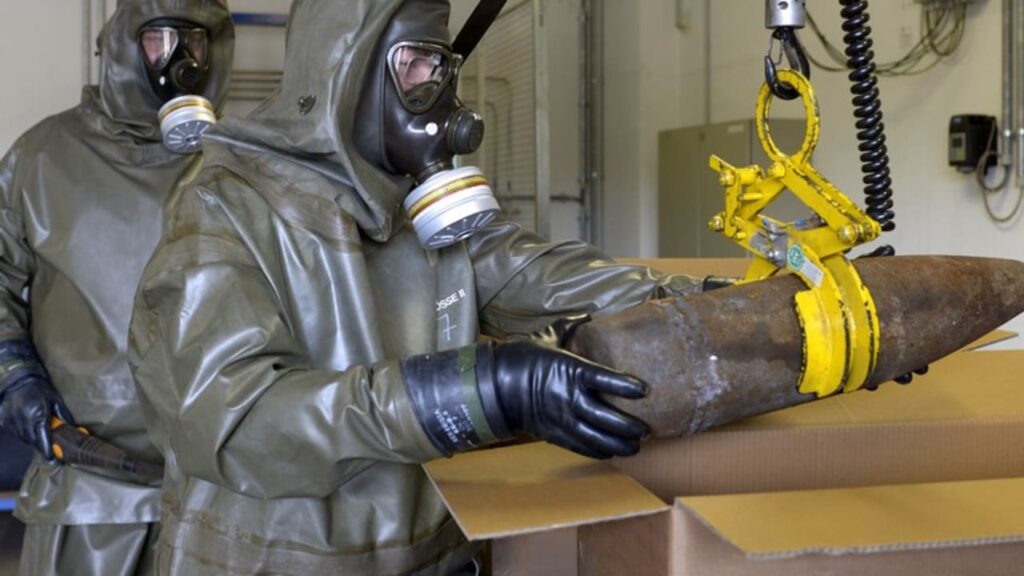
Syria’s government has found remnants of the Assad regime’s chemical weapons program. A Syrian official told Reuters on Tuesday that the country’s government had “located remnants of former Syrian president Bashar al-Assad’s clandestine chemical weapons program, including raw materials and munitions similar to those used to carry out deadly gas attacks during the country’s long-running civil war,” the report said.
In addition, the country arrested 18 people suspected of involvement in the former regime’s chemical weapons program. These include “high-level military, political, and technical officials, said Mohamad Katoub, Syria’s permanent representative to the Organization for the Prohibition of Chemical Weapons (OPCW) in The Hague, in an interview,” Reuters noted.
Agence France-Presse noted in an article published by Al-Arabiya that “Syria’s interior ministry on Friday announced the arrest of a general from ousted president Bashar al-Assad’s era, accusing him of involvement in a 2013 chemical attack on a suburb of the capital, Damascus.”
The general was accused of being involved in crimes that led to the killing of 1,400 people.
On Friday, Syria’s Interior Ministry said it arrested “Khardal Ahmed Dayoub, a former brigadier-general in the forces of the ousted regime and former head of the Air Force Intelligence branch in Daraa, for his direct involvement in systematic violations against civilians.”
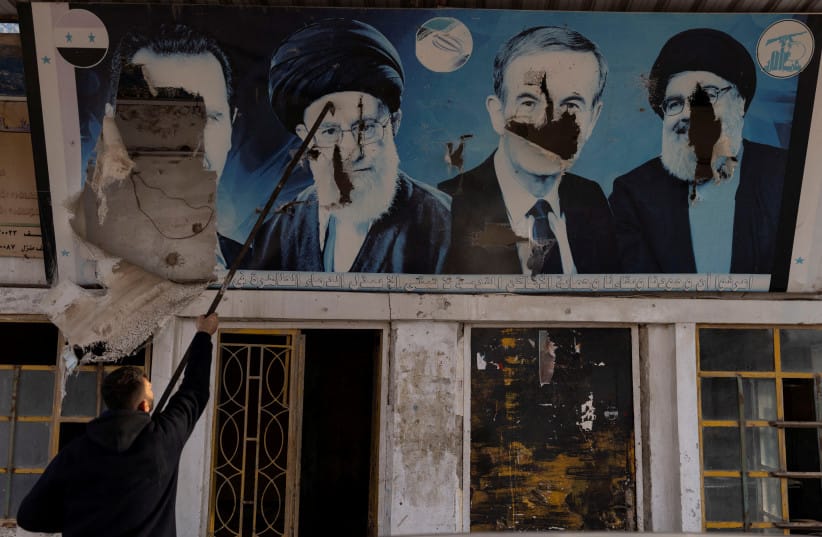 A worker tears down the pictures of Syria’s Bashar al-Assad, former Syrian President Hafez al-Assad, Lebanon’s late Hezbollah leader Sayyed Hassan Nasrallah and Iran’s Supreme Leader Ayatollah Ali Khamenei at a gas station in Nubl, in rural Aleppo, Syria, December 11, 2024. (credit: UMIT BEKTAS/REUTERS)
The report added that “the ministry accused Dayoub of being ‘implicated in chemical attacks during his service in the Damascus branch and his presence in the Harasta area,’ where ‘he oversaw repressive operations and contributed to the logistical coordination for the bombing of Eastern Ghouta with internationally prohibited chemical weapons.’”
Syrian state media did not initially report on the arrests.
Assad regime’s use of chemical weapons in Syria
Assad’s regime used chemical weapons against Syrians during the Syrian civil war. For instance, in 2013, the regime attacked the Ghouta area. The BBC noted at the time that a “team of UN chemical weapons inspectors have confirmed that the nerve agent sarin was used in an attack on the Ghouta agricultural belt around Damascus on the morning of August 21.”
The report added that “UN Secretary-General Ban Ki-moon told the UN Security Council that he believed the attack constituted a war crime. The UN report, he said, detailed the ‘most significant confirmed use of chemical weapons against civilians since Saddam Hussein used them’ in Halabja in 1988.” The attack began at 2.45 p.m. local time on August 21 in Ein Tarma. Another attack took place in Zamalka nearby.
There was a push for strikes against Syria’s regime in 2013 in response to the use of chemical weapons. The UK and the US were ready to move forward. However, UK lawmakers voted against strikes in late August 2013.
At the time, National Public Radio noted that “a White House official issued a statement tonight that said: We have seen the result of the Parliament vote. Tonight, the US will continue to consult with the UK government. President Obama’s decision-making will be guided by what is in the best interests of the United States. He believes there are core interests at stake. And countries who violate international norms regarding chemical weapons need to be held accountable.”
The Arms Control Association later said in 2021 that “an investigation into 77 allegations of chemical weapons use by Syria has concluded that chemical weapons were likely or definitely used in 17 cases, the OPCW reported to the UN Security Council on June 3.”
In 2014, the UN said that 96% of Syria’s chemical weapons had been removed. The Obama administration was critiqued for stepping back from strikes.
In 2017, the Trump administration carried out strikes on Syria. United States Naval Institute news noted at the time, “Senior US defense officials today briefed reporters on the planning and execution of a Tomahawk strike on al-Shayrat Airfield in Western Syria Thursday night, which involved two guided-missile destroyers launching 59 missiles at targets.”
The report added that “the US strike comes after an April 4 chemical weapons attack on the town of Khan Sheikhoun, where several dozen civilians, including many children and women, were killed by what appears to be sarin gas.”
Efforts to eliminate chemical weapon supply set in motion after fall of Assad regime
The Assad regime fell in December 2024. By June 2025, the “UN’s top disarmament official has welcomed signs of increased cooperation from Syria’s interim authorities in efforts to eliminate the country’s chemical weapons once and for all, as preparations move forward for a third round of inspections by international experts,” the UN said.
“However, serious concerns remain over potential undeclared stockpiles and more than a decade of incomplete or inconsistent disclosures by Syria, raising doubts about full compliance.” The report noted that UN High Representative for Disarmament Affairs Izumi Nakamitsu said that recent missions by OPCW, the international chemical weapons watchdog, had made “meaningful progress.”
On August 21, 2025, the Syrian Network for Human Rights noted, “Today marks the 12th anniversary of the largest chemical weapons attack in Syria, which targeted Eastern and Western Ghouta in the Damascus countryside at dawn on Wednesday, August 21, 2013. Bashar al-Assad’s forces carried out a coordinated attack using missiles loaded with sarin gas as part of a systematic policy of using chemical weapons against civilians, with clear targeting of women and children, with the intent of terrorizing society and imposing control by force.”