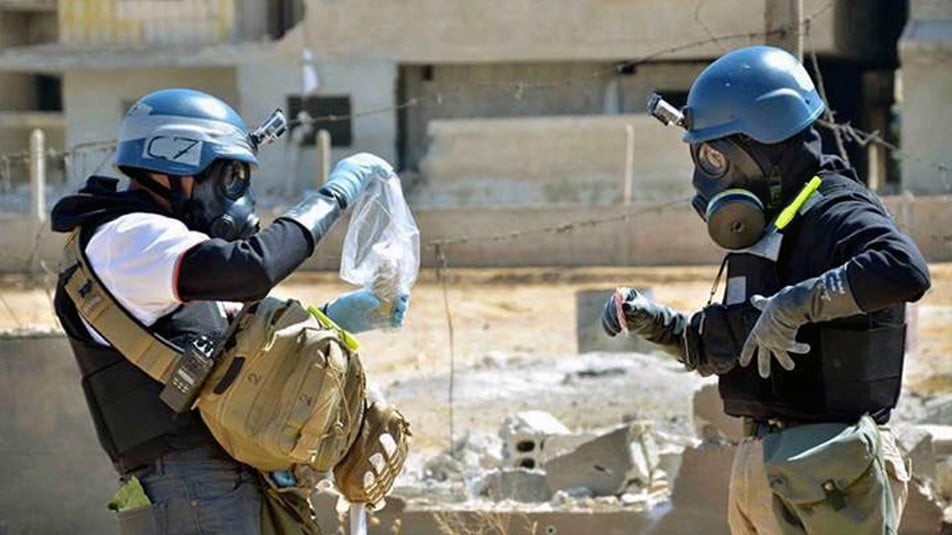
AMSTERDAM, Netherlands (Reuters) — Syria’s transitional leadership has located remnants of former Syrian President Bashar al-Assad’s clandestine chemical weapons program, including raw materials and munitions similar to those used to carry out deadly gas attacks during the country’s long-running civil war, a Syrian official told Reuters on Tuesday.
Syrian authorities have also taken into custody 18 suspects for alleged involvement in Assad’s chemical weapons program, including high-level military, political and technical officials, Mohamad Katoub, Syria’s permanent representative to the Organisation for the Prohibition of Chemical Weapons in The Hague, said in an interview.
The names of the suspects were not made public because the investigation was ongoing, he said, adding that several had served as major generals under the Assad regime. At least four were on European, UK or US sanctions lists, he said.
Syria, emerging from its 14-year civil war as an ally of the West, has vowed to work with the international community to rid itself of legacy weapons of mass destruction that pose a proliferation risk.
Chemical munitions found
The OPCW said in a report on Tuesday that its team in Syria had visited several high-priority undeclared locations in the northern coastal and central areas with Syrian authorities. The mission was ongoing, it said, but “dozens of undeclared chemical munitions such as aerial bombs and rockets, as well as separately found chemicals and related equipment” had been discovered.
Syrian teams, working for months with OPCW inspectors, located more than 70 rockets and aerial bombs, as well as raw ingredients for the production of sarin, a nerve agent used by Assad’s forces in attacks that killed more than 1,300 people in the Damascus suburb of Ghouta in August 2013 and Al-Lataminah in March 2017, Katoub said.
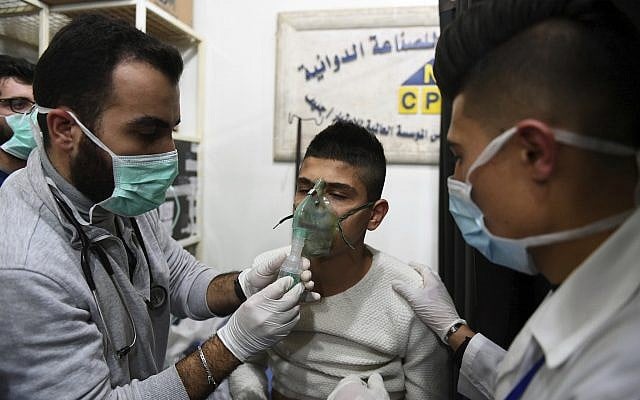
A man receiving oxygen through respirators following a suspected chemical attack on the town of al-Khalidiya, in Aleppo, Syria, November 24, 2018 (SANA via AP)
Chemical weapon mixing and storage equipment and hexamine, a stabilization agent known to have been used by Assad’s forces in sarin production, were also found during searches at three locations.
“Despite the secrecy, the danger, and the immense security challenges … today we delivered for the Syrian people and for the world,” Katoub said. “It is the first time such munitions could be recovered before they were used in crimes against the Syrian people.”
He said securing and storing the found materials contributes to national and global security.
Joint investigations by the United Nations and the global chemical weapons watchdog in The Hague had previously found that sarin, as well as chlorine and sulfur mustard gas, were used repeatedly by the Assad regime. The OPCW, which oversees the international ban on toxic munitions, has said as many as 100 sites across Syria need to be inspected.
Syria signed the Chemical Weapons Convention in 2013 and declared a 1,300-ton stockpile, but prohibited use continued. The size of the remaining program and stockpile has remained unclear.
In March, Syria launched a plan supported by Washington to rid the Middle Eastern country of its legacy chemical weapons.