
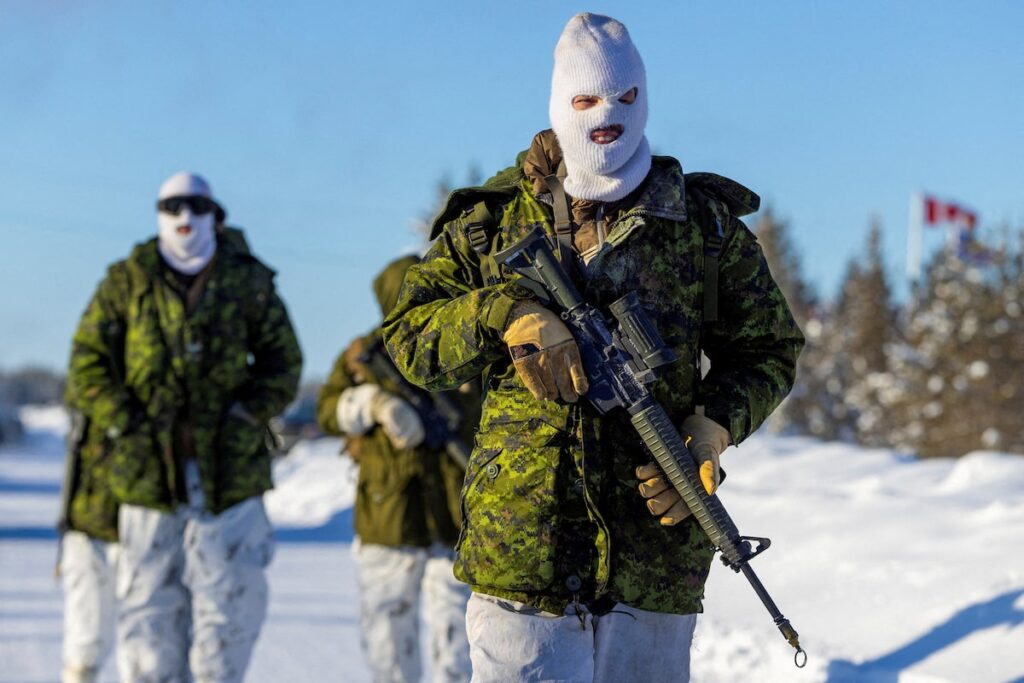
Members of the Loyal Edmonton Regiment take part in defensive operations near Edzo Airport during Operation Nanook-Nunalivut, a yearly series of drills designed to highlight the military’s ability to defend the Canadian Arctic, Behchoko, NWT, Feb. 18.Carlos Osorio/Reuters
Foreign Affairs Minister Anita Anand is calling for NATO to craft a security and defence strategy for the Arctic in recognition that this region is the alliance’s northern flank.
Ms. Anand, who wrapped up a NATO foreign ministers’ meeting last week in Helsingborg, Sweden, said this blueprint for securing the Arctic requires a full-blown threat assessment of the region and Russia’s role there.
She said Moscow’s war on Ukraine shouldn’t distract the West from Russia’s growing strength in the Arctic.
“There is one country that has 17 military bases in the Arctic and has been approaching Canada’s airspace and maritime domain consistently, and that is Russia,” the Foreign Affairs Minister said in an interview Tuesday.
Foreign Minister Anita Anand speaks to media at the NATO Foreign Ministers’ meeting in Helsingborg, Sweden, May 22.Johan Nilsson/The Associated Press
“As we talk about Russia’s illegal and unjustifiable invasion in Ukraine and the need for us as an alliance to stand strongly with Ukraine in the short and the long term, we cannot forget that Russia’s focus is also in the Arctic.”
The Canadian Armed Forces’ biggest overseas deployment is in Latvia, where Canadians are helping reinforce NATO’s eastern flank. Canada leads a multinational NATO brigade there and has committed to expanding its presence to 2,200 troops by 2026, up from 2,000 in August, 2025.
Ottawa commits millions to study micro nuclear reactors for Northern defence facilities
But Canada is under pressure to do more in the Arctic and last November announced billions more in defence spending with an increased focus on asserting territorial sovereignty in the Arctic. This and previous commitments include modernizing the North American Aerospace Defence Command, implementing over-the-horizon radar, purchasing early warning aircraft, and spending nearly $35-billion to upgrade northern military installations aimed at defending against threats to the continent.
NATO is preparing for its annual leaders’ summit, which this year will be held in Turkey in July.
In response to U.S. President Donald Trump’s repeated allegation that Greenland is inadequately defended – part of his campaign to acquire the island for the United States – NATO in February launched Arctic Sentry, an effort to coordinate allied defence activities across the Arctic under a single command.
Ms. Anand said Denmark, including Greenland and the Faroe Islands, as well as Finland, Iceland, Norway, Sweden and the United States support deepening NATO’s focus on the Arctic.
In a joint statement on May 22, Canada and these allies talked about stepping up activities in the region.
“With Russia’s increased military activity and China’s growing strategic interest, we seek to bolster stability in the Arctic region,” Canada and these other countries and territories said in the statement.
The joint statement said this effort will include not only Arctic Sentry but also allied air policing efforts in Iceland and Forward Land Forces Finland, a NATO multinational force based in northern Finland and led by Sweden, designed to deter Russia and reinforce the alliance’s northern flank.
Opinion: Speed is the new sovereignty in the Arctic
Canada last June committed to raising defence spending by 2035 to 5 per cent of gross domestic product, of which 1.5 percentage points are for defence- or security-related investments made by all levels of Canadian government, such as dual-use infrastructure that can be used for security purposes as well as telecommunication or emergency preparedness systems.
Ms. Anand said Canada’s infrastructure spending in the North will contribute significantly to this particular NATO target.
She said a NATO security blueprint for the Arctic would help guide this.
“We want to work within the NATO alliance to ensure that what we’re doing in the North is actually consistent with the broader strategy and the approach that other Arctic nations are taking.”