
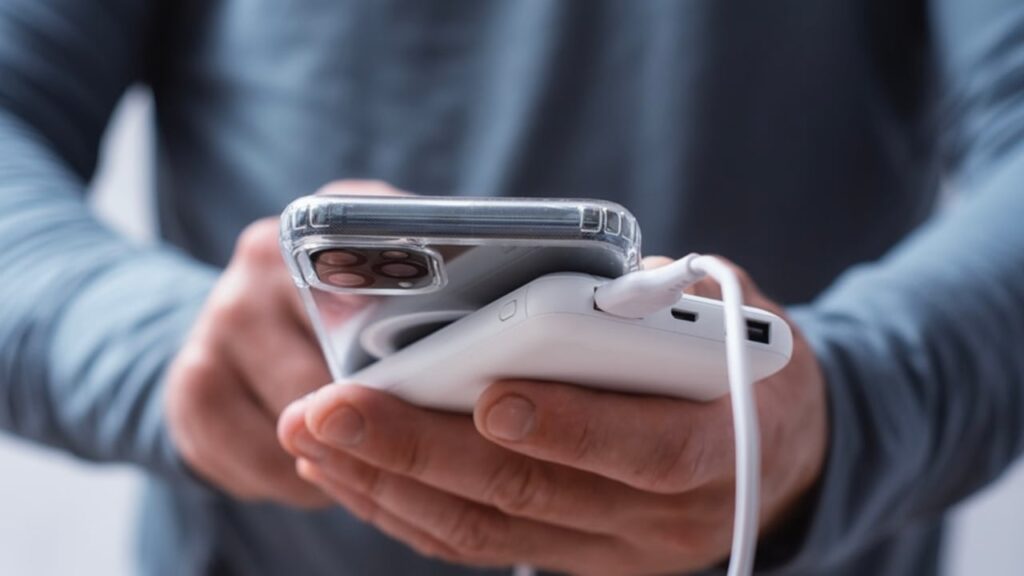
Last October, an Air China flight on its way to Seoul was forced to make an emergency landing in Shanghai after a fire broke out in one of the storage compartments due to an igniting lithium-ion battery. In April, a recall of over 400,000 batteries from a company called “Casely” was announced following reports of batteries catching fire on planes as well, and just recently– five passengers on a flight of the Indian company “IndiGo” were injured by smoke inhalation as a result of a portable battery that exploded and filled the cabin with smoke.
It is not for nothing that airlines around the world decided to limit the use of external batteries based on lithium-ion and lithium-polymer, since if one of these explodes or ignites, it is a real risk to the flight.
The problem lies in the chemical structure of lithium-ion batteries, the battery technology that powers the entire modern world from smartphones, through laptops, to electric cars and everything in between: The batteries are based on an electrolytic liquid, and lithium is integrated into the rods that generate the electrical reaction (anode and cathode), while lithium has an annoying trait: It ignites when it comes into contact with oxygen, meaning, it ignites upon contact with air. As long as the battery pack is intact and the lithium is separated from the external environment, everything is fine. However, the moment the smallest crack or puncture is formed as a result of distortion from heat, an impact, fracture, or puncturing of the pack – boom. The lithium will catch fire and the battery may explode. And this, is a big problem when it happens inside a tin box flying at an altitude of 10,000 feet.
However, a technological solution has been found for this problem as well, which is considered the holy grail of the industry, and in fact, one of the inventors of the lithium-ion battery worked on solving this problem until his dying day: Solid-state batteries, or Solid State Battery, in English. In these batteries, some or all of the electrolytic liquid is replaced with a solid material – and salvation has come: A solid material maintains its shape even if it is damaged and continues to isolate the volatile lithium, so there is no danger of fire or ignition.
Such batteries are already being showcased and are available for purchase as external batteries for smartphones from companies like KUXIU or BMX (see also in the video), and are also already being presented as a solution for electric vehicle ignitions, where these are giant batteries and fires that can burn for days(!) because of the large amount of lithium involved.
Even though the technology has already solved the problem it created itself, the snail-paced regulatory world of the aviation industry – is in no hurry to align itself, and is still deeply immersed in the trauma caused by the previous technology: The International Air Transport Association (IATA) does not have a separate classification for solid-state batteries (surprisingly, sodium-ion batteries actually do), and as far as they are concerned, these are exactly the same batteries as the dangerous liquid lithium-ion batteries –
And go explain to a flight attendant who does not understand technology that the battery you are using is not in danger of ignition and therefore the restrictions, in fact, should not apply to it. And no, the single power outlets shared by every two seats located near the floor, which require you to be a contortionist to reach in those horribly crowded seats, are not a proper solution to the power shortage, nor are the USB ports in the back of the seats which are low power – they cannot charge a laptop like a portable battery can.
Therefore, for the welfare of passengers and flight safety, the International Air Transport Association needs, contrary to its usual practice, to act quickly and issue directives that permit the use of this alternative (yet still expensive, it must be said) technology of solid-state batteries on flights – so that you can continue to charge your devices even on long flights, where a portable power source is a real necessity of the modern world.