
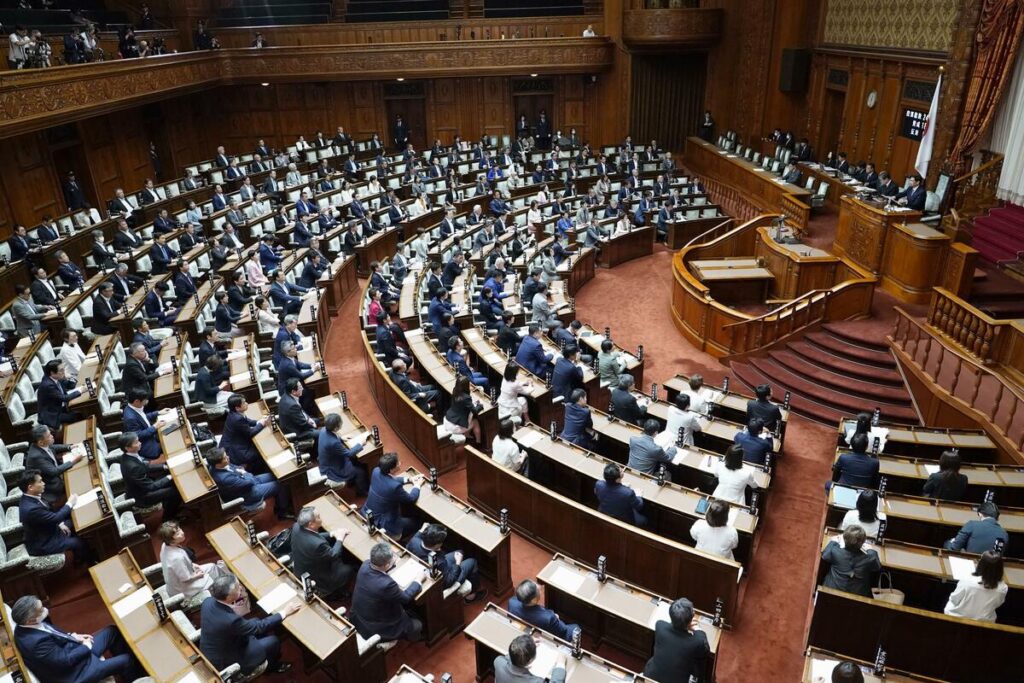
TOKYO – Japan’s parliament enacted a law Wednesday to establish a new National Intelligence Council to centralize information gathering in response to overseas threats, legislation that has raised concerns over civil liberties.
Establishing the council is a key aim in the governing agenda of Prime Minister Sanae Takaichi, a security hawk who has pledged to strengthen intelligence and counterespionage capabilities as part of a response to what her government calls the most complex security environment since the end of World War II.
The enactment paves the way for further legislation to boost Japan’s intelligence capabilities. Takaichi has said a system for registering foreign government actors engaged in lobbying activities must be considered, and it is important that Japan establish its own external intelligence agency.
The new law lacks provisions for parliament to monitor intelligence activities, leaving questions regarding democratic oversight unresolved.
Devised in response to national security concerns including cyberattacks and election interference via social media disinformation, the council will be chaired by the prime minister and composed of nine other Cabinet members, including the chief Cabinet secretary and foreign minister.
It will centralize a fragmented intelligence apparatus, with the law stating the council’s secretariat, the National Intelligence Bureau, will comprehensively coordinate intelligence gathered by the National Police Agency, the Foreign Ministry, the Defense Ministry and other organizations, with the authority to ask them to share information.
The government could establish the council and bureau as early as July and set up an expert panel to discuss counterespionage legislation. It is expected to formulate policy with an eye to submitting a bill during the regular parliamentary session in 2027.
The legislation was passed Wednesday by the House of Councillors, in which the ruling Liberal Democratic Party and its junior partner the Japan Innovation Party do not hold a majority of seats, with the backing of parts of the opposition camp.
When the bill cleared the House of Representatives in April, it was supported by the chamber’s largest opposition Centrist Reform Alliance. However, its founding party, the Constitutional Democratic Party of Japan, opposed the legislation in the upper house over fears it could infringe on people’s rights and politicize intelligence activity.