

Matthew Kenyon and crew sail a Jeanneau Attalia from London’s South Dock to Amsterdam via the East Coast of England
Leaving South Dock with a full ebb tide, we swept out of the city centre, through the rapidly developing east of London.
Avoiding barges, ferries and the detritus that always flows downriver, we motored, helped by the jib, past the Thames Barrier to the Gravesend Sailing Club.
Heleen and I had stopped here on our way to London from Ramsgate.
Our plan was to stay here the night, then use the ebb tide to help us up the East Coast. Our eventual goal was Lowestoft, from where we would cross the North Sea to Amsterdam.
After a restful evening (aside from some ships’ wake), we set out and punched the flood from Gravesend to well beyond Southend, taking care to cross the shipping channel at the correct place and (having missed a vessel traffic services call on our way to London), listening intently to the VHF.
There was little wind as we emerged into the estuary proper, but the turning tide helped as we motor-sailed past the buoys and banks that make this an easy place to mess up.
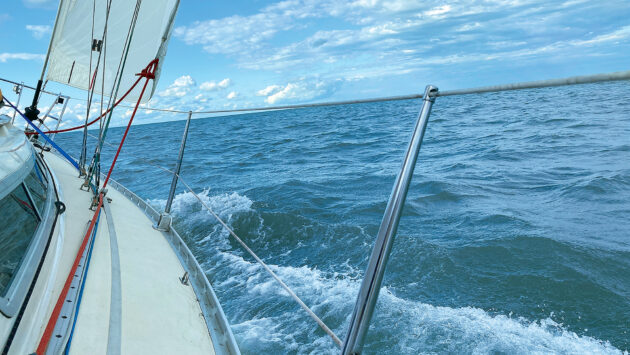
A great sail up the Wallet. Photo by Matthew Kenyon & Heleen Arps
Visibility was excellent, but with many channels and marks, we double-checked our course changes and position.
Vigorously-turning wind turbines ashore teased us as we bobbed along slowly but our frustrations vanished as we threaded the Spitway between the Swin and the Wallet.
When the wind picked up, we enjoyed a great sail to the Naze.
These are familiar waters as we used to sail out of Titchmarsh Marina and spent many nights in Walton Backwaters.
So, despite the low tide (it was nearly springs) and the late hour, as we arrived off Harwich Harbour, we gave in to temptation, ghosted past Pye End buoy and – confident in our local knowledge and lifting keel – crept up the channel under sail and anchored in Hamford Water just in time to see the sun set. Magical.
Backwaters idyll
It felt special to awake in a place we had loved but left behind when we moved to Holland.
The Backwaters stillness, broken only by bird cries, is a stark contrast to the huge cranes on the horizon at Felixstowe.
After a cooked breakfast we took our dinghy up Oakley Creek to see the seals, then raised anchor and hopped round to Harwich and Halfpenny Pier.
Harwich is welcoming, with good facilities, and friends joined us at the excellent Alma Inn.
The next day we sailed up the Orwell to Ipswich.
As there were no ship movements in Harwich harbour, we made maximum use of the space to tack our 10m Caran in the shadow of the huge container vessels docked at Felixstowe.
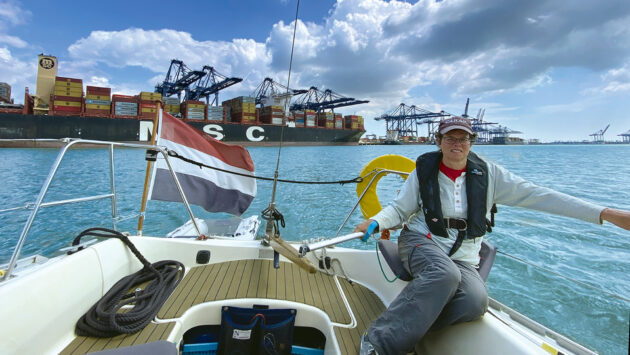
Heleen in Harwich Harbour, which is ‘always welcoming, with good facilities. Photo by Matthew Kenyon & Heleen Arps
It was blustery enough for a reef and the river was busy with leisure boats, but we threaded our way through the moorings, past Pin Mill and motored under the imposing bridge carrying the A14, and into Fox’s Marina.
After some nav light maintenance, we went to bed, ready for a long day ahead.
This was July, and we were up at 0400, before first light, to get a tidal boost to sail down the Orwell and past Landguard Point before turning north to Southwold.
The falling tide helped us past Felixstowe pier, the River Deben entrance and along the coast to Orford Ness where we entered new waters as our previous trips had never passed this stretch of shingle.
Keeping close in, we had an excellent view of the ‘pagodas’, remnants of the historic site of military and technological research, and later, the huge radio masts which once carried BBC World Service programmes.
This was nostalgic for me as, having worked in Bush House for many years, my voice had been beamed from these towers across Europe on 648 MW.
FM relays and the internet now provide a clearer signal for the BBC, but the masts remain and now host programming from the former shipboard station Radio Caroline. The ‘pirates’ have moved ashore.
Challenging port
We kept between the drying banks and shoreline, enjoying good sailing as we rounded the point, but as we passed pretty Aldeburgh, the tide turned against us.
We kept sailing but became very fed up with the view of Sizewell nuclear site.
Despite appearances, we were making progress and shortly before high water, as advised by the pilot book and harbour-master (who we had called the day before), we arrived off Southwold.
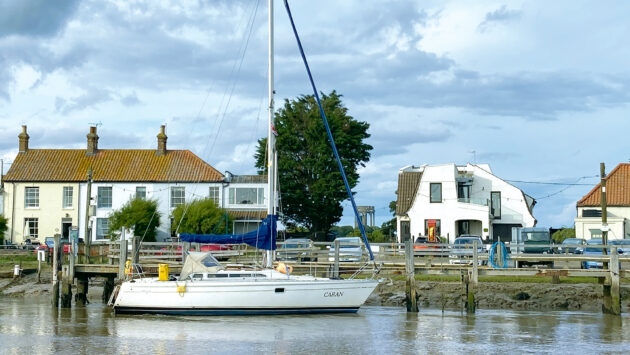
Caran’s lines needed plenty of play to allow for the tide at Southwold. Photo by Matthew Kenyon & Heleen Arps
This port can cause trepidation for a first-time arrival.
Studying charts and books, we knew that once past the ‘strong cross tides’ at the entrance, we should turn sharply towards the north bank to avoid steeply shoaling mud, before judging when the time is right to turn back to the channel middle.
There’s a rowing ferry to watch out for, the river is narrow, tidal streams are strong and there is a fixed bridge just beyond the last mooring. Plus plenty of watching tourists.
It was a relief to tie up alongside. The harbourmaster took our lines and made sure they had plenty of play so we could rise and fall with the tide against the fixed quayside. Fender boards were provided.
Southwold proved to be a delightful stop. Clambering up and down a slippery ladder, the muddy riverbanks emerging as the tide dropped, with our extended stern line straining against the powerful ebb, was a contrast to marina life.
Sitting aboard on the first night listening to the nearby Latitude festival, we were grateful not to be camping in the rain. Instead, for a small fee, we could use the dinghy sailing club facilities and dine at The Harbour Inn.
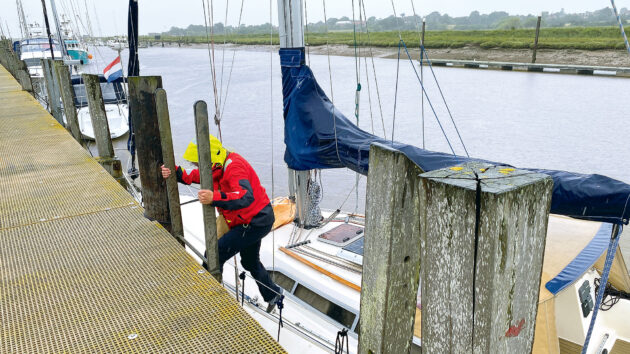
Carefully climbing the slippery quay ladder at Southwold. Photo by Matthew Kenyon & Heleen Arps
UK departure
We had a couple of days to explore this lovely town, indulging in fish and chips, ice cream, a stroll across the beach (and over the bridge to Walberswick) and visiting the Adnam’s brewery, before my brother, Ed, joined us for the North Sea crossing.
A coastal hop to Lowestoft enabled Ed to get used to Caran and top up our fuel tanks before our 24-hour voyage.
The strong winds of the past few days had created confused seas. Plus wind against tide made for a relatively uncomfortable trip.
It was fortunate that I had been to Lowestoft before and knew what to look for because it was awkward to drop the sails, call port control and negotiate the narrow entrance in the growing waves.
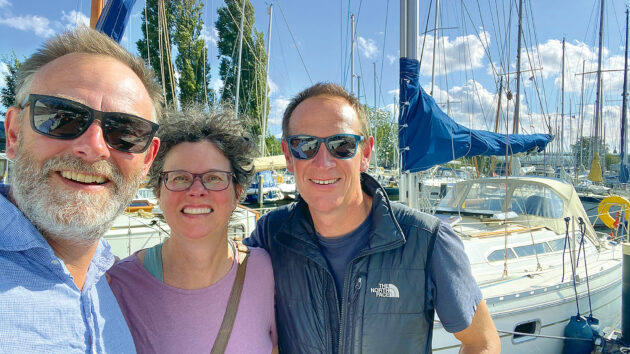
Matthew, Heleen and Ed were delighted to find a berth at Sixhaven, Amsterdam. Photo by Matthew Kenyon & Heleen Arps
Soon enough, we were tied up at the Royal Norfolk and Suffolk Yacht Club, had topped up our tanks, then ourselves with fish and chips, ready for a good sleep.
We set out at 0830 to give us enough daylight to get into the swing of the crossing then a lightening sky as we arrived – if things went to plan.
It was exciting to call port control for permission to leave the harbour, and to watch the English coast disappear. A track of 90° or so would take us to our new home country.
As the day wore on, the wind dropped off and came round behind us, making for an uncomfortable sea state. Caran began to wallow.
We dropped the main to avoid an accidental gybe, and started the engine to provide some momentum. The motor stayed on for most of the rest of the trip and as darkness fell, we clipped on, even in the cockpit.
A combination of tiredness and the rough motion meant Ed felt queasy and Heleen was very seasick. She was able to spend a couple of hours in the cockpit under clear, starry skies but then went downhill again and didn’t emerge until IJmuiden harbour mouth.
The crossing’s last few hours were tricky due to a cluster of platforms near the rapidly expanding wind farms, multiple shipping channels and anchorages all squeezed into a small area off IJmuiden.
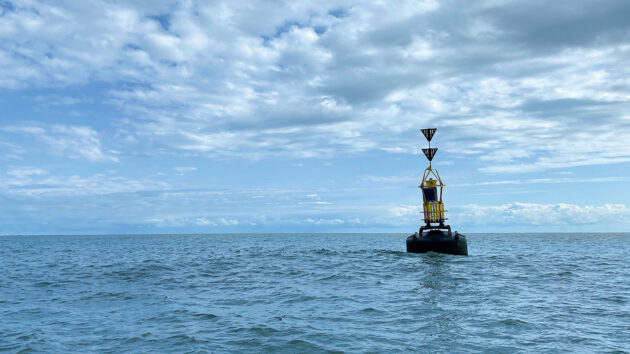
We seemed to always be in sight of something manmade (a ship, wind farms, buoys) throughout the North Sea crossing. Photo by Matthew Kenyon & Heleen Arps
Trying to avoid this, while being pushed by the tide, meant we ended up cutting the corner a little. It was hard to judge the shipping from all angles in the dark, with multiple lights from anchored ships and turbines.
In reality there was plenty of room, but I felt the sensory overload!
As we closed the Dutch coast, a large squall gathered behind and accelerated over us, with torrential rain and gusting winds. Ed and I got an absolute soaking.
We were unnerved by the waterspouts a kilometre or so away. Visibility was reduced and we were relieved to have dropped the main earlier.
As the squall moved on it blocked out the coastline which had been emerging in the dawn light.
I was left nervous as we approached IJmuiden, imagining breaking waves in the harbour entrance and was considering alternate options (Scheveningen or Den Helder).
It was a relief, as the squall cleared, to see an array of vessels emerging as if nothing was amiss – powerful catamarans heading for the windfarms and a small flotilla of Dutch yachts, putting up full sails.
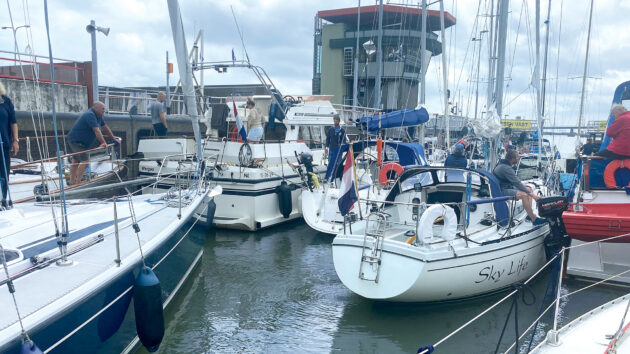
Locks can be lively. This is the Oranjesluis between Amsterdam and the Markermeer. Photo by Matthew Kenyon & Heleen Arps
This welcome reassurance that everything would be fine if we kept our concentration proved correct, as Heleen, who recovered swiftly in the calm of the harbour mouth, manoeuvred us into a Seaport Marina berth.
After some food, much needed sleep and a shower, we set out for Amsterdam.
Just how big the IJmuiden sea locks are was demonstrated when we were overtaken by the 291m cruise ship Ventura and its waving passengers, as we sailed from the smaller Kleine Sluis on the port’s south side.
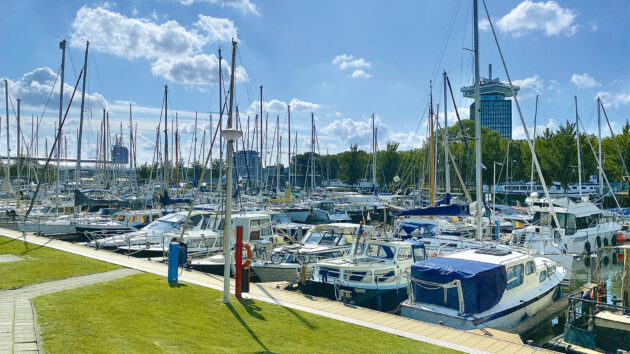
Sixhaven can get busy. Photo by Matthew Kenyon & Heleen Arps
In the Dutch capital, we found a lucky berth in Sixhaven marina, which is an excellent, atmospheric place to stay.
A short ferry ride took us to Central Station, then the city centre for a beer and delicious Indonesian meal by the canals.
The next morning Ed took the ferry again, to catch the train to Schiphol airport. After another night in Sixhaven, Heleen and I took Caran back through the Oranjesluis to the Markermeer and our home port of Hoorn.
The end of a hugely satisfying, enjoyable but challenging trip.
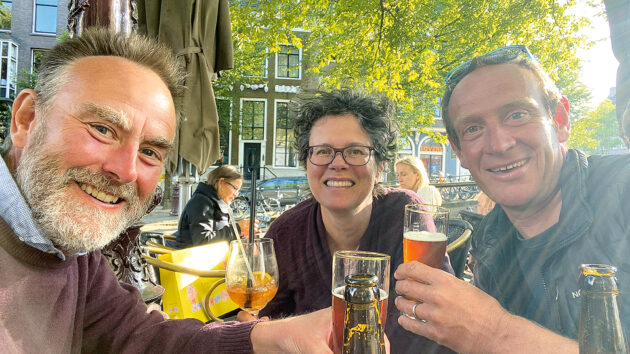
A welcome drink by the canal in Amsterdam. Photo by Matthew Kenyon & Heleen Arps
Skipper’s notes – Sailing from the UK to the Netherlands
Recommended reading
Crossing the Thames Estuary is an invaluable book.
The precision with which Roger Gaspar has worked out waypoints, routes, tidal factors and more is outstanding and takes a lot of the stress out of the planning.
East Coast Pilot and North Sea Passage Pilot, also from Imray, are also both very helpful.
East Coast notes
In the Thames, Gravesend Sailing Club kindly allowed us to pick up a mooring free. We didn’t go ashore as it was just a stop for the night/tide.
Threading the banks of the Thames estuary, avoiding the ubiquitous pot markers, meant it was a tiring sail from Gravesend up towards Harwich.
We wouldn’t have chosen to head into the Walton Backwaters at low water if we hadn’t had local knowledge of it.
The channel is well marked from Pye End safe water mark, but the sand is hard and entering after dark is risky.
We bought diesel from the fuel station at ASDA in Lowestoft and carried it in jerry cans.
As a Dutch boat we can’t have red diesel in our tanks, but fuel is available at Royal Norfolk and Suffolk Yacht Club.
Leaving the UK
I emailed Border Force the details and received an acknowledgement clearing us to head off.
In IJmuiden, we called up Dutch Marechaussee and arranged a meeting with them as we went through the lock into the North Sea Canal. They popped down from their nearby office in a car, and stamped Ed’s passport on the quay.
We didn’t plan a watch system, although we were aware of the need for us all to rest at different times. All three of us were in the cockpit enjoying the sail during the day.
Once Heleen got seasick it was left to Ed and me to share the duties. If we had been going even slightly further we would have needed more structure.
Provisioning
It sounds flippant, but the Spicy Chicken cup-a-soup I served to keep the crew warm was not a good idea!
It played a part in both Heleen and Ed feeling seasick.
Next time tomato, or tea. Heleen’s recommendation for those feeling queasy is to eat only fruit.
Notes on the Netherlands
There’s a watch on the platforms and windfarms off IJmuiden. You can expect a call if you get too close!
We paid for two berths on the day we arrived back in the Netherlands – in Seaport Marina and then in Amsterdam’s Sixhaven.
It was worth it to grab a couple of hours rest in IJmuiden before the North Sea Canal. If you want to stay a night in IJmuiden, there’s a lovely beach, restaurants and bars very close to the marina.
The North Sea Canal is different to the open sea, but demands just as much respect, especially as you approach Amsterdam, with plenty of commercial traffic, ferries, trip boats and yachts in a rather narrow area.
Don’t be intimidated by the locks in the Netherlands. Lock-keepers will happily operate for just one vessel and will often get ready if they see you coming.
More likely there will be plenty of other boats – especially in summer. The light signals are clear, and you can also listen on the appropriate VHF channel.
It can feel like a bit of a race to get in, but usually there is plenty of room. Don’t stint on fenders though!
Sixhaven is the most convenient place for a small yacht to berth in Amsterdam, being just across the water from the Central Station. They do their best to squeeze everyone in and we had to shuffle around twice during our stay.
There’s not much room to manoeuvre if full – we woke up in a box to find a yacht tied across our exit route. But it’s well managed in a friendly, efficient way.
Amsterdam Marina (to the west of the city centre but also connected by a free ferry) is a much bigger option, and will take larger vessels. There are alternatives further east as well.
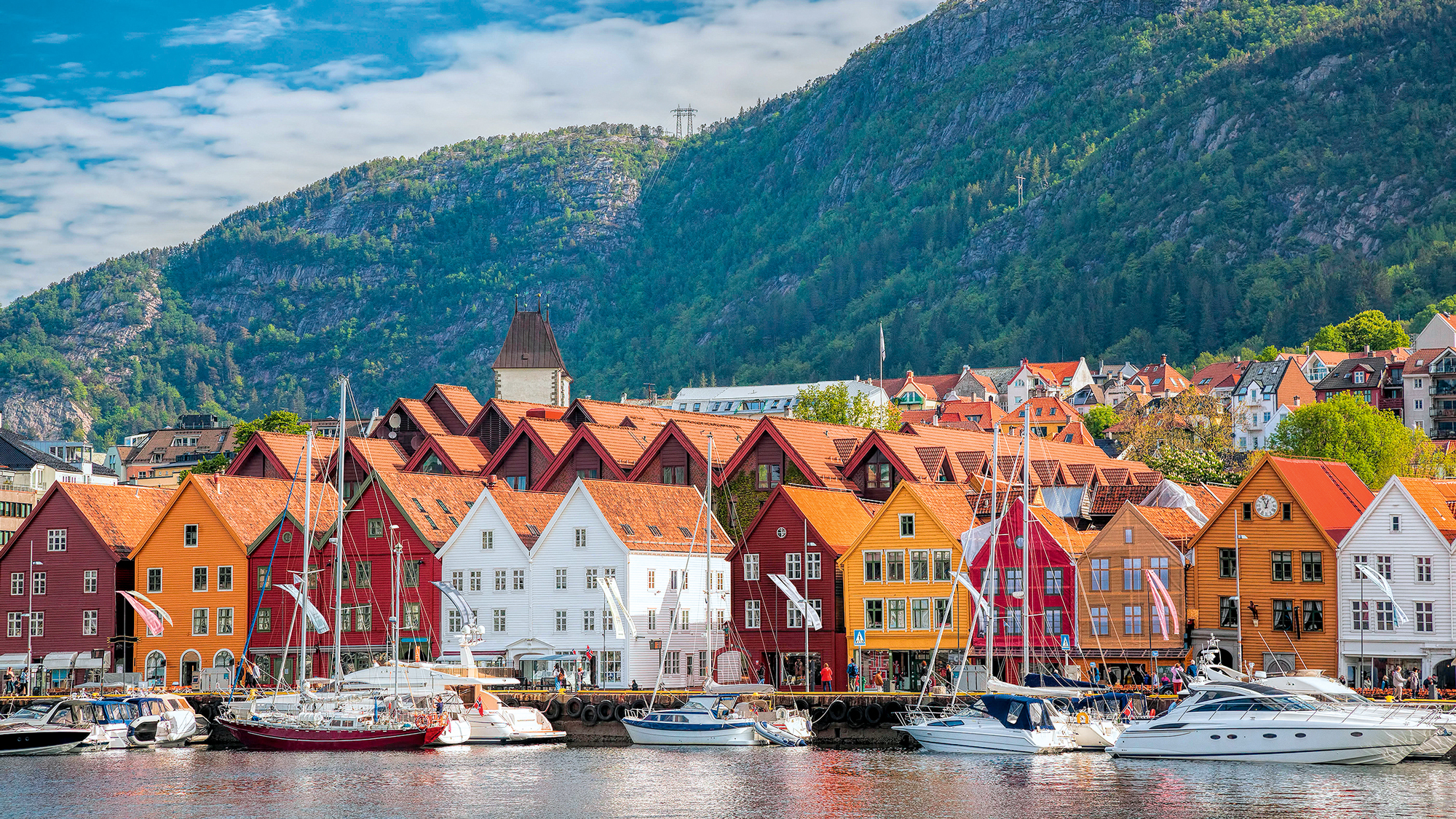
Sailing north from Scotland takes you into a different world. Towering cliffs, remote islands, and empty, white-sand beaches await sailors…
Sailing across the North Sea from the Netherlands to the UK in two and a half days just for Lowestoft…
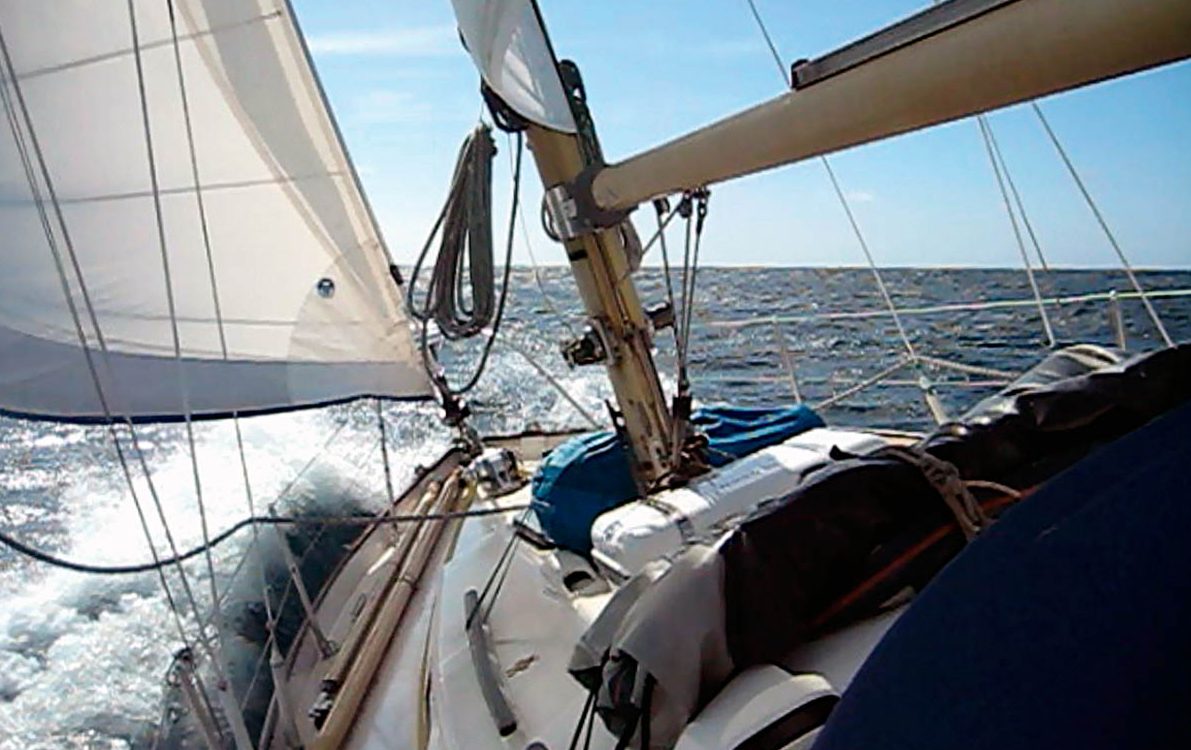
In 34 knots of wind and a North Sea swell nearing mast height, our Nicholson 32 is beating with a…
As I prepared myself for my first meeting with the North Sea, I thought about the legend among sailors. There…
Want to read more articles like this?
A subscription to Practical Boat Owner magazine costs around 40% less than the cover price.
Print and digital editions are available through Magazines Direct – where you can also find the latest deals.
PBO is packed with information to help you get the most from boat ownership – whether sail or power.
-
-
-
- Take your DIY skills to the next level with trusted advice on boat maintenance and repairs
- Impartial, in-depth gear reviews
- Practical cruising tips for making the most of your time afloat
-
-
Follow us on Facebook, Instagram, TikTok and Twitter