
Image: Unsplash
Market reality check
Chinese polysilicon prices often hit record lows due to massive economies of scale and low energy costs. Beyond the clear appeal of a local supply chain, what practical strategies will you use to keep your price point competitive and attractive for European module manufacturers?
Gosse Boxhoorn: Scale is absolute, which is why our blueprint scopes out a production volume of 13,000 MT per year in our initial phase, expanding to 26,000 MT per year. It is also critical to understand that the solar market is heavily distorted. Roughly half of global polysilicon production originates in Xinjiang, which many reports link to forced labor and to cheap, high-emission coal. Europe is implementing structural defensive measures, including the Carbon Border Adjustment Mechanism (CBAM), the Net-Zero Industry Act (NZIA), and strict forced-labor regulations, to establish a level playing field. Furthermore, we are not relying solely on solar. We are targeting three distinct high-value verticals: semiconductors, solar, and battery anodes. The semiconductor space, for example, demands extreme purity levels (up to 12N-grade) where Chinese producers do not dominate, allowing us to capture premium margins. However, tapping into the solar market is required to achieve economies of scale.
We have to understand that geographic independence is not cheap; production in Europe simply carries higher costs. However, if our strategic industry value chain is affected by geographic policy, the European automotive and defense industries will be affected similarly. So what is the price for security of supply we’re ultimately willing to pay?
High-level strategic support is essential, but building a facility with a €900 million capital requirement demands firm commercial backing. How is the process of securing long-term off-take agreements with European partners progressing?
Remco Rijn: The very first question any serious investor asks centers on off-take security. In the semiconductor sector, the demand for local supply and dual-sourcing options is immediate and highly proven. We recently announced a promising early-stage collaboration with a potential launching customer, TopSil, which validates this commercial track record. The solar market requires a bit more regulatory stability, as buyers need full certainty on how domestic content criteria will be enforced across all 27 EU member states. Meanwhile, the battery space represents an exciting, embryonic vertical. We are engaged in advanced discussions with silicon-anode battery pioneers like GDI and LeydenJar, structuring a balanced product mix of polysilicon, silane, and specialized industrial gases.
Infrastructure and technology
The Delfzijl facility is designed to be fully powered by renewable energy. Given the current grid congestion and intermittency challenges in the Netherlands, how do you plan to secure the 24/7 ‘firm’ power required for a high-heat chemical process?
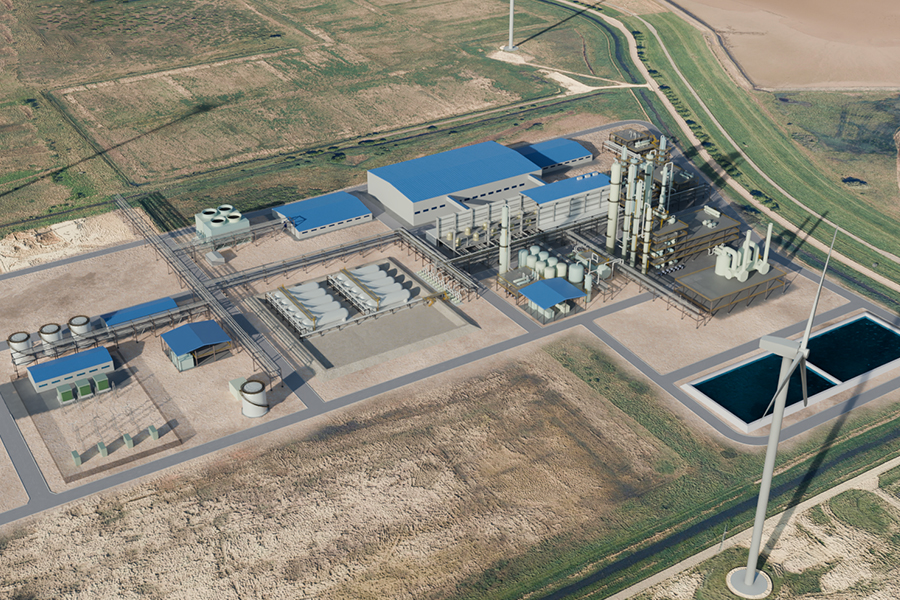
Remco Rijn: Securing a continuous, stable power profile is a substantial operational hurdle for any heavy chemical refinery. Our approach relies on the unique geographical advantage of the Groningen Sea Ports network, which handles the direct intake of major offshore wind assets. By positioning our facility right at the landing point of this clean generation, we mitigate a significant portion of national grid transit constraints.
You are working with technology from Advanced Material Solutions (AMS) to reduce energy consumption by a reported 30% compared to traditional manufacturing methods. What makes this specific process more efficient and sustainable?
Remco Rijn: Traditional manufacturing relies on multi-step cooling, solidifying, and mechanical breaking processes that consume immense amounts of electricity. The technical approach, developed alongside our partners AMS and the engineering firm Fluor, optimizes chemical vapor deposition directly in the gas phase. By maintaining the raw chemical components in a high-purity gaseous state for longer, we eliminate energy-intensive secondary processing steps. This clean loop design not only slashes our electrical overhead by nearly a third but also opens up opportunities to innovate downstream products directly from the gas phase, bypassing legacy manufacturing bottlenecks entirely.