
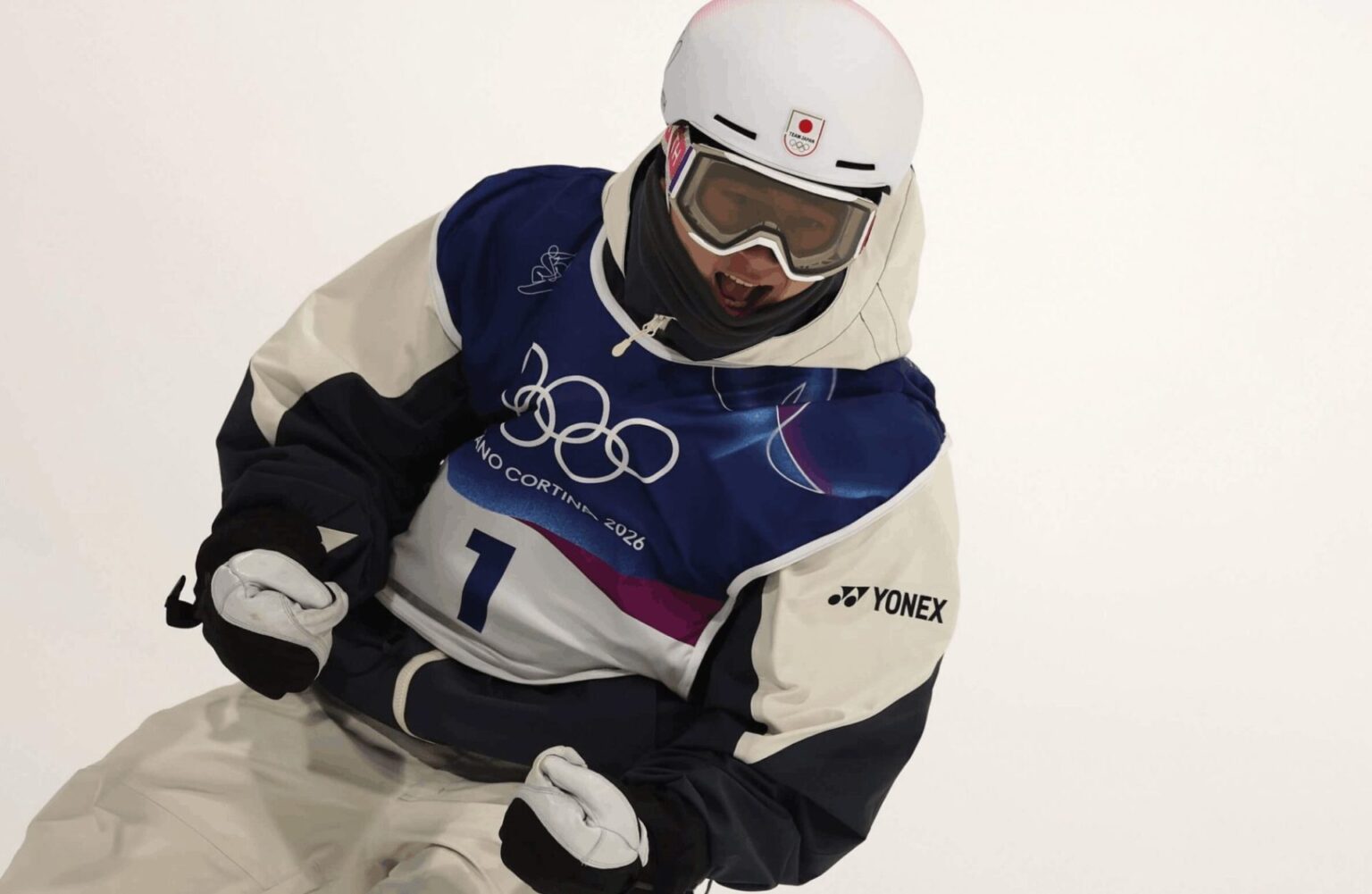
 Japan’s Yuto Totsuka celebrates after putting down an incredible run at the 2026 Milano-Cortina Olympics. | Credit: The INFORMER Facebook
Over the past decade, Japan has produced some of the world’s best freestyle snowboarders. From halfpipe to slopestyle, Japanese domination in World Cups, Olympics, and X Games has become the expectation.
At the 2026 Winter Olympics in Milano-Cortina, Italy, 18 total medals were awarded across three freestyle snowboarding disciplines: halfpipe, slopestyle, and big air. Nine medals — or half of them — were won by Japanese snowboarders. Of the nine, four were gold medals.
Not only are Japanese snowboarders dominating competitions, but they are inventing tricks, too. Just last November, Kokomo Murase became the first woman to land a backside triple cork 1620. She won X Games big air with the same trick. One year earlier, at the 2025 X Games, Hiroto Ogiwara landed the world’s first backside 2340 in big air competition. At the 2022 Winter Olympics in Beijing, China, Ayumu Hirano landed a first triple cork 1440, the first ever in a halfpipe competition. And the list goes on.
So, how did Japanese snowboarders come to dominate the freestyle competition scene? One answer to that question is off-season training facilities.
Japan is home to some of the world’s best training facilities that allow snowboarders to train for competition year-round. Dozens of turf and synthetic snow parks are scattered throughout the country, allowing snowboarders to work on jump and rail tricks without snow. During the summers, competitive Japanese snowboarders take to these “dry slopes” to train. Slopes like Tokyo’s Saitama Quest have big air-sized jumps designed for simulating competition.
Air bag snowboarding has also played a large role in Japan’s snowboarding success. Instead of landing on a hard surface, snowboarders learn tricks by landing on large, inflatable airbags. Using airbags, snowboarders can safely practice difficult spins and flips without risking dangerous landings. Air bag training has taken off in Japan, with various facilities around the country offering year-round access to air bags. This is something many other countries do not have.
Japan is also home to one of the world’s few indoor halfpipes. Kamui Misaka, located near Mount Fuji, is an indoor halfpipe facility that features a 12-foot halfpipe made of artificial snow. The halfpipe is maintained year-round and is utilized by professional Japanese halfpipe riders who need to train during the summer months. Olympic snowboarders like Ruka Hirano and Yuto Totsuka (2026 Olympic Gold medalist) have trained at Kamui Misaka.
“Even in the off-season, we have great training facilities. We definitely have more halfpipe training facilities (than before),” Japanese snowboarder Mitsuki Ono told The Japan Times. Ono won bronze in women’s halfpipe at the 2026 Milano-Cortina Olympics.
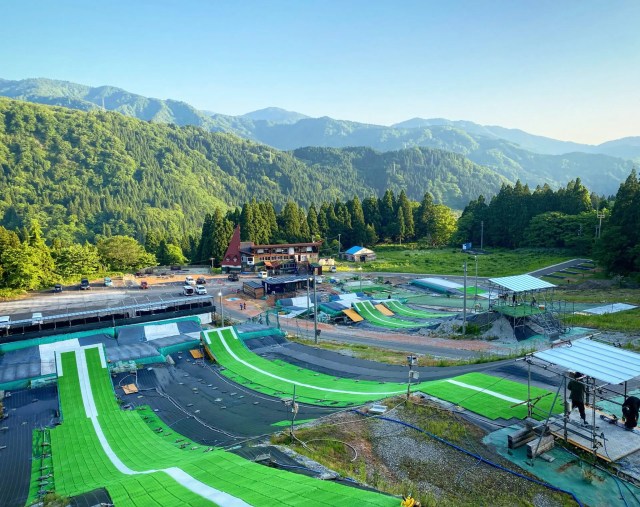 Dry slope and air bag facilities help Japanese snowboarders train year-round without snow. | Credit: Slab Outdoorpark Tateyama
In addition to world-class facilities, dedicated training and coaching have helped Japan reach the top of the freestyle snowboarding world. Years of intense training and coaching help shape Japanese snowboarders into the best in the world.
Moreover, top Japanese snowboarders are constantly spending time with each other. Whether that be during training or competition, the Japanese snowboard team is tight-knit, and many are friends with each other. This creates a breeding ground for competitiveness, as Japanese snowboarders are constantly competing with one another in training.
“We hate to lose,” Ogiwara said in an ESPN article.
The push for the 2030 Olympics in the French Alps is soon to begin, and Team Japan does not look to be slowing down any time soon. 20-year-old Ryusei Yamada, who won bronze in men’s halfpipe in 2026, will look to return to the games in 2030. 24-year-old Ruka Hirano, who came in fourth in men’s halfpipe, will look to do the same.
Sara Shimizu and Rise Kudo, both only 16, competed in women’s halfpipe at the 2026 Olympics and finished fourth and sixth, respectively. They will also look to improve their placement in 2030.
As the 2030 Olympics slowly creep closer, Japanese snowboarders will continue to train to keep Japan as the mecca of freestyle snowboarding.
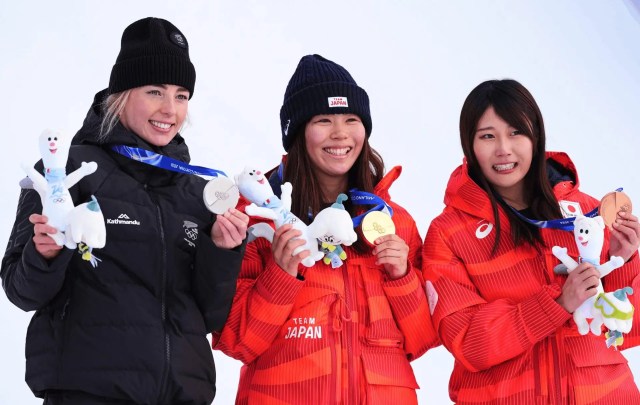 Japanese snowboarder Mari Fukada smiles with her gold medal in women’s slopestyle. | Credit: CGTN Sports Scene Facebook