
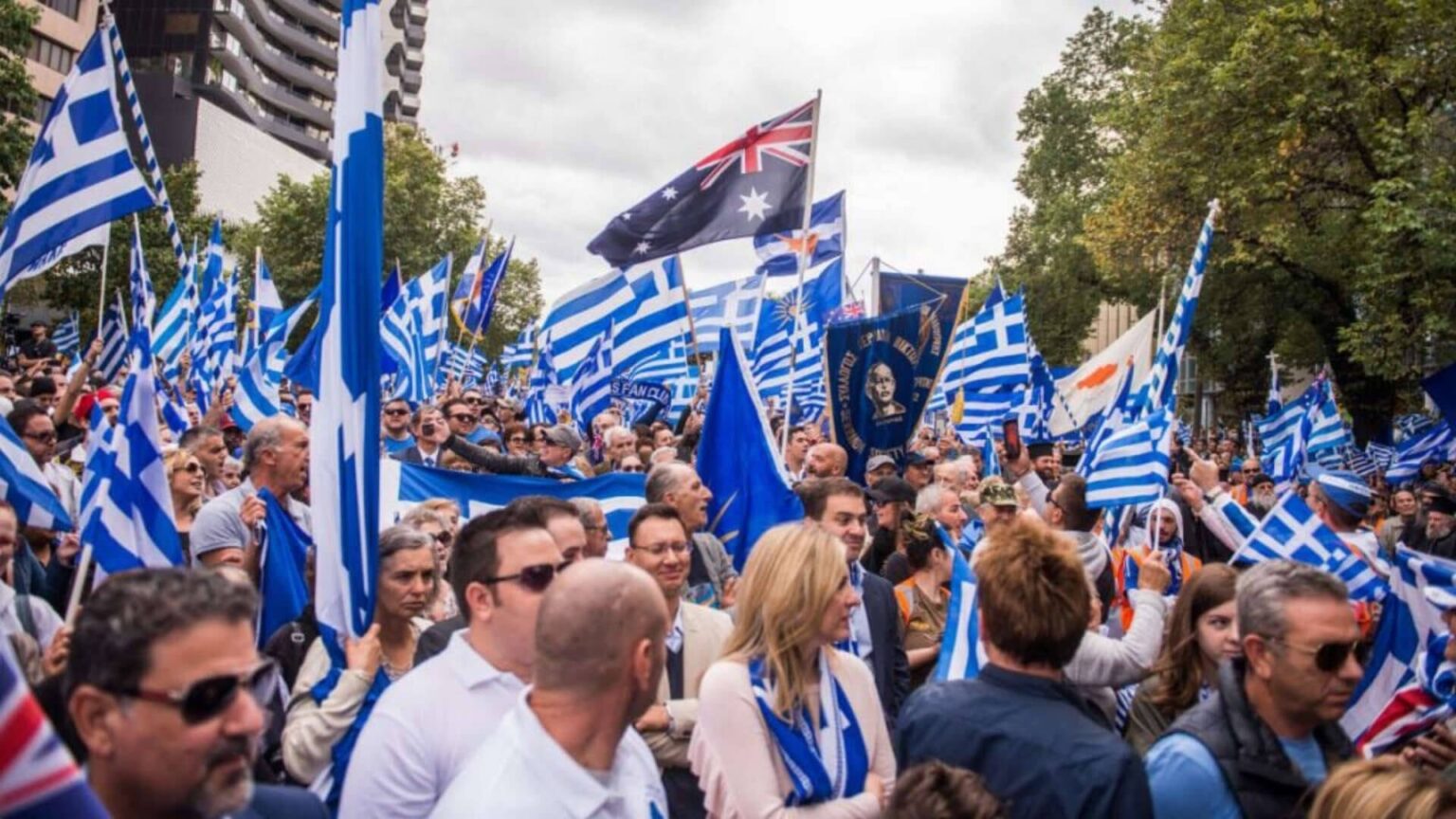
The “Macedonian issue”, a matter that for decades shaped relations between the Greek diaspora and organised groups originating from North Macedonia, appears to be returning forcefully to the forefront of Australian public life. This comes at a time when many believed the Prespa Agreement had, at least institutionally, closed a chapter of international dispute.
Recent developments in Melbourne suggest that tensions have not only failed to disappear, but are reigniting on multiple levels including political, cultural, communal and symbolic.
The issue began with the decision by organisers of Melbourne’s major MOOMBA parade to prohibit the use of national symbols, specifically the Vergina Sun, a symbol that for years has been a point of contention between the Greek community and organisations within the Slavo-Macedonian diaspora. The decision was viewed by many as an attempt to avoid tensions; however, rather than de-escalating the situation, it appears to have sparked a new cycle of reactions.
A few days later, individuals of North Macedonian background appeared at an AFL match involving the Collingwood Football Club carrying flags featuring the Vergina Sun. The incident triggered a strong reaction from well-known Greek Australian activist Sam Kostoulias, who submitted a formal written complaint arguing that the display constituted a provocative use of a Greek historical symbol and violated the spirit of the Prespa Agreement.
In its response to Kostoulias, the Collingwood club stated:
“We recognise that cultural and historical symbols can hold deep meaning for different communities and appreciate you taking the time to explain why this issue is important to you.
We have reviewed your correspondence, the image you provided and the AFL Ticket and Entry Conditions. Under these Conditions, patrons are generally permitted to bring flags into a venue, provided relevant size and safety requirements are met. The Conditions do not restrict flags exclusively to official national flags.
The Conditions also make clear that political signage and the distribution of political material are not permitted. Any assessment of whether specific material falls within these provisions is made by the AFL and venue management on match day, taking into account the relevant context and circumstances at the time.
Decisions regarding compliance with the AFL Entry Conditions therefore rest with the AFL and venue operations, rather than the Club.”
However, tensions escalated further during an anniversary event organised by the “Macedonian Orthodox Youth of Australia” (MOYA), held in Sunshine West in the presence of representatives from both the Victorian Government and the Opposition.
Diplomatic representatives from North Macedonia also attended the event, while the organisation repeatedly used the term “Republic of Macedonia” in public references and online posts instead of the internationally recognised “North Macedonia”.
The use of this name prompted an immediate and strong reaction from the Pammacedonian Association of Melbourne and Victoria, which sent formal letters to Victorian Premier Jacinta Allan and Opposition Leader Jess Wilson.
In the detailed letters, Pammacedonian president Peter (Panagiotis) Stefanidis and secretary Haris Tsairis argued that the use of the term “Republic of Macedonia” constitutes a blatant violation of the 2019 Prespa Agreement, which internationally established the name “North Macedonia”.
At the same time, they expressed strong dissatisfaction over the presence of MPs from both the Labor and Liberal parties at the event, arguing that their participation created the impression of political tolerance or even indirect acceptance of terminology that, as they stressed, contradicts international law.
Particular emphasis was also placed on the issue of cultural and historical identity. The Pammacedonian Association argues that the term “Macedonian” cannot be monopolised by a single community, as it forms an inseparable part of the historical and cultural heritage of millions of Greeks originating from the regions of Greek Macedonia: Central, Western and Eastern Macedonia and Thrace.
The letter also makes extensive reference to Australia’s historical ties with Greek Macedonia. It highlights the participation of Australian soldiers on the Macedonian Front during World War I, the work of Major George Devine Treloar in Thrace and Macedonia following the Asia Minor Catastrophe, as well as the shared wartime experience of Greeks and Australians during the Battle of Greece and the Battle of Crete in World War II.
The letter does not limit itself to historical references. It also invokes international agreements such as the International Covenant on Civil and Political Rights (ICCPR) and UNESCO’s Convention on Cultural Diversity, stressing that no community can claim exclusivity over a cultural identity at the expense of another community with deeper historical ties.
Further reactions were sparked by the presence of Greek Orthodox clergy at the MOYA event. According to reports, complaints have already been made to church circles, while a related letter has also been published in the letters section of Neos Kosmos. For many Macedonians within the Greek Australian community, the participation of clergy at an event where the term “Republic of Macedonia” was used was viewed as a particularly sensitive and emotionally charged issue.
Perhaps the most significant aspect of this renewed dispute is that the “Macedonian issue” is no longer solely a matter between Greece and North Macedonia. It is now clearly being transferred into multicultural Australia, affecting inter-community relations, the stance of political parties and the public image of institutions.
The Greek community in Australia appears determined to defend what it considers non-negotiable elements of its historical and cultural identity. On the other hand, organisations within the Slavo-Macedonian community continue to promote their own historical narrative and self-identification.