
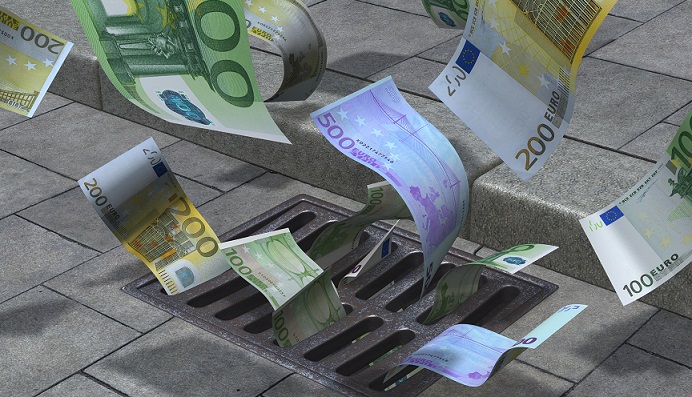
The world economy loses around 25.4 trillion euros in value annually, equivalent to almost 31% of the global GDP of 82.6 trillion euros, due to the linear way resources are managed – which means that for every three euros created, one euro is lost, according to The Circularity Gap Report 2026, conducted by Deloitte and Circle Economy. This year’s report introduces the concept of Value Gap, which is a monetary quantification of the economic value lost due to inefficient use of resources, but which also shows the opportunities created by the circular economy, which reduces waste generation and retains more value in the economy.
The estimated losses are grouped into five major sources. The largest category is end-of-life waste, estimated at more than 10 trillion euros: products and assets discarded prematurely, before their functional value is fully utilized.
This is followed by energy losses, estimated at 8.7 trillion euros, generated by inefficiencies along the entire energy chain (from extraction to the final consumer), fixed capital consumption, meaning accelerated deterioration of sustainable assets (such as buildings, infrastructure or machinery), estimated at 5.2 trillion euros, then processing losses, of around 904.2 billion euros. Food losses and waste, estimated at 650.7 billion euros, refer to food leaving the supply chain unconsumed, including losses occurring during storage, transport, retail and final consumption.
Food that deteriorates along supply chains, increasing costs for households, electronic products discarded long before their full potential is utilized, or fast fashion, which encourages the frequent purchase of clothes worn for very short periods, are all examples that reflect the linear economic model and generate hidden costs.
These hidden losses and costs accumulate along the entire value chain, and the consequences are ultimately borne by society. Circular approaches aim to change this trajectory by extending the products lifespans, improving reuse and repair, but also by recovering the value of materials at the end of their life cycle.

In this way, value losses can be significantly reduced, and the value created is preserved and used efficiently, instead of being wasted, the report shows.
“The Value Gap is not only an indicator of inefficiency, but also a map of opportunities, and the European Union has already introduced several rules that encourage the recycling and recovery of materials from waste, in line with the objectives of the circular economy. For example, the new EU Packaging and Packaging Waste Regulation (PPWR), which will become applicable in August 2026, shifts the focus from formal compliance to economic efficiency and long-term value. Recyclability, reducing the weight and volume of packaging, as well as the use of a minimum level of recycled content in production are becoming standards that help companies lower their costs, optimize their supply chains and remain relevant to consumers. Companies that produce, import or place packaging or packaged products on the market can approach the constraints of this regulation as an opportunity to turn packaging into a resource and a competitive advantage,” said Adrian Teampău, Director for Circular Economy at Deloitte Romania.
The study shows that reducing the value gap depends on coordinated efforts from companies, financiers and policymakers to systemically address challenges, remove the bottlenecks of the linear model and unlock structural transformations. This transition is essential not only to limit value losses, but also to reduce economic risks, strengthen resilience and build a circular economy.
Companies play a key role in turning circular economy opportunities into tangible results, the report highlights. By identifying inefficiencies in resources use and innovating business models, they can preserve existing value and create new sources of value. At the same time, companies are encouraged to collaborate beyond the organizational boundaries in order to generate value across the system.
The report also indicates that the financial sector plays an important role in the transition to the circular economy by integrating resource use concerns into lending and investment decisions and by assessing exposure to risks related to raw material shortages and supply chain disruptions.
Policymakers can help bridge the value gap through public policies that address the challenges and bottlenecks of the linear model, from fiscal rules and sectoral standards to international agreements and market behaviors. Correcting market failures through consistent regulation and fair competition conditions is essential not only for reducing value losses and waste, but also for lowering economic risks and unlocking new value creation opportunities, the study shows.
“The latest edition of the Circularity Gap report shows that linearity is not just an environmental issue, but a structural economic vulnerability. Companies and public institutions that understand this now and start building more sustainable resource management systems will be better positioned to cope with volatile raw material prices, regulatory restrictions and increasingly demanding investor and consumer expectations,” said Ovidiu Popescu, Partner at Deloitte Romania and Leader of the energy and sustainability practices.