
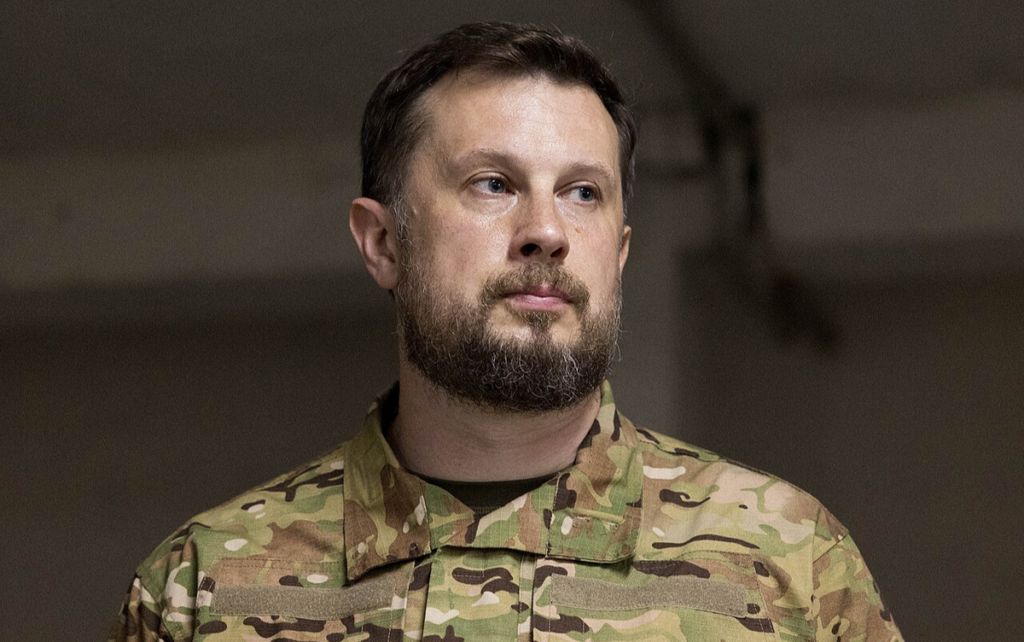
A senior Ukrainian commander said on Wednesday, May 27, that Kyiv has a six-month window to seize the battlefield initiative from Russia and improve its leverage in potential peace talks, predicting a major “turning point” in the war is approaching.
Brigadier General Andriy Biletsky, commander of Ukraine’s Third Army Corps, told Reuters in an interview at an undisclosed underground location in the Kharkiv region that Russian forces are becoming exhausted after more than four years of full-scale war.
Follow our coverage of the war on the @Kyivpost_official.
“I believe the next six to nine months are a turning point,” Biletsky said.
“More precisely, I think the next six are the most critical.”
Russia has continued making gradual advances along the front line since launching its full-scale invasion in February 2022, though the pace of those gains has slowed in 2026 as Ukrainian forces intensified pressure on Russian logistics, air defenses and military infrastructure.
Biletsky said Ukraine could regain battlefield momentum if it maintains pressure over the coming months and secures strategic positions before entering negotiations with Moscow.
“We need to define those directions where we can improve our positions, take some strategic points, and then speak with the Russians from a position of strength – not weakness – about a truly stable truce,” he said.
The issue of control over the Donetsk region remains one of the main obstacles in US-backed peace talks, which have largely stalled. Moscow demands full control over the region, while Kyiv refuses to withdraw from territories that Russian troops have failed to capture.
Other Topics of Interest
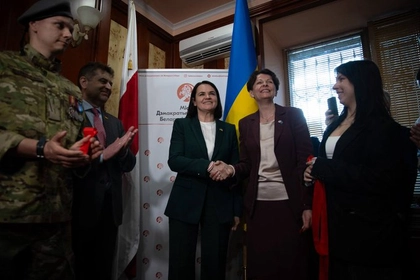
Belarusian Democratic Forces Open Mission in Kyiv
On Tuesday, Belarusian democratic forces officially opened a mission in Kyiv aimed at strengthening cooperation with Ukraine and supporting Belarusians living in the country. The new office will coordinate work with Ukrainian institutions, support volunteers and deepen political dialogue between Ukraine and Belarusian opposition groups amid threats of invasion from Belarus under the Lukashenko administration.
Russia’s Defense Ministry did not immediately comment on Biletsky’s remarks. Russian President Vladimir Putin said earlier this month that he believes Moscow is nearing victory in the war.
Russian advances slowing amid battlefield fatigue
Biletsky said Russia’s army is struggling to sustain the same level of offensive operations seen a year ago, citing growing personnel shortages and heavy losses among field commanders.
“The lack of personnel no longer allows them to advance the way they did, for example, a year ago,” he said.
John Helin, an analyst with the Finland-based Black Bird Group, echoed that assessment in comments to Reuters, saying Russian forces appear increasingly exhausted while Ukraine’s own manpower issues have not yet reached a breaking point.
“It does seem like, four or five months into this year, it’s much more likely that the Russians will get exhausted before the Ukrainian problems come to a breaking point,” Helin said.
On Monday, the Institute for the Study of War (ISW) said Ukrainian forces are now “actively challenging the positional character of the war” and could soon conduct limited mechanized assaults.
Meanwhile, fighting continues around eastern Ukraine’s so-called “Fortress Belt” – a chain of heavily fortified cities that anchors Kyiv’s defenses in the Donbas.
Russian troops are currently pressuring Kostiantynivka, one of the key cities in the defensive line. Capturing the area could allow Moscow to threaten the rest of the Donbas.
Biletsky said his forces are holding positions near Sloviansk, the northern section of the defensive belt, and forcing Russian troops into costly frontal assaults.
Drone warfare reshaping battlefield
Biletsky also highlighted the growing importance of drone warfare and battlefield technology, saying Ukraine currently leads Russia in unmanned ground vehicles (UGVs) and heavy bomber drones, while Moscow has an advantage in fiber-optic drones that cannot be jammed electronically.
He credited billionaire Elon Musk’s decision to block Russian military access to Starlink satellite communications as a major factor weakening Russian battlefield coordination.
“Moscow is radically losing in battlefield communications,” Biletsky said.
Ukraine has significantly increased medium-range drone strikes against Russian air defenses and logistics hubs in recent months, helping long-range attacks penetrate deeper into Russian territory.
President Volodymyr Zelensky said last week that Ukrainian forces had retaken nearly 600 square kilometers (230 square miles) of territory in 2026.
According to Biletsky, Ukraine’s Third Army Corps is actively integrating robotic systems into frontline operations, including kamikaze drones and armed ground robots designed to replace infantry units.
He said the corps aims for robotic systems to perform roughly 30% of battlefield functions by 2027.
“The next revolution will allow commanders to stage more creative combined assault operations while conserving precious troops,” Biletsky said.
“It will happen this year, and I think we’ll show how our corps is a vivid example of it.”