
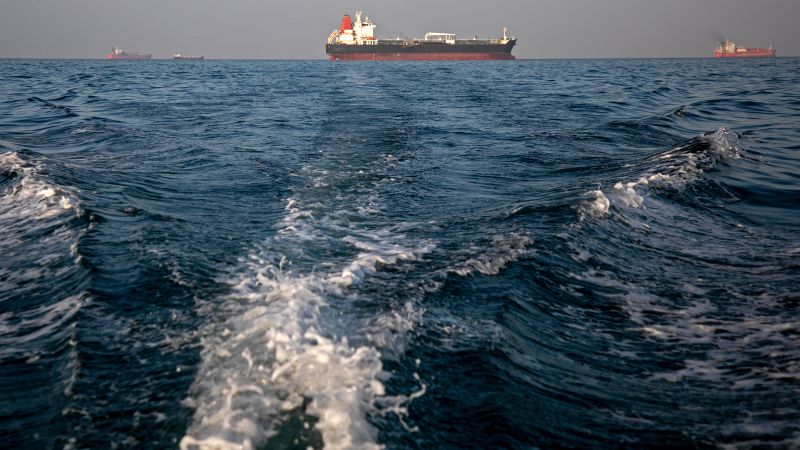

Shipping through the Strait of Hormuz remains very restricted as the US and Iran continue to negotiate a memorandum that would allow for oil and other commodities to resume flowing in and out of the Persian Gulf, according to maritime tracking services.
Late Tuesday, the navy of Iran’s Revolutionary Guard Corps (IRGC) claimed that 25 ships had passed through the strait in the previous 24 hours, including oil tankers, container ships, and other commercial vessels.
It said the vessels had passed “after obtaining authorization and in coordination with, and under the security protection of, the IRGC Navy.”
Ship tracking services could not confirm the number, partly because vessels that transit the strait invariably turn off AIS transponders which show their location.
However, industry sources say two tankers exited the waterway on Tuesday.
“12 vessels transited the strait on 26 May – 7 inbound, 5 outbound,” on Tuesday, maritime intelligence firm Windward said in a note published Wednesday.
“5 of those transits ran dark with no AIS broadcast,” it added.
One of the ships transiting was an oil products tanker – the Miraan – which was sanctioned by the US Treasury in April, according to Windward.
“Signal jamming has been especially pronounced over the last week,” S&P Global Intelligence told CNN Wednesday.
Three laden liquid natural gas tankers transited the Strait of Hormuz over the weekend, carrying shipments from the United Arab Emirates and Qatar to Asian destinations, according to analysts at trade intelligence firm Kpler.
Against this background of very limited passages, a senior Iranian official said Wednesday that Iran and the United States have not yet reached an agreement on unblocking the strait.
“Iran and Oman are negotiating a new procedure for ships to pass through the Strait of Hormuz,” said Ali Bagheri, deputy secretary of Iran’s Supreme National Security Council.