
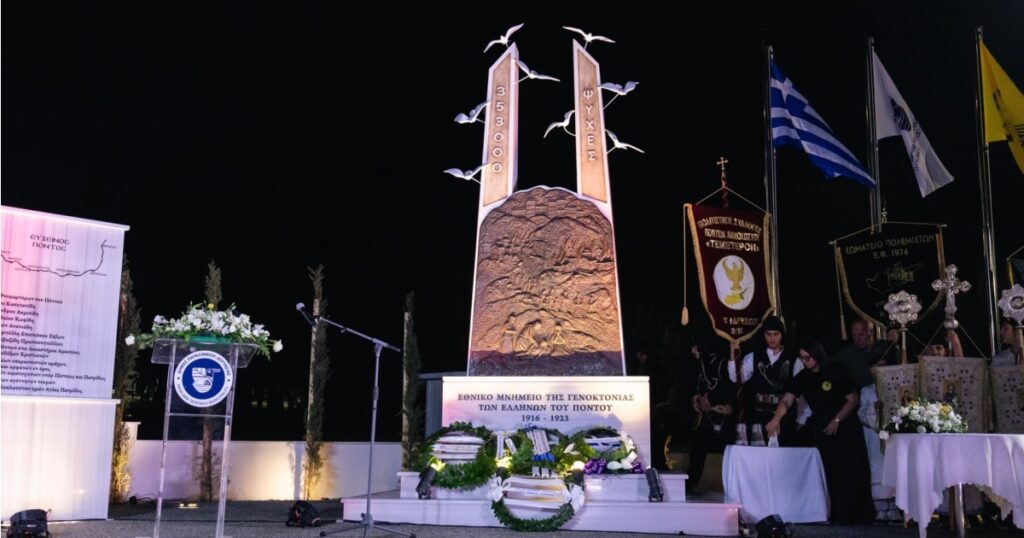
NICOSIA — Cyprus is turning remembrance of the Pontic Greek Genocide into a public policy, with a new memorial in Paralimni and a formal decision to teach the subject in public schools. In an op-ed for the IDI Center, Uzay Bulut wrote that the Republic of Cyprus had built a monument to the victims and was integrating the genocide into its education system, describing the move as a significant step in restoring a largely neglected part of history.
The remembrance drive culminated on 19 May, the anniversary of the genocide, when Cyprus marked the unveiling of the National Pontic Greek Genocide Memorial in Paralimni. The monument was opened that day by President Nikos Christodoulides, with the site designed as both a memorial and a public square for reflection. The project was backed by the Republic of Cyprus and the Municipality of Paralimni-Deryneia, with a sculptural work by artist Giorgos Kikotis at its center.
The education ministry has also moved the issue into classrooms. Education Minister Athena Michaelidou said public schools across Cyprus will now officially teach and commemorate the Pontic Greek Genocide, calling historical memory a priority and saying parliament had already passed measures establishing a specific remembrance day. She told students at a remembrance event in Lakatamia that the commemoration had become part of the institutional educational framework.
From 1914 to 1923, during the Pontic Greek Genocide, the forces of the Ottoman Empire deported and killed Greek communities in the Pontus region of Anatolia. Historical estimates commonly place the death toll at about 353,000. The anniversary is observed on 19 May in Greece and Cyprus. Pontic Greeks, Armenians, and Syriacs (Arameans–Assyrians–Chaldeans) were targeted as part of a broader campaign against Christian minorities in the collapsing Ottoman Empire.
The new memorial and curriculum changes also reflect Cyprus’ own political memory. In 2025, President Christodoulides linked Pontic remembrance to Cyprus’ experience of displacement and occupation, arguing that the island’s history gives it a particular duty to keep such atrocities in public view. Government officials described the genocide as a historical reality and a stain on humanity, while the opposition called for wider international recognition.
Beyond Cyprus, Pontic remembrance continues to appear in broader advocacy among Greek, Syriac (Aramean–Assyrian–Chaldean) and other Christian communities. Commemorations were held this year by the European Syriac Union, which said the Pontic Greek genocide should be remembered alongside the Armenian and Sayfo genocides and called for justice and recognition.