
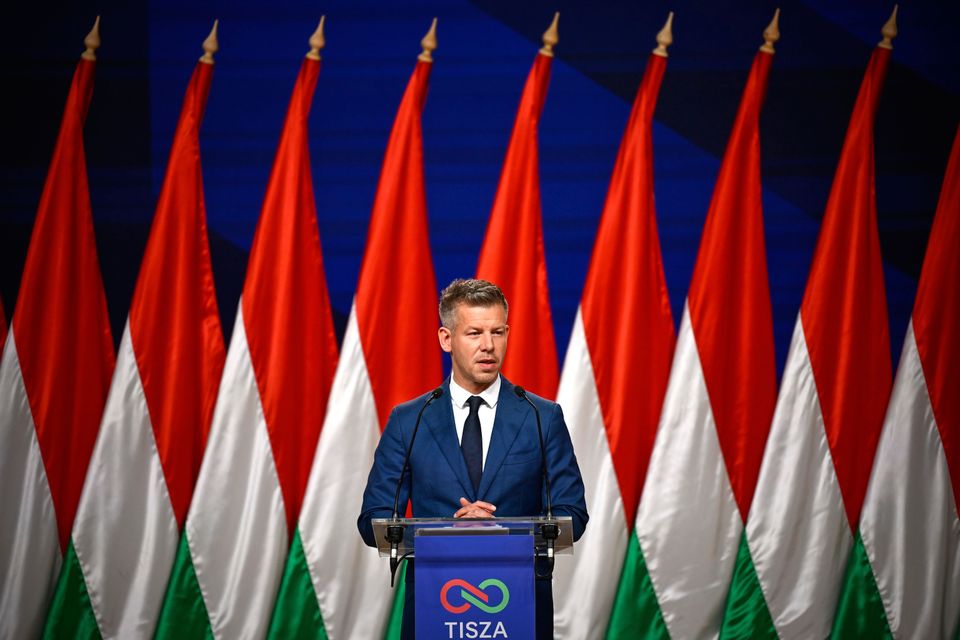
The Prime Minister of Hungary, Péter Magyar has revealed he will instruct his government officials to examine the possibility of making a Eurovision comeback for the upcoming contest in Bulgaria next May.
Péter Magyar to instruct government officials to assess Eurovision comeback
After Bulgaria’s thrilling victory in Vienna, attention quickly turns to the Eurovision Song Contest 2027. Already North Macedonia has expressed interest in ending its absence from the contest. Now Hungary is looking to potentially return to the Eurovision Song Contest 2027 in Bulgaria next May.
The newly-elected Prime Minister Péter Magyar has stated publicly that he will instruct his Minister or State Secretary for Culture to examine the conditions necessary to enable a return to the contest. During a meeting in Vienna, Austria he spoke with media from ORF, the host broadcaster of Eurovision 2026 to confirm his interest in bringing the nation back to the biggest stage in Europe.
“To be honest, it’s not up to the Hungarian Prime Minister. It’s not my decision whether Hungary will participate again in this contest. I have received many letters and pleas from the younger generation to nominate Hungary to this competition. So, I will instruct the Minister or State Secretary for Culture to investigate or scrutinise our opportunities and I will come back to you and to the younger generations with a reply. I hope so. There is no objection from my part and there is no sense not to participate in such a contest.”
May 2026
This reaffirms an earlier statement made in a meeting with voters during his campaign trail last year, Peter Magyar stated:
“Not participating is a bad decision, and we shouldn’t have withdrawn. I agree with Russia’s exclusion; we shouldn’t allow any war criminals to participate. So, if we win—that’s what happens—we’ll be back. If the government decides, we’ll be back in Eurovision.”
August 2025
This comes after Magyar made returning to the contest one of his campaign promises. Alongside restoring media pluralism and press freedoms across the broadcast networks that previously broadcasted and participated in the contest on behalf of the nation.
Since taking office in April, Magyar has sought to reform its national broadcast services and media to introduce more press freedoms and impartiality of its coverage. Many concerns were raised during the Orban government that the media was state-controlled and serving as his personal mouthpiece. Now with an ambition to align or exceed the BBC protocols regarding press and television reporting, it is hoped this will look more favourable to the EU and the EBU to meet their international standards.
Hungary in the Eurovision Song Contest
After failing to qualify for the contest in 1993, Hungary made their Eurovision debut in Dublin in 1994. Friderika Bayer represented the country with “Kinek mondjam el vétkeimet?”, which finished in 4th place with 122 points. It remains as Hungary’s best result to date.
Absent from the contest from 1999 until 2005, Hungary didn’t make the top 10 again until 2007. Magdi Rúzsa took her “Unsubstantial Blues” to a ninth-place finish in Helsinki, after placing 2nd in Eurovision’s largest-ever semi-final a few days earlier.
Hungary’s last participation in the contest was in 2019 when Joci Pápai – who had previously represented the country in 2017 – returned to the stage with “Az én apám”. Despite his 8th place finish in Kyiv, Joci failed to make the final in Tel Aviv, placing in 12th place with 97 points in the semi-final.
Withdrawal from 2020 contest
Late 2019, long before the eventual cancellation of the contest due to the COVID-19 pandemic, MTVA the Hungarian broadcaster announced its withdrawal from Eurovision. No reason was given by the broadcaster. In a formal statement, the broadcaster simply revealed a reallocation of funds that would otherwise be spent on Eurovision participation. “Instead of taking part in the Eurovision Song Contest in 2020, we will support the valuable productions created by the talents of Hungarian pop music directly.”
From 2012 to 2019 Hungary used its annual music competition A Dal (The Song) to select its Eurovision representative. To this day, the format still exists and is currently used as an opportunity to support local talent and offer wider media opportunities and financial prizes for the winning act.
Under the leadership of Orban the country increasingly leaned towards Christian-Conservative values and enforced greater restrictions on the LGBTQIA+ community following its withdrawal from the Eurovision Song Contest. Many observers in the nation at the time, celebrating the nations decision to not participate in the contest. Although denied by officials, it was assumed by international media that this hardline approach played a part in Hungary’s Eurovision exit.
Do you want Hungary to return to Eurovision 2027? Let us know! Keep track of the latest news by following @ESCXTRA on Twitter, @escxtra.bsky.social on Bluesky, @escxtra on Instagram, @escxtra on TikTok, subscribing to YouTube and liking our Facebook page! Also, follow us on Spotify for the latest music from your favourite Eurovision acts.
Copy URL URL Copied