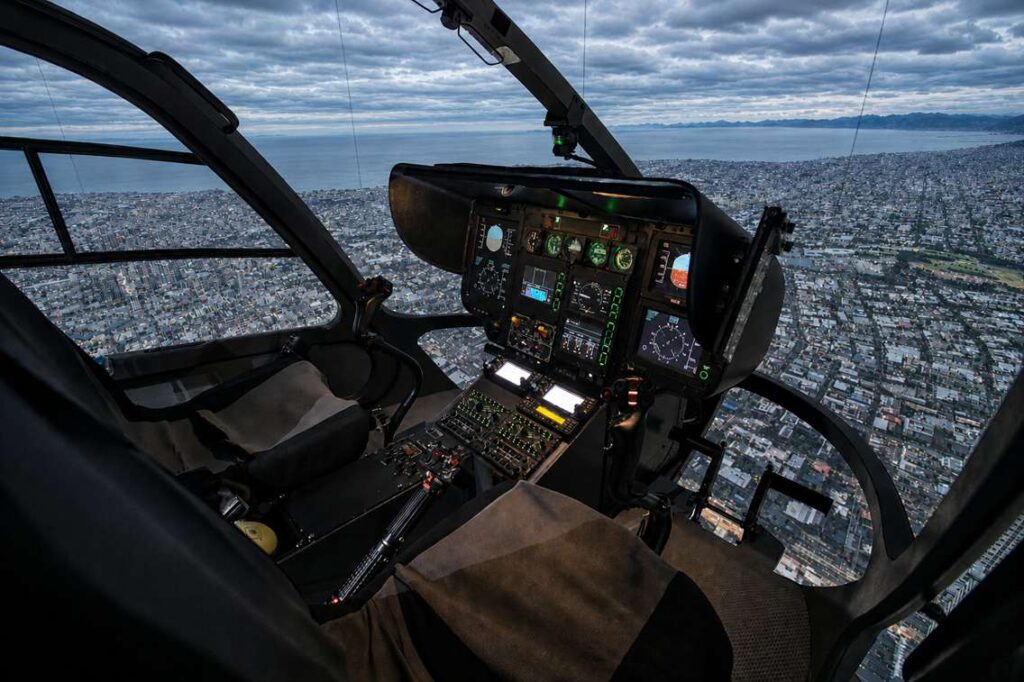
Indra Group and the Polish construction company NDI will jointly carry out the expansion and modernization of the pilot and crew training center for the Polish Medical Air Service (LPR), which is under the Ministry of Health of this country.
The facilities will be equipped with a new EC135 helicopter simulator developed by Indra. The contract also includes the renovation of the current FTD (Flight Training Device) simulator room and post-delivery maintenance support. The simulator will have roll-in/roll-out capability, allowing for the future integration of additional cabins for new LPR helicopters.
Reduction of flight hours
Among the advantages of simulation-based training is the reduction (by up to 40%) of the number of real flight hours needed for training, instruction, and qualification of aircrews. It also improves operational safety and helps limit operating and maintenance costs, concerning helicopter technical service, fuel consumption, and material wear. This increases the availability of helicopters for medical support missions.
Equipped with a projection system based on 4LED technology, the system incorporates a fourth infrared light channel, which facilitates pilot training with night vision goggles (NVG) and simultaneously improves image quality.
Extensive use
Realism is enhanced with a highly detailed database of Poland, covering all LPR operational areas (airports, heliports, hospitals, and other takeoff and landing points) and the scenarios necessary for HEMS (Helicopter Emergency Medical Service) missions performed by LPR, both day and night and under various weather conditions.
The EC135 is one of the most successful twin-engine light helicopters worldwide and is widely used in police, medical, and corporate transport operations. The H135 family has more than 1,600 aircraft delivered to over 300 operators worldwide.
Indra Group and the Polish construction company NDI will jointly carry out the expansion and modernization of the pilot and crew training center for the Polish Medical Air Service (LPR), which is under the Ministry of Health of this country.
The facilities will be equipped with a new EC135 helicopter simulator developed by Indra. The contract also includes the renovation of the current FTD (Flight Training Device) simulator room and post-delivery maintenance support. The simulator will have roll-in/roll-out capability, allowing for the future integration of additional cabins for new LPR helicopters.
Reduction of flight hours
Among the advantages of simulation-based training is the reduction (by up to 40%) of the number of real flight hours needed for training, instruction, and qualification of aircrews. It also improves operational safety and helps limit operating and maintenance costs, concerning helicopter technical service, fuel consumption, and material wear. This increases the availability of helicopters for medical support missions.
Equipped with a projection system based on 4LED technology, the system incorporates a fourth infrared light channel, which facilitates pilot training with night vision goggles (NVG) and simultaneously improves image quality.
Extensive use
Realism is enhanced with a highly detailed database of Poland, covering all LPR operational areas (airports, heliports, hospitals, and other takeoff and landing points) and the scenarios necessary for HEMS (Helicopter Emergency Medical Service) missions performed by LPR, both day and night and under various weather conditions.
The EC135 is one of the most successful twin-engine light helicopters worldwide and is widely used in police, medical, and corporate transport operations. The H135 family has more than 1,600 aircraft delivered to over 300 operators worldwide.
Become a premium member for free!